

difficult. The exchange of the phosphine substituents in L1 from phenyl to isopropyl,
however, enabled the isolation of a dinitrogen complex L1Ni
0 (N 2 ), which upon
addition of H 2 gas exchanges ligands to form a nonclassical Ni–(H 2 ) adduct (Scheme
3) [65]. Over the course of several hours, the formation of a bridging borohydride–
Ni–hydride complex was observed by NMR.
During H 2 activation, the nature of the Ni!B interaction changes from a modest
perturbation exerted by the empty p(B) orbital on the d
10 (Ni) center bearing a
σ-bound H 2 ligand to the interaction of an anionic borohydride ligand stabilizing
the mononuclear Ni
II
–H species. While cis homolytic H 2 activation via a cisdihydride intermediate cannot be fully ruled out, computational studies conclude
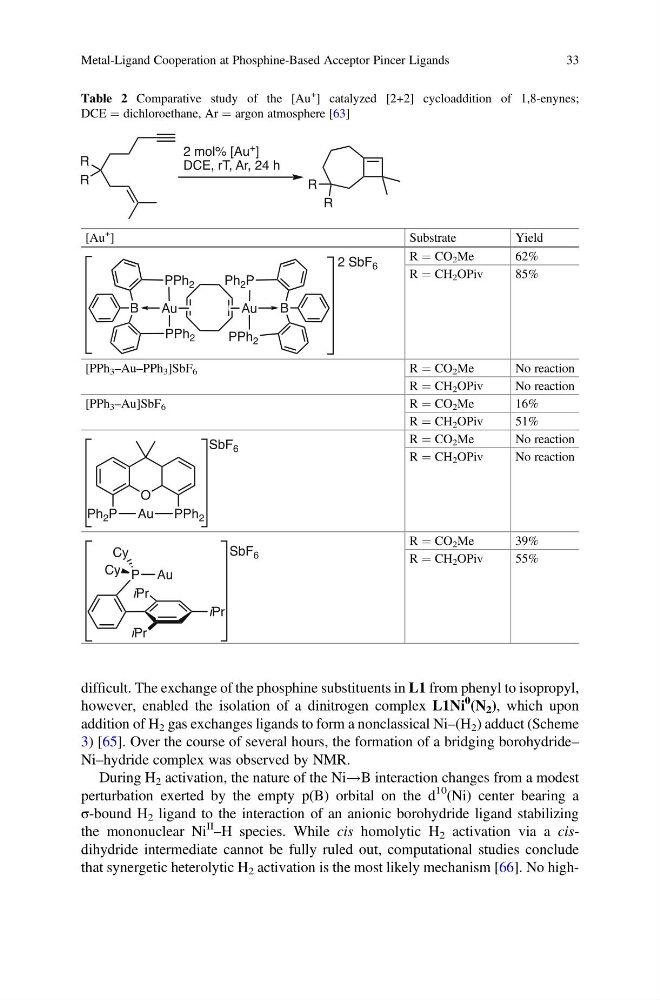
that synergetic heterolytic H 2 activation is the most likely mechanism [66]. No highTable 2 Comparative study of the [Au
+ ] catalyzed [2+2] cycloaddition of 1,8-enynes;
DCE ¼ dichloroethane, Ar ¼ argon atmosphere [63]
[Au
+ ]
Substrate
Yield
R ¼ CO 2 Me
62%
R ¼ CH 2 OPiv
85%
[PPh 3 –Au–PPh 3 ]SbF 6
R ¼ CO 2 Me
No reaction
R ¼ CH 2 OPiv
No reaction
[PPh 3 –Au]SbF 6
R ¼ CO 2 Me
16%
R ¼ CH 2 OPiv
51%
R ¼ CO 2 Me
No reaction
R ¼ CH 2 OPiv
No reaction
R ¼ CO 2 Me
39%
R ¼ CH 2 OPiv
55%
Metal-Ligand Cooperation at Phosphine-Based Acceptor Pincer Ligands
33
however, enabled the isolation of a dinitrogen complex L1Ni
0 (N 2 ), which upon
addition of H 2 gas exchanges ligands to form a nonclassical Ni–(H 2 ) adduct (Scheme
3) [65]. Over the course of several hours, the formation of a bridging borohydride–
Ni–hydride complex was observed by NMR.
During H 2 activation, the nature of the Ni!B interaction changes from a modest
perturbation exerted by the empty p(B) orbital on the d
10 (Ni) center bearing a
σ-bound H 2 ligand to the interaction of an anionic borohydride ligand stabilizing
the mononuclear Ni
II
–H species. While cis homolytic H 2 activation via a cisdihydride intermediate cannot be fully ruled out, computational studies conclude
that synergetic heterolytic H 2 activation is the most likely mechanism [66]. No highTable 2 Comparative study of the [Au
+ ] catalyzed [2+2] cycloaddition of 1,8-enynes;
DCE ¼ dichloroethane, Ar ¼ argon atmosphere [63]
[Au
+ ]
Substrate
Yield
R ¼ CO 2 Me
62%
R ¼ CH 2 OPiv
85%
[PPh 3 –Au–PPh 3 ]SbF 6
R ¼ CO 2 Me
No reaction
R ¼ CH 2 OPiv
No reaction
[PPh 3 –Au]SbF 6
R ¼ CO 2 Me
16%
R ¼ CH 2 OPiv
51%
R ¼ CO 2 Me
No reaction
R ¼ CH 2 OPiv
No reaction
R ¼ CO 2 Me
39%
R ¼ CH 2 OPiv
55%
Metal-Ligand Cooperation at Phosphine-Based Acceptor Pincer Ligands
33