

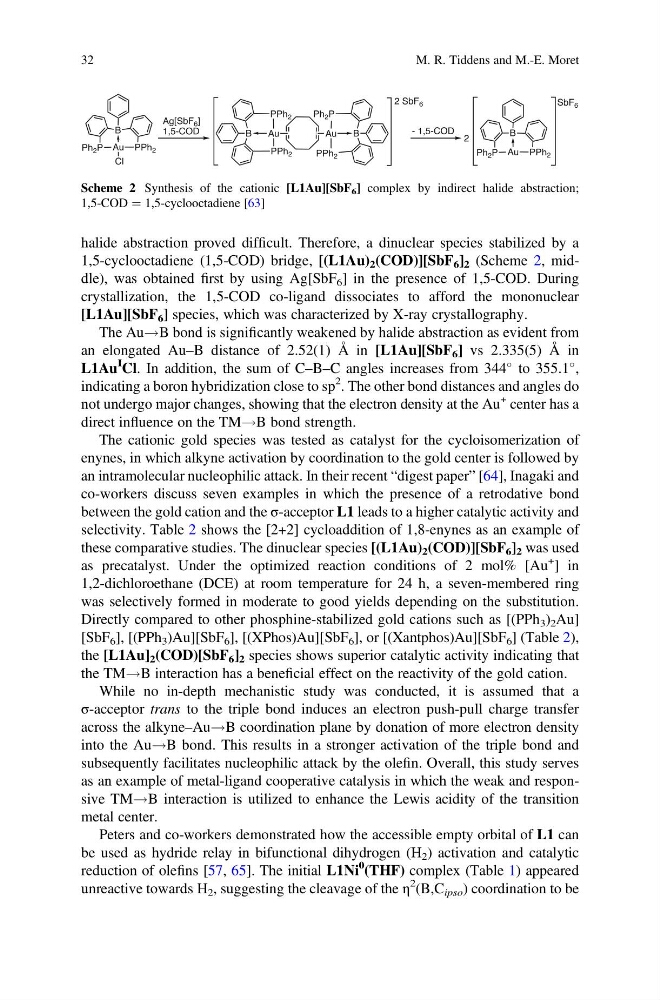
halide abstraction proved difficult. Therefore, a dinuclear species stabilized by a
1,5-cyclooctadiene (1,5-COD) bridge, [(L1Au) 2 (COD)][SbF 6 ] 2 (Scheme 2, middle), was obtained first by using Ag[SbF 6 ] in the presence of 1,5-COD. During
crystallization, the 1,5-COD co-ligand dissociates to afford the mononuclear
[L1Au][SbF 6 ] species, which was characterized by X-ray crystallography.
The Au!B bond is significantly weakened by halide abstraction as evident from
an elongated Au–B distance of 2.52(1) Å in [L1Au][SbF 6 ] vs 2.335(5) Å in
L1Au
I Cl. In addition, the sum of C–B–C angles increases from 344
to 355.1
,
indicating a boron hybridization close to sp
2 . The other bond distances and angles do
not undergo major changes, showing that the electron density at the Au
+ center has a
direct influence on the TM!B bond strength.
The cationic gold species was tested as catalyst for the cycloisomerization of
enynes, in which alkyne activation by coordination to the gold center is followed by
an intramolecular nucleophilic attack. In their recent “digest paper” [64], Inagaki and
co-workers discuss seven examples in which the presence of a retrodative bond
between the gold cation and the σ-acceptor L1 leads to a higher catalytic activity and
selectivity. Table 2 shows the [2+2] cycloaddition of 1,8-enynes as an example of
these comparative studies. The dinuclear species [(L1Au) 2 (COD)][SbF 6 ] 2 was used
as precatalyst. Under the optimized reaction conditions of 2 mol% [Au
+
] in
1,2-dichloroethane (DCE) at room temperature for 24 h, a seven-membered ring
was selectively formed in moderate to good yields depending on the substitution.
Directly compared to other phosphine-stabilized gold cations such as [(PPh 3 ) 2 Au]
[SbF 6 ], [(PPh 3 )Au][SbF 6 ], [(XPhos)Au][SbF 6 ], or [(Xantphos)Au][SbF 6 ] (Table 2),
the [L1Au] 2 (COD)[SbF 6 ] 2 species shows superior catalytic activity indicating that
the TM!B interaction has a beneficial effect on the reactivity of the gold cation.
While no in-depth mechanistic study was conducted, it is assumed that a
σ-acceptor trans to the triple bond induces an electron push-pull charge transfer
across the alkyne–Au!B coordination plane by donation of more electron density
into the Au!B bond. This results in a stronger activation of the triple bond and
subsequently facilitates nucleophilic attack by the olefin. Overall, this study serves
as an example of metal-ligand cooperative catalysis in which the weak and responsive TM!B interaction is utilized to enhance the Lewis acidity of the transition
metal center.
Peters and co-workers demonstrated how the accessible empty orbital of L1 can
be used as hydride relay in bifunctional dihydrogen (H 2 ) activation and catalytic
reduction of olefins [57, 65]. The initial L1Ni
0 (THF) complex (Table 1) appeared
unreactive towards H 2 , suggesting the cleavage of the η
2 (B,C ipso ) coordination to be
Scheme 2 Synthesis of the cationic [L1Au][SbF 6 ] complex by indirect halide abstraction;
1,5-COD ¼ 1,5-cyclooctadiene [63]
32
M. R. Tiddens and M.-E. Moret
1,5-cyclooctadiene (1,5-COD) bridge, [(L1Au) 2 (COD)][SbF 6 ] 2 (Scheme 2, middle), was obtained first by using Ag[SbF 6 ] in the presence of 1,5-COD. During
crystallization, the 1,5-COD co-ligand dissociates to afford the mononuclear
[L1Au][SbF 6 ] species, which was characterized by X-ray crystallography.
The Au!B bond is significantly weakened by halide abstraction as evident from
an elongated Au–B distance of 2.52(1) Å in [L1Au][SbF 6 ] vs 2.335(5) Å in
L1Au
I Cl. In addition, the sum of C–B–C angles increases from 344
to 355.1
,
indicating a boron hybridization close to sp
2 . The other bond distances and angles do
not undergo major changes, showing that the electron density at the Au
+ center has a
direct influence on the TM!B bond strength.
The cationic gold species was tested as catalyst for the cycloisomerization of
enynes, in which alkyne activation by coordination to the gold center is followed by
an intramolecular nucleophilic attack. In their recent “digest paper” [64], Inagaki and
co-workers discuss seven examples in which the presence of a retrodative bond
between the gold cation and the σ-acceptor L1 leads to a higher catalytic activity and
selectivity. Table 2 shows the [2+2] cycloaddition of 1,8-enynes as an example of
these comparative studies. The dinuclear species [(L1Au) 2 (COD)][SbF 6 ] 2 was used
as precatalyst. Under the optimized reaction conditions of 2 mol% [Au
+
] in
1,2-dichloroethane (DCE) at room temperature for 24 h, a seven-membered ring
was selectively formed in moderate to good yields depending on the substitution.
Directly compared to other phosphine-stabilized gold cations such as [(PPh 3 ) 2 Au]
[SbF 6 ], [(PPh 3 )Au][SbF 6 ], [(XPhos)Au][SbF 6 ], or [(Xantphos)Au][SbF 6 ] (Table 2),
the [L1Au] 2 (COD)[SbF 6 ] 2 species shows superior catalytic activity indicating that
the TM!B interaction has a beneficial effect on the reactivity of the gold cation.
While no in-depth mechanistic study was conducted, it is assumed that a
σ-acceptor trans to the triple bond induces an electron push-pull charge transfer
across the alkyne–Au!B coordination plane by donation of more electron density
into the Au!B bond. This results in a stronger activation of the triple bond and
subsequently facilitates nucleophilic attack by the olefin. Overall, this study serves
as an example of metal-ligand cooperative catalysis in which the weak and responsive TM!B interaction is utilized to enhance the Lewis acidity of the transition
metal center.
Peters and co-workers demonstrated how the accessible empty orbital of L1 can
be used as hydride relay in bifunctional dihydrogen (H 2 ) activation and catalytic
reduction of olefins [57, 65]. The initial L1Ni
0 (THF) complex (Table 1) appeared
unreactive towards H 2 , suggesting the cleavage of the η
2 (B,C ipso ) coordination to be
Scheme 2 Synthesis of the cationic [L1Au][SbF 6 ] complex by indirect halide abstraction;
1,5-COD ¼ 1,5-cyclooctadiene [63]
32
M. R. Tiddens and M.-E. Moret