

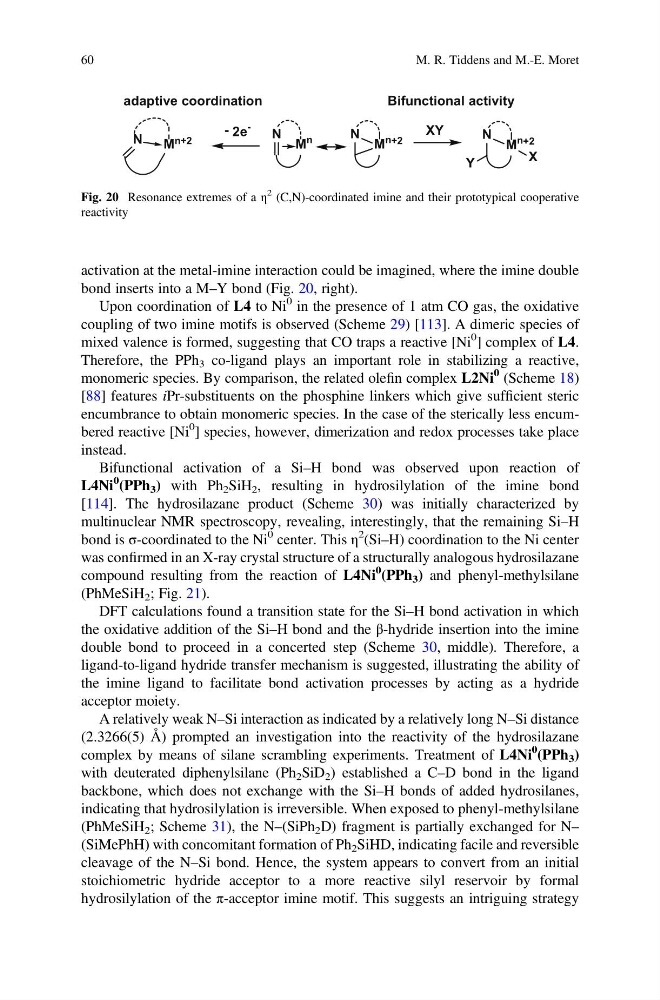
activation at the metal-imine interaction could be imagined, where the imine double
bond inserts into a M–Y bond (Fig. 20, right).
Upon coordination of L4 to Ni
0 in the presence of 1 atm CO gas, the oxidative
coupling of two imine motifs is observed (Scheme 29) [113]. A dimeric species of
mixed valence is formed, suggesting that CO traps a reactive [Ni
0 ] complex of L4.
Therefore, the PPh 3 co-ligand plays an important role in stabilizing a reactive,
monomeric species. By comparison, the related olefin complex L2Ni
0 (Scheme 18)
[88] features iPr-substituents on the phosphine linkers which give sufficient steric
encumbrance to obtain monomeric species. In the case of the sterically less encumbered reactive [Ni
0 ] species, however, dimerization and redox processes take place
instead.
Bifunctional activation of a Si–H bond was observed upon reaction of
L4Ni
0 (PPh 3 ) with Ph 2 SiH 2 , resulting in hydrosilylation of the imine bond
[114]. The hydrosilazane product (Scheme 30) was initially characterized by
multinuclear NMR spectroscopy, revealing, interestingly, that the remaining Si–H
bond is σ-coordinated to the Ni
0 center. This η
2 (Si–H) coordination to the Ni center
was confirmed in an X-ray crystal structure of a structurally analogous hydrosilazane
compound resulting from the reaction of L4Ni
0 (PPh 3 ) and phenyl-methylsilane
(PhMeSiH 2 ; Fig. 21).
DFT calculations found a transition state for the Si–H bond activation in which
the oxidative addition of the Si–H bond and the β-hydride insertion into the imine
double bond to proceed in a concerted step (Scheme 30, middle). Therefore, a
ligand-to-ligand hydride transfer mechanism is suggested, illustrating the ability of
the imine ligand to facilitate bond activation processes by acting as a hydride
acceptor moiety.
A relatively weak N–Si interaction as indicated by a relatively long N–Si distance
(2.3266(5) Å) prompted an investigation into the reactivity of the hydrosilazane
complex by means of silane scrambling experiments. Treatment of L4Ni
0 (PPh 3 )
with deuterated diphenylsilane (Ph 2 SiD 2 ) established a C–D bond in the ligand
backbone, which does not exchange with the Si–H bonds of added hydrosilanes,
indicating that hydrosilylation is irreversible. When exposed to phenyl-methylsilane
(PhMeSiH 2 ; Scheme 31), the N–(SiPh 2 D) fragment is partially exchanged for N–
(SiMePhH) with concomitant formation of Ph 2 SiHD, indicating facile and reversible
cleavage of the N–Si bond. Hence, the system appears to convert from an initial
stoichiometric hydride acceptor to a more reactive silyl reservoir by formal
hydrosilylation of the π-acceptor imine motif. This suggests an intriguing strategy
M
n
N
M
n+2
N
M n+2
N
Bifunctional activity
adaptive coordination
XY
- 2e
-
M
n+2
N
X
Y
Fig. 20 Resonance extremes of a η
2 (C,N)-coordinated imine and their prototypical cooperative
reactivity
60
M. R. Tiddens and M.-E. Moret
bond inserts into a M–Y bond (Fig. 20, right).
Upon coordination of L4 to Ni
0 in the presence of 1 atm CO gas, the oxidative
coupling of two imine motifs is observed (Scheme 29) [113]. A dimeric species of
mixed valence is formed, suggesting that CO traps a reactive [Ni
0 ] complex of L4.
Therefore, the PPh 3 co-ligand plays an important role in stabilizing a reactive,
monomeric species. By comparison, the related olefin complex L2Ni
0 (Scheme 18)
[88] features iPr-substituents on the phosphine linkers which give sufficient steric
encumbrance to obtain monomeric species. In the case of the sterically less encumbered reactive [Ni
0 ] species, however, dimerization and redox processes take place
instead.
Bifunctional activation of a Si–H bond was observed upon reaction of
L4Ni
0 (PPh 3 ) with Ph 2 SiH 2 , resulting in hydrosilylation of the imine bond
[114]. The hydrosilazane product (Scheme 30) was initially characterized by
multinuclear NMR spectroscopy, revealing, interestingly, that the remaining Si–H
bond is σ-coordinated to the Ni
0 center. This η
2 (Si–H) coordination to the Ni center
was confirmed in an X-ray crystal structure of a structurally analogous hydrosilazane
compound resulting from the reaction of L4Ni
0 (PPh 3 ) and phenyl-methylsilane
(PhMeSiH 2 ; Fig. 21).
DFT calculations found a transition state for the Si–H bond activation in which
the oxidative addition of the Si–H bond and the β-hydride insertion into the imine
double bond to proceed in a concerted step (Scheme 30, middle). Therefore, a
ligand-to-ligand hydride transfer mechanism is suggested, illustrating the ability of
the imine ligand to facilitate bond activation processes by acting as a hydride
acceptor moiety.
A relatively weak N–Si interaction as indicated by a relatively long N–Si distance
(2.3266(5) Å) prompted an investigation into the reactivity of the hydrosilazane
complex by means of silane scrambling experiments. Treatment of L4Ni
0 (PPh 3 )
with deuterated diphenylsilane (Ph 2 SiD 2 ) established a C–D bond in the ligand
backbone, which does not exchange with the Si–H bonds of added hydrosilanes,
indicating that hydrosilylation is irreversible. When exposed to phenyl-methylsilane
(PhMeSiH 2 ; Scheme 31), the N–(SiPh 2 D) fragment is partially exchanged for N–
(SiMePhH) with concomitant formation of Ph 2 SiHD, indicating facile and reversible
cleavage of the N–Si bond. Hence, the system appears to convert from an initial
stoichiometric hydride acceptor to a more reactive silyl reservoir by formal
hydrosilylation of the π-acceptor imine motif. This suggests an intriguing strategy
M
n
N
M
n+2
N
M n+2
N
Bifunctional activity
adaptive coordination
XY
- 2e
-
M
n+2
N
X
Y
Fig. 20 Resonance extremes of a η
2 (C,N)-coordinated imine and their prototypical cooperative
reactivity
60
M. R. Tiddens and M.-E. Moret