

intermediates of Co
III -OO-Co
III can be produced in the catalytic water oxidation
process of Co-Pi [256]. Inspired by this, the role of peroxide bond in the catalytic
cycle of homogeneous catalyst O137–138 was studied. It is well known that
Co-based compounds are easily oxidized to cobalt oxides under neutral or alkaline
conditions, because of cobalt oxides having strong catalytic capacity for water
oxidation, which always obscures the effects of molecular catalyst themselves.
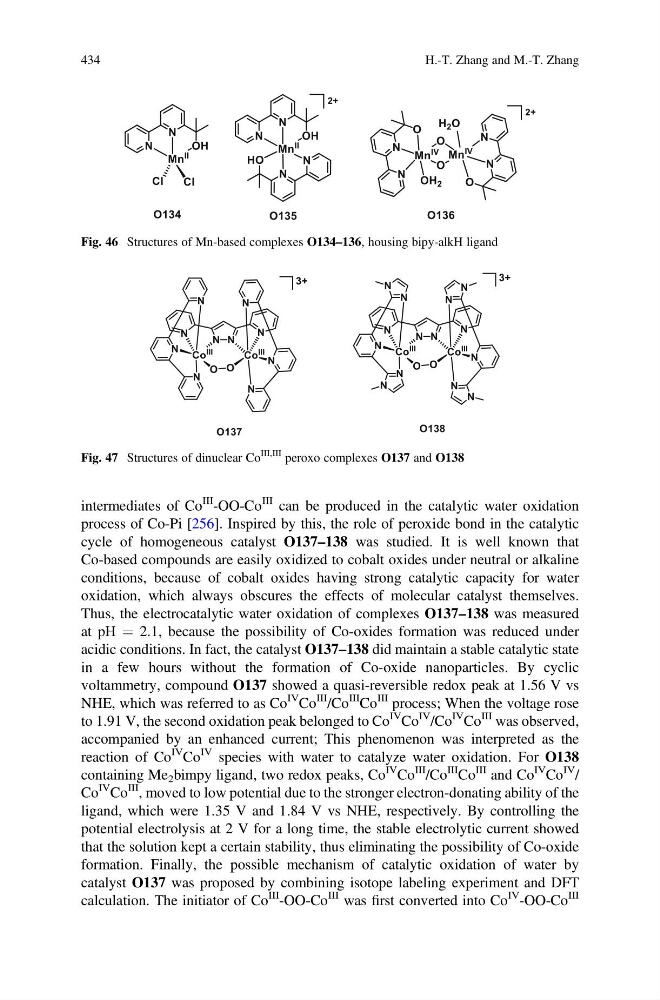
Thus, the electrocatalytic water oxidation of complexes O137–138 was measured
at pH ¼ 2.1, because the possibility of Co-oxides formation was reduced under
acidic conditions. In fact, the catalyst O137–138 did maintain a stable catalytic state
in a few hours without the formation of Co-oxide nanoparticles. By cyclic
voltammetry, compound O137 showed a quasi-reversible redox peak at 1.56 V vs
NHE, which was referred to as Co
IV
Co
III /Co
III Co
III process; When the voltage rose
to 1.91 V, the second oxidation peak belonged to Co
IV
Co
IV /Co
IV
Co
III was observed,
accompanied by an enhanced current; This phenomenon was interpreted as the
reaction of Co
IV
Co
IV species with water to catalyze water oxidation. For O138
containing Me 2 bimpy ligand, two redox peaks, Co
IV
Co
III /Co
III Co
III and Co
IV
Co
IV
/
Co
IV Co
III , moved to low potential due to the stronger electron-donating ability of the
ligand, which were 1.35 V and 1.84 V vs NHE, respectively. By controlling the
potential electrolysis at 2 V for a long time, the stable electrolytic current showed
that the solution kept a certain stability, thus eliminating the possibility of Co-oxide
formation. Finally, the possible mechanism of catalytic oxidation of water by
catalyst O137 was proposed by combining isotope labeling experiment and DFT
calculation. The initiator of Co
III -OO-Co
III was first converted into Co
IV
-OO-Co
III
Fig. 46 Structures of Mn-based complexes O134–136, housing bipy-alkH ligand
Fig. 47 Structures of dinuclear Co
III,III peroxo complexes O137 and O138
434
H.-T. Zhang and M.-T. Zhang
III -OO-Co
III can be produced in the catalytic water oxidation
process of Co-Pi [256]. Inspired by this, the role of peroxide bond in the catalytic
cycle of homogeneous catalyst O137–138 was studied. It is well known that
Co-based compounds are easily oxidized to cobalt oxides under neutral or alkaline
conditions, because of cobalt oxides having strong catalytic capacity for water
oxidation, which always obscures the effects of molecular catalyst themselves.
Thus, the electrocatalytic water oxidation of complexes O137–138 was measured
at pH ¼ 2.1, because the possibility of Co-oxides formation was reduced under
acidic conditions. In fact, the catalyst O137–138 did maintain a stable catalytic state
in a few hours without the formation of Co-oxide nanoparticles. By cyclic
voltammetry, compound O137 showed a quasi-reversible redox peak at 1.56 V vs
NHE, which was referred to as Co
IV
Co
III /Co
III Co
III process; When the voltage rose
to 1.91 V, the second oxidation peak belonged to Co
IV
Co
IV /Co
IV
Co
III was observed,
accompanied by an enhanced current; This phenomenon was interpreted as the
reaction of Co
IV
Co
IV species with water to catalyze water oxidation. For O138
containing Me 2 bimpy ligand, two redox peaks, Co
IV
Co
III /Co
III Co
III and Co
IV
Co
IV
/
Co
IV Co
III , moved to low potential due to the stronger electron-donating ability of the
ligand, which were 1.35 V and 1.84 V vs NHE, respectively. By controlling the
potential electrolysis at 2 V for a long time, the stable electrolytic current showed
that the solution kept a certain stability, thus eliminating the possibility of Co-oxide
formation. Finally, the possible mechanism of catalytic oxidation of water by
catalyst O137 was proposed by combining isotope labeling experiment and DFT
calculation. The initiator of Co
III -OO-Co
III was first converted into Co
IV
-OO-Co
III
Fig. 46 Structures of Mn-based complexes O134–136, housing bipy-alkH ligand
Fig. 47 Structures of dinuclear Co
III,III peroxo complexes O137 and O138
434
H.-T. Zhang and M.-T. Zhang