

through one-electron oxidation, then Co
IV
-OO-Co
IV was synthesized by
one-electron oxidation of Co
IV -OO-Co
III ; And oxygen was released immediately
after further oxidation; With the participation of water molecules and through multistep proton-coupled electron transfer reaction, it returned to the initial state of Co
III -
OO-Co
III . In 2016, Llobet discovered an important intermediate
[H 2 OÀCo
III Co
III
ÀOO•]
4+ species in the process of water oxidation catalyzed by
catalyst O137, which was characterized resonance Raman, electron paramagnetic
resonance and X-ray absorption spectroscopy [257]. The capture of this species
provided a strong support for uncovering the veil of oxygen release process.
Recently, copper-based catalysts for water oxidation have not been discovered
and studied [232, 258, 259]. In 2017, the only copper-based water oxidation catalyst
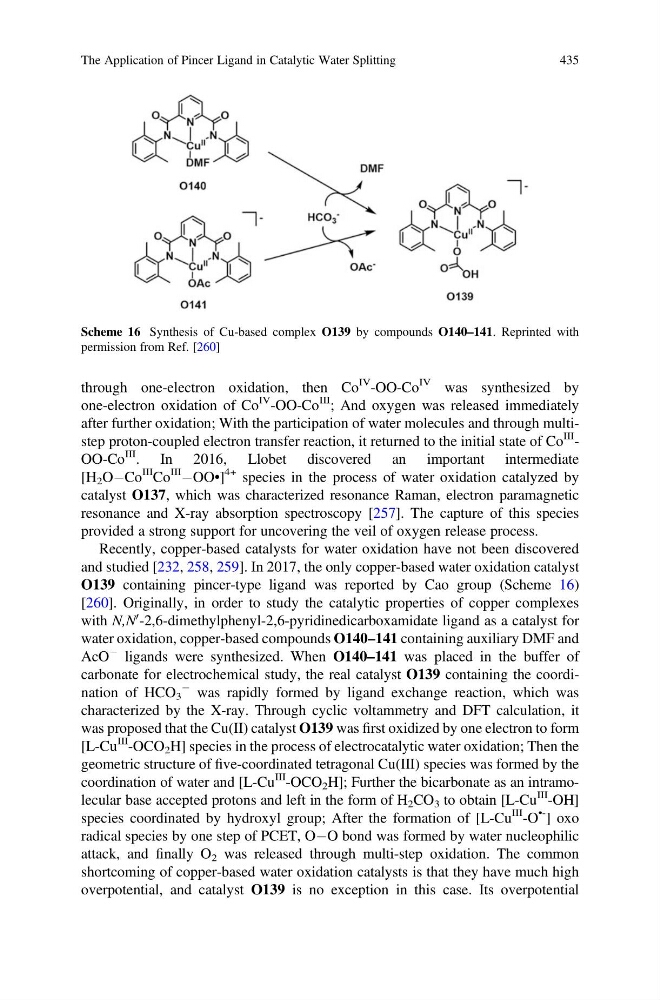
O139 containing pincer-type ligand was reported by Cao group (Scheme 16)
[260]. Originally, in order to study the catalytic properties of copper complexes
with N,N
0 -2,6-dimethylphenyl-2,6-pyridinedicarboxamidate ligand as a catalyst for
water oxidation, copper-based compounds O140–141 containing auxiliary DMF and
AcO
À ligands were synthesized. When O140–141 was placed in the buffer of
carbonate for electrochemical study, the real catalyst O139 containing the coordination of HCO 3
À was rapidly formed by ligand exchange reaction, which was
characterized by the X-ray. Through cyclic voltammetry and DFT calculation, it
was proposed that the Cu(II) catalyst O139 was first oxidized by one electron to form
[L-Cu
III
-OCO 2 H] species in the process of electrocatalytic water oxidation; Then the
geometric structure of five-coordinated tetragonal Cu(III) species was formed by the
coordination of water and [L-Cu
III -OCO 2 H]; Further the bicarbonate as an intramolecular base accepted protons and left in the form of H 2 CO 3 to obtain [L-Cu
III -OH]
species coordinated by hydroxyl group; After the formation of [L-Cu
III -O
•- ] oxo
radical species by one step of PCET, OÀO bond was formed by water nucleophilic
attack, and finally O 2 was released through multi-step oxidation. The common
shortcoming of copper-based water oxidation catalysts is that they have much high
overpotential, and catalyst O139 is no exception in this case. Its overpotential
Scheme 16 Synthesis of Cu-based complex O139 by compounds O140–141. Reprinted with
permission from Ref. [260]
The Application of Pincer Ligand in Catalytic Water Splitting
435
IV
-OO-Co
IV was synthesized by
one-electron oxidation of Co
IV -OO-Co
III ; And oxygen was released immediately
after further oxidation; With the participation of water molecules and through multistep proton-coupled electron transfer reaction, it returned to the initial state of Co
III -
OO-Co
III . In 2016, Llobet discovered an important intermediate
[H 2 OÀCo
III Co
III
ÀOO•]
4+ species in the process of water oxidation catalyzed by
catalyst O137, which was characterized resonance Raman, electron paramagnetic
resonance and X-ray absorption spectroscopy [257]. The capture of this species
provided a strong support for uncovering the veil of oxygen release process.
Recently, copper-based catalysts for water oxidation have not been discovered
and studied [232, 258, 259]. In 2017, the only copper-based water oxidation catalyst
O139 containing pincer-type ligand was reported by Cao group (Scheme 16)
[260]. Originally, in order to study the catalytic properties of copper complexes
with N,N
0 -2,6-dimethylphenyl-2,6-pyridinedicarboxamidate ligand as a catalyst for
water oxidation, copper-based compounds O140–141 containing auxiliary DMF and
AcO
À ligands were synthesized. When O140–141 was placed in the buffer of
carbonate for electrochemical study, the real catalyst O139 containing the coordination of HCO 3
À was rapidly formed by ligand exchange reaction, which was
characterized by the X-ray. Through cyclic voltammetry and DFT calculation, it
was proposed that the Cu(II) catalyst O139 was first oxidized by one electron to form
[L-Cu
III
-OCO 2 H] species in the process of electrocatalytic water oxidation; Then the
geometric structure of five-coordinated tetragonal Cu(III) species was formed by the
coordination of water and [L-Cu
III -OCO 2 H]; Further the bicarbonate as an intramolecular base accepted protons and left in the form of H 2 CO 3 to obtain [L-Cu
III -OH]
species coordinated by hydroxyl group; After the formation of [L-Cu
III -O
•- ] oxo
radical species by one step of PCET, OÀO bond was formed by water nucleophilic
attack, and finally O 2 was released through multi-step oxidation. The common
shortcoming of copper-based water oxidation catalysts is that they have much high
overpotential, and catalyst O139 is no exception in this case. Its overpotential
Scheme 16 Synthesis of Cu-based complex O139 by compounds O140–141. Reprinted with
permission from Ref. [260]
The Application of Pincer Ligand in Catalytic Water Splitting
435