

proton transfer; Ru
V
¼O species was formed in a multi-step PCET process, and water
molecules attack Ru
V
¼O nucleophilically to form OÀO bond, eventually releasing
oxygen back to Ru
III- OH 2 state. Because the uncoordinated nitrogen in imidazole
can be used as an effective proton transfer station in the whole catalytic cycle, the
important step of PCET can occur smoothly. When 10 times the amount of oxidant
[Ru(bpy) 3 ]
3+ was added to the catalytic system, the existence of corresponding highenergy [Ru
V
¼O + H
+
]
+ intermediates can be detected by high-resolution mass
spectrometry. This indicated that the bi-anionic tridentate ligand skeleton can greatly
improve the stability of high-energy intermediates [224]. Catalysts with low redox
potential, such as O105 and O106, have a great opportunity to design molecular
assemblies for the conversion of solar energy to chemical energy.
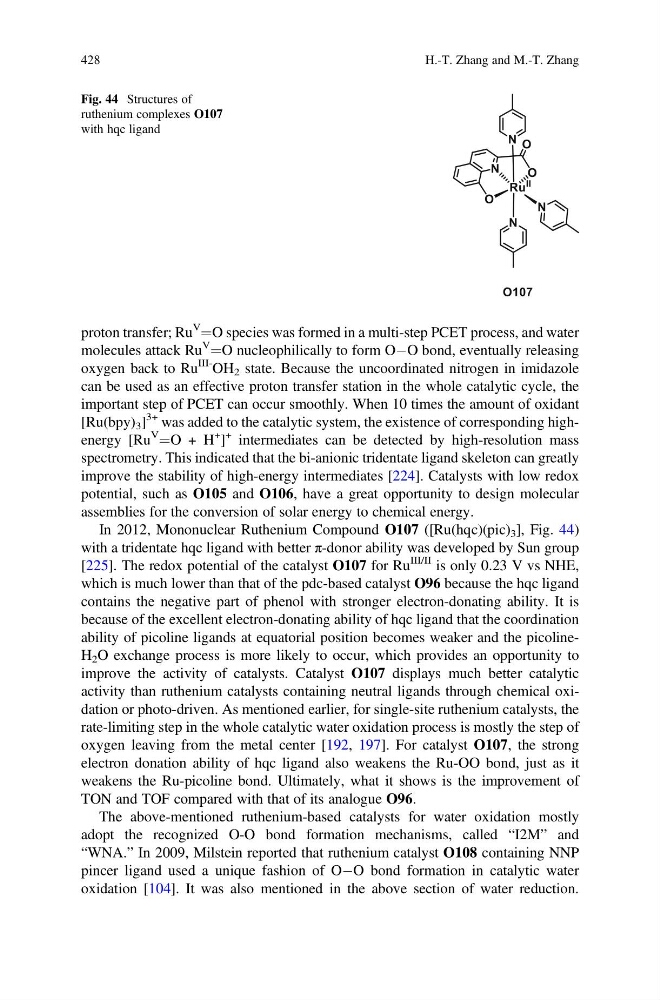
In 2012, Mononuclear Ruthenium Compound O107 ([Ru(hqc)(pic) 3 ], Fig. 44)
with a tridentate hqc ligand with better π-donor ability was developed by Sun group
[225]. The redox potential of the catalyst O107 for Ru
III/II is only 0.23 V vs NHE,
which is much lower than that of the pdc-based catalyst O96 because the hqc ligand
contains the negative part of phenol with stronger electron-donating ability. It is
because of the excellent electron-donating ability of hqc ligand that the coordination
ability of picoline ligands at equatorial position becomes weaker and the picolineH 2 O exchange process is more likely to occur, which provides an opportunity to
improve the activity of catalysts. Catalyst O107 displays much better catalytic
activity than ruthenium catalysts containing neutral ligands through chemical oxidation or photo-driven. As mentioned earlier, for single-site ruthenium catalysts, the
rate-limiting step in the whole catalytic water oxidation process is mostly the step of
oxygen leaving from the metal center [192, 197]. For catalyst O107, the strong
electron donation ability of hqc ligand also weakens the Ru-OO bond, just as it
weakens the Ru-picoline bond. Ultimately, what it shows is the improvement of
TON and TOF compared with that of its analogue O96.
The above-mentioned ruthenium-based catalysts for water oxidation mostly
adopt the recognized O-O bond formation mechanisms, called “I2M” and
“WNA.” In 2009, Milstein reported that ruthenium catalyst O108 containing NNP
pincer ligand used a unique fashion of OÀO bond formation in catalytic water
oxidation [104]. It was also mentioned in the above section of water reduction.
Fig. 44 Structures of
ruthenium complexes O107
with hqc ligand
428
H.-T. Zhang and M.-T. Zhang
V
¼O species was formed in a multi-step PCET process, and water
molecules attack Ru
V
¼O nucleophilically to form OÀO bond, eventually releasing
oxygen back to Ru
III- OH 2 state. Because the uncoordinated nitrogen in imidazole
can be used as an effective proton transfer station in the whole catalytic cycle, the
important step of PCET can occur smoothly. When 10 times the amount of oxidant
[Ru(bpy) 3 ]
3+ was added to the catalytic system, the existence of corresponding highenergy [Ru
V
¼O + H
+
]
+ intermediates can be detected by high-resolution mass
spectrometry. This indicated that the bi-anionic tridentate ligand skeleton can greatly
improve the stability of high-energy intermediates [224]. Catalysts with low redox
potential, such as O105 and O106, have a great opportunity to design molecular
assemblies for the conversion of solar energy to chemical energy.
In 2012, Mononuclear Ruthenium Compound O107 ([Ru(hqc)(pic) 3 ], Fig. 44)
with a tridentate hqc ligand with better π-donor ability was developed by Sun group
[225]. The redox potential of the catalyst O107 for Ru
III/II is only 0.23 V vs NHE,
which is much lower than that of the pdc-based catalyst O96 because the hqc ligand
contains the negative part of phenol with stronger electron-donating ability. It is
because of the excellent electron-donating ability of hqc ligand that the coordination
ability of picoline ligands at equatorial position becomes weaker and the picolineH 2 O exchange process is more likely to occur, which provides an opportunity to
improve the activity of catalysts. Catalyst O107 displays much better catalytic
activity than ruthenium catalysts containing neutral ligands through chemical oxidation or photo-driven. As mentioned earlier, for single-site ruthenium catalysts, the
rate-limiting step in the whole catalytic water oxidation process is mostly the step of
oxygen leaving from the metal center [192, 197]. For catalyst O107, the strong
electron donation ability of hqc ligand also weakens the Ru-OO bond, just as it
weakens the Ru-picoline bond. Ultimately, what it shows is the improvement of
TON and TOF compared with that of its analogue O96.
The above-mentioned ruthenium-based catalysts for water oxidation mostly
adopt the recognized O-O bond formation mechanisms, called “I2M” and
“WNA.” In 2009, Milstein reported that ruthenium catalyst O108 containing NNP
pincer ligand used a unique fashion of OÀO bond formation in catalytic water
oxidation [104]. It was also mentioned in the above section of water reduction.
Fig. 44 Structures of
ruthenium complexes O107
with hqc ligand
428
H.-T. Zhang and M.-T. Zhang