

potential of accessing high-valent (Ru
IV and Ru
V , for example) states of ruthenium
WOCs; (ii) reducing the overpotential of catalytic water oxidation; (iii) enhancing
the rate of ligand exchange (H 2 O/pic in this case); (iv) facilitating release of
dioxygen from the ruthenium center, and (v) possibly drawing the water molecule
close to the reactive Ru site via a hydrogen bond.” [223] Of course, these ligands
also have some shortcomings. For example, the existence of multiple oxygen atoms
can easily be protonated, which hinders proton transfer. There are also potential
degradation possibilities of decarboxylation and ligand dissociation in high oxidation state.
In 2012, two novel Ru
III
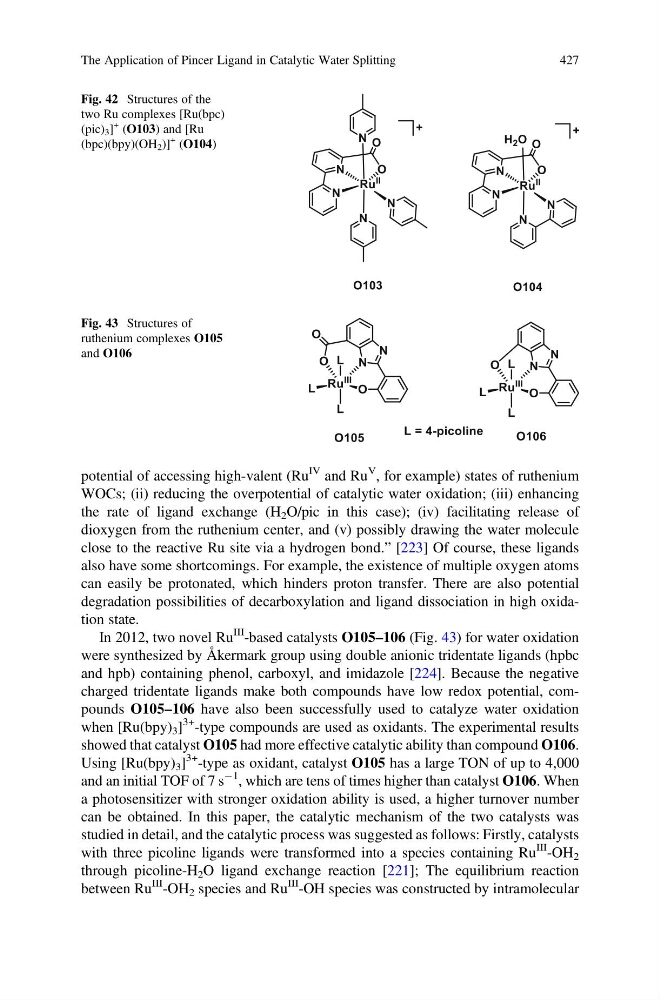
-based catalysts O105–106 (Fig. 43) for water oxidation
were synthesized by Åkermark group using double anionic tridentate ligands (hpbc
and hpb) containing phenol, carboxyl, and imidazole [224]. Because the negative
charged tridentate ligands make both compounds have low redox potential, compounds O105–106 have also been successfully used to catalyze water oxidation
when [Ru(bpy) 3 ]
3+ -type compounds are used as oxidants. The experimental results
showed that catalyst O105 had more effective catalytic ability than compound O106.
Using [Ru(bpy) 3 ]
3+ -type as oxidant, catalyst O105 has a large TON of up to 4,000
and an initial TOF of 7 s
À1 , which are tens of times higher than catalyst O106. When
a photosensitizer with stronger oxidation ability is used, a higher turnover number
can be obtained. In this paper, the catalytic mechanism of the two catalysts was
studied in detail, and the catalytic process was suggested as follows: Firstly, catalysts
with three picoline ligands were transformed into a species containing Ru
III -OH 2
through picoline-H 2 O ligand exchange reaction [221]; The equilibrium reaction
between Ru
III
-OH 2 species and Ru
III -OH species was constructed by intramolecular
Fig. 42 Structures of the
two Ru complexes [Ru(bpc)
(pic) 3 ]
+ (O103) and [Ru
(bpc)(bpy)(OH 2 )]
+ (O104)
Fig. 43 Structures of
ruthenium complexes O105
and O106
The Application of Pincer Ligand in Catalytic Water Splitting
427
IV and Ru
V , for example) states of ruthenium
WOCs; (ii) reducing the overpotential of catalytic water oxidation; (iii) enhancing
the rate of ligand exchange (H 2 O/pic in this case); (iv) facilitating release of
dioxygen from the ruthenium center, and (v) possibly drawing the water molecule
close to the reactive Ru site via a hydrogen bond.” [223] Of course, these ligands
also have some shortcomings. For example, the existence of multiple oxygen atoms
can easily be protonated, which hinders proton transfer. There are also potential
degradation possibilities of decarboxylation and ligand dissociation in high oxidation state.
In 2012, two novel Ru
III
-based catalysts O105–106 (Fig. 43) for water oxidation
were synthesized by Åkermark group using double anionic tridentate ligands (hpbc
and hpb) containing phenol, carboxyl, and imidazole [224]. Because the negative
charged tridentate ligands make both compounds have low redox potential, compounds O105–106 have also been successfully used to catalyze water oxidation
when [Ru(bpy) 3 ]
3+ -type compounds are used as oxidants. The experimental results
showed that catalyst O105 had more effective catalytic ability than compound O106.
Using [Ru(bpy) 3 ]
3+ -type as oxidant, catalyst O105 has a large TON of up to 4,000
and an initial TOF of 7 s
À1 , which are tens of times higher than catalyst O106. When
a photosensitizer with stronger oxidation ability is used, a higher turnover number
can be obtained. In this paper, the catalytic mechanism of the two catalysts was
studied in detail, and the catalytic process was suggested as follows: Firstly, catalysts
with three picoline ligands were transformed into a species containing Ru
III -OH 2
through picoline-H 2 O ligand exchange reaction [221]; The equilibrium reaction
between Ru
III
-OH 2 species and Ru
III -OH species was constructed by intramolecular
Fig. 42 Structures of the
two Ru complexes [Ru(bpc)
(pic) 3 ]
+ (O103) and [Ru
(bpc)(bpy)(OH 2 )]
+ (O104)
Fig. 43 Structures of
ruthenium complexes O105
and O106
The Application of Pincer Ligand in Catalytic Water Splitting
427