

structures of compounds O96 and O97 differ little, complex O96 exhibited stronger
catalytic activity compared with modest O97, using both photocatalytic and chemical oxidation methods. The initial catalytic rate of the catalysts was linearly correlated, which indicated that the OÀO bond formation was most likely to adopt WNA
mechanism based on the high-valent Ru ¼ O species. Because of the need to
generate high-valent Ru ¼ O species, the process of H 2 O-picoline exchange
becomes a necessary step. Compound O96 contains three picoline ligands which
can easily generate [Ru(pdc)(pic) 2 (OH 2 )]
+ active species in the catalytic system for
further catalytic water oxidation. On the contrary, O97 contains only one picoline
ligand, and its para-position is occupied by a nitrogen of bpy, which makes H 2 O
-picoline exchange not easy to occur, thus reducing the catalytic efficiency of O97
for water oxidation.
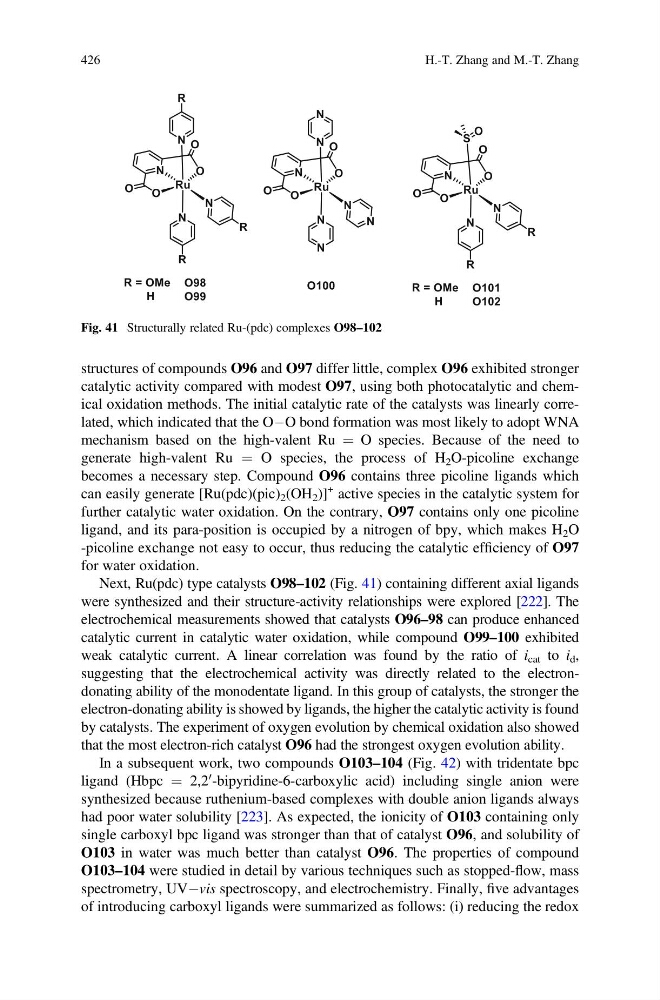
Next, Ru(pdc) type catalysts O98–102 (Fig. 41) containing different axial ligands
were synthesized and their structure-activity relationships were explored [222]. The
electrochemical measurements showed that catalysts O96–98 can produce enhanced
catalytic current in catalytic water oxidation, while compound O99–100 exhibited
weak catalytic current. A linear correlation was found by the ratio of i cat to i d ,
suggesting that the electrochemical activity was directly related to the electrondonating ability of the monodentate ligand. In this group of catalysts, the stronger the
electron-donating ability is showed by ligands, the higher the catalytic activity is found
by catalysts. The experiment of oxygen evolution by chemical oxidation also showed
that the most electron-rich catalyst O96 had the strongest oxygen evolution ability.
In a subsequent work, two compounds O103–104 (Fig. 42) with tridentate bpc
ligand (Hbpc ¼ 2,2
0 -bipyridine-6-carboxylic acid) including single anion were
synthesized because ruthenium-based complexes with double anion ligands always
had poor water solubility [223]. As expected, the ionicity of O103 containing only
single carboxyl bpc ligand was stronger than that of catalyst O96, and solubility of
O103 in water was much better than catalyst O96. The properties of compound
O103–104 were studied in detail by various techniques such as stopped-flow, mass
spectrometry, UVÀvis spectroscopy, and electrochemistry. Finally, five advantages
of introducing carboxyl ligands were summarized as follows: (i) reducing the redox
Fig. 41 Structurally related Ru-(pdc) complexes O98–102
426
H.-T. Zhang and M.-T. Zhang
catalytic activity compared with modest O97, using both photocatalytic and chemical oxidation methods. The initial catalytic rate of the catalysts was linearly correlated, which indicated that the OÀO bond formation was most likely to adopt WNA
mechanism based on the high-valent Ru ¼ O species. Because of the need to
generate high-valent Ru ¼ O species, the process of H 2 O-picoline exchange
becomes a necessary step. Compound O96 contains three picoline ligands which
can easily generate [Ru(pdc)(pic) 2 (OH 2 )]
+ active species in the catalytic system for
further catalytic water oxidation. On the contrary, O97 contains only one picoline
ligand, and its para-position is occupied by a nitrogen of bpy, which makes H 2 O
-picoline exchange not easy to occur, thus reducing the catalytic efficiency of O97
for water oxidation.
Next, Ru(pdc) type catalysts O98–102 (Fig. 41) containing different axial ligands
were synthesized and their structure-activity relationships were explored [222]. The
electrochemical measurements showed that catalysts O96–98 can produce enhanced
catalytic current in catalytic water oxidation, while compound O99–100 exhibited
weak catalytic current. A linear correlation was found by the ratio of i cat to i d ,
suggesting that the electrochemical activity was directly related to the electrondonating ability of the monodentate ligand. In this group of catalysts, the stronger the
electron-donating ability is showed by ligands, the higher the catalytic activity is found
by catalysts. The experiment of oxygen evolution by chemical oxidation also showed
that the most electron-rich catalyst O96 had the strongest oxygen evolution ability.
In a subsequent work, two compounds O103–104 (Fig. 42) with tridentate bpc
ligand (Hbpc ¼ 2,2
0 -bipyridine-6-carboxylic acid) including single anion were
synthesized because ruthenium-based complexes with double anion ligands always
had poor water solubility [223]. As expected, the ionicity of O103 containing only
single carboxyl bpc ligand was stronger than that of catalyst O96, and solubility of
O103 in water was much better than catalyst O96. The properties of compound
O103–104 were studied in detail by various techniques such as stopped-flow, mass
spectrometry, UVÀvis spectroscopy, and electrochemistry. Finally, five advantages
of introducing carboxyl ligands were summarized as follows: (i) reducing the redox
Fig. 41 Structurally related Ru-(pdc) complexes O98–102
426
H.-T. Zhang and M.-T. Zhang