

function is beyond the reach of many ordinary neutral ligand catalysts, which require
stronger chemical oxidants to assist catalysts in catalytic water oxidation. In 2009,
Ru(bda)(pic) 2 , a mononuclear ruthenium catalyst reported by Sun group as water
oxidation catalyst, confirmed the rationality of the analysis and showed significantly
lower redox potential [220].
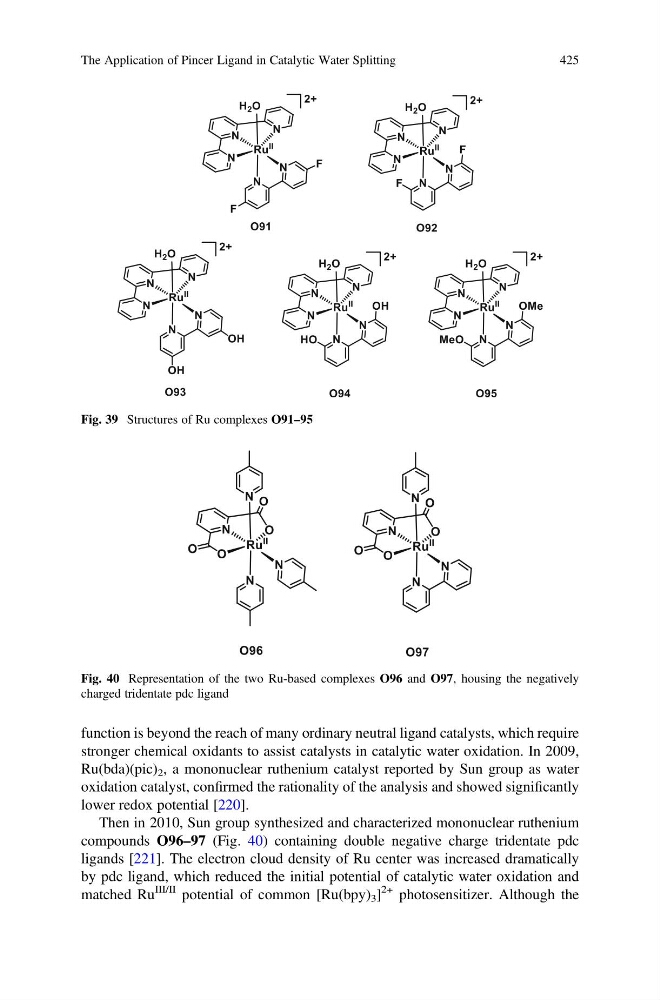
Then in 2010, Sun group synthesized and characterized mononuclear ruthenium
compounds O96–97 (Fig. 40) containing double negative charge tridentate pdc
ligands [221]. The electron cloud density of Ru center was increased dramatically
by pdc ligand, which reduced the initial potential of catalytic water oxidation and
matched Ru
III/II potential of common [Ru(bpy) 3 ]
2+ photosensitizer. Although the
Fig. 39 Structures of Ru complexes O91–95
Fig. 40 Representation of the two Ru-based complexes O96 and O97, housing the negatively
charged tridentate pdc ligand
The Application of Pincer Ligand in Catalytic Water Splitting
425
stronger chemical oxidants to assist catalysts in catalytic water oxidation. In 2009,
Ru(bda)(pic) 2 , a mononuclear ruthenium catalyst reported by Sun group as water
oxidation catalyst, confirmed the rationality of the analysis and showed significantly
lower redox potential [220].
Then in 2010, Sun group synthesized and characterized mononuclear ruthenium
compounds O96–97 (Fig. 40) containing double negative charge tridentate pdc
ligands [221]. The electron cloud density of Ru center was increased dramatically
by pdc ligand, which reduced the initial potential of catalytic water oxidation and
matched Ru
III/II potential of common [Ru(bpy) 3 ]
2+ photosensitizer. Although the
Fig. 39 Structures of Ru complexes O91–95
Fig. 40 Representation of the two Ru-based complexes O96 and O97, housing the negatively
charged tridentate pdc ligand
The Application of Pincer Ligand in Catalytic Water Splitting
425