

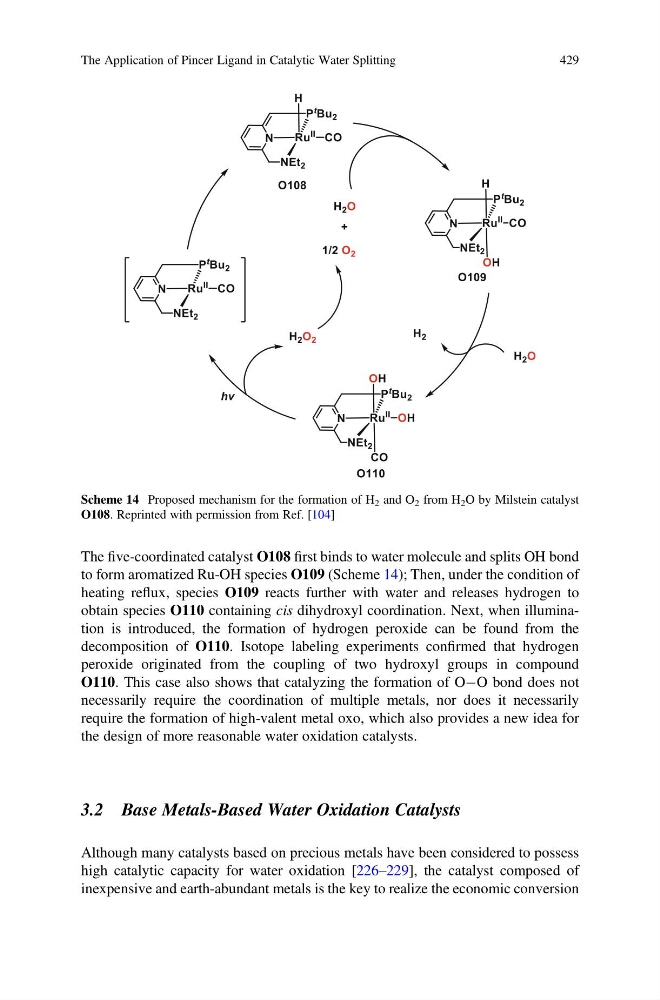
The five-coordinated catalyst O108 first binds to water molecule and splits OH bond
to form aromatized Ru-OH species O109 (Scheme 14); Then, under the condition of
heating reflux, species O109 reacts further with water and releases hydrogen to
obtain species O110 containing cis dihydroxyl coordination. Next, when illumination is introduced, the formation of hydrogen peroxide can be found from the
decomposition of O110. Isotope labeling experiments confirmed that hydrogen
peroxide originated from the coupling of two hydroxyl groups in compound
O110. This case also shows that catalyzing the formation of OÀO bond does not
necessarily require the coordination of multiple metals, nor does it necessarily
require the formation of high-valent metal oxo, which also provides a new idea for
the design of more reasonable water oxidation catalysts.
3.2 Base Metals-Based Water Oxidation Catalysts
Although many catalysts based on precious metals have been considered to possess
high catalytic capacity for water oxidation [226–229], the catalyst composed of
inexpensive and earth-abundant metals is the key to realize the economic conversion
Scheme 14 Proposed mechanism for the formation of H 2 and O 2 from H 2 O by Milstein catalyst
O108. Reprinted with permission from Ref. [104]
The Application of Pincer Ligand in Catalytic Water Splitting
429
to form aromatized Ru-OH species O109 (Scheme 14); Then, under the condition of
heating reflux, species O109 reacts further with water and releases hydrogen to
obtain species O110 containing cis dihydroxyl coordination. Next, when illumination is introduced, the formation of hydrogen peroxide can be found from the
decomposition of O110. Isotope labeling experiments confirmed that hydrogen
peroxide originated from the coupling of two hydroxyl groups in compound
O110. This case also shows that catalyzing the formation of OÀO bond does not
necessarily require the coordination of multiple metals, nor does it necessarily
require the formation of high-valent metal oxo, which also provides a new idea for
the design of more reasonable water oxidation catalysts.
3.2 Base Metals-Based Water Oxidation Catalysts
Although many catalysts based on precious metals have been considered to possess
high catalytic capacity for water oxidation [226–229], the catalyst composed of
inexpensive and earth-abundant metals is the key to realize the economic conversion
Scheme 14 Proposed mechanism for the formation of H 2 and O 2 from H 2 O by Milstein catalyst
O108. Reprinted with permission from Ref. [104]
The Application of Pincer Ligand in Catalytic Water Splitting
429