

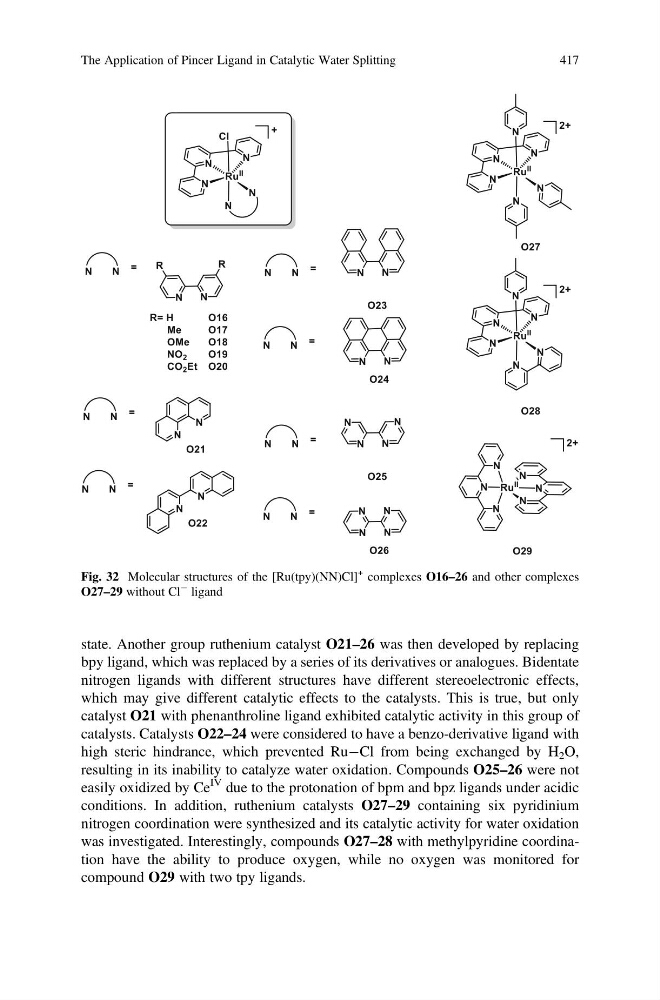
state. Another group ruthenium catalyst O21–26 was then developed by replacing
bpy ligand, which was replaced by a series of its derivatives or analogues. Bidentate
nitrogen ligands with different structures have different stereoelectronic effects,
which may give different catalytic effects to the catalysts. This is true, but only
catalyst O21 with phenanthroline ligand exhibited catalytic activity in this group of
catalysts. Catalysts O22–24 were considered to have a benzo-derivative ligand with
high steric hindrance, which prevented RuÀCl from being exchanged by H 2 O,
resulting in its inability to catalyze water oxidation. Compounds O25–26 were not
easily oxidized by Ce
IV due to the protonation of bpm and bpz ligands under acidic
conditions. In addition, ruthenium catalysts O27–29 containing six pyridinium
nitrogen coordination were synthesized and its catalytic activity for water oxidation
was investigated. Interestingly, compounds O27–28 with methylpyridine coordination have the ability to produce oxygen, while no oxygen was monitored for
compound O29 with two tpy ligands.
Fig. 32 Molecular structures of the [Ru(tpy)(NN)Cl]
+ complexes O16–26 and other complexes
O27–29 without Cl
À ligand
The Application of Pincer Ligand in Catalytic Water Splitting
417
bpy ligand, which was replaced by a series of its derivatives or analogues. Bidentate
nitrogen ligands with different structures have different stereoelectronic effects,
which may give different catalytic effects to the catalysts. This is true, but only
catalyst O21 with phenanthroline ligand exhibited catalytic activity in this group of
catalysts. Catalysts O22–24 were considered to have a benzo-derivative ligand with
high steric hindrance, which prevented RuÀCl from being exchanged by H 2 O,
resulting in its inability to catalyze water oxidation. Compounds O25–26 were not
easily oxidized by Ce
IV due to the protonation of bpm and bpz ligands under acidic
conditions. In addition, ruthenium catalysts O27–29 containing six pyridinium
nitrogen coordination were synthesized and its catalytic activity for water oxidation
was investigated. Interestingly, compounds O27–28 with methylpyridine coordination have the ability to produce oxygen, while no oxygen was monitored for
compound O29 with two tpy ligands.
Fig. 32 Molecular structures of the [Ru(tpy)(NN)Cl]
+ complexes O16–26 and other complexes
O27–29 without Cl
À ligand
The Application of Pincer Ligand in Catalytic Water Splitting
417