

produced by four ruthenium-based catalysts, the difficulty extent of oxidizing
methylenic moieties can be reasonably speculated [ 188].
Initially inspired by Mn 4 Ca-cluster, researchers designed a large number of
binuclear and multinuclear catalysts, because people mistakenly believed that
single-site catalysts could not catalyze water oxidation independently, and that
catalytic water oxidation could be achieved at least by bimetallic cooperation. In
2005, Thummel group provided reliable evidence for the first time that mononuclear
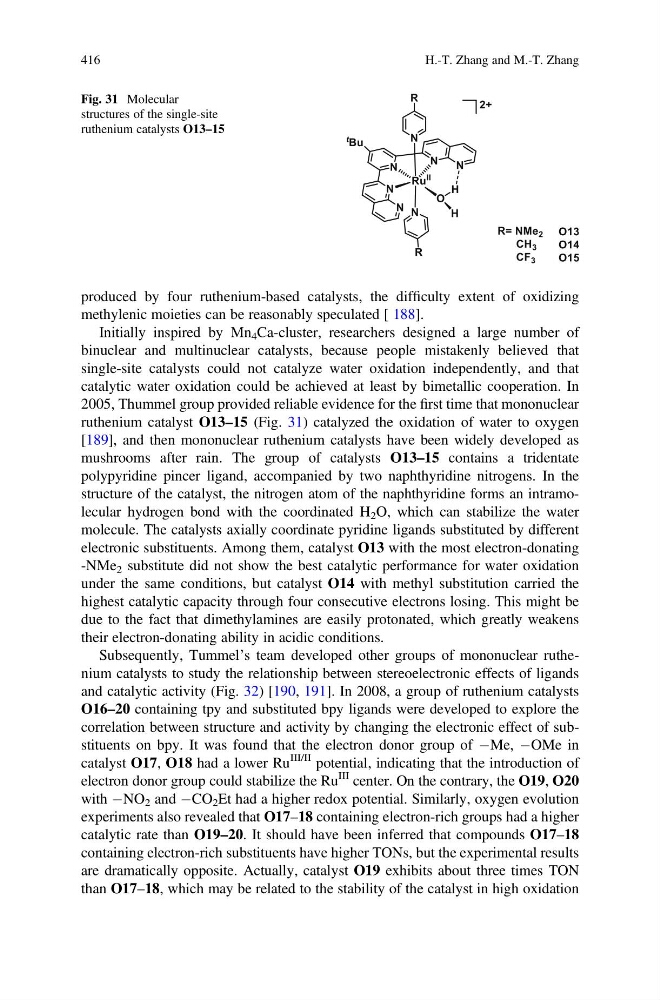
ruthenium catalyst O13–15 (Fig. 31) catalyzed the oxidation of water to oxygen
[189], and then mononuclear ruthenium catalysts have been widely developed as
mushrooms after rain. The group of catalysts O13–15 contains a tridentate
polypyridine pincer ligand, accompanied by two naphthyridine nitrogens. In the
structure of the catalyst, the nitrogen atom of the naphthyridine forms an intramolecular hydrogen bond with the coordinated H 2 O, which can stabilize the water
molecule. The catalysts axially coordinate pyridine ligands substituted by different
electronic substituents. Among them, catalyst O13 with the most electron-donating
-NMe 2 substitute did not show the best catalytic performance for water oxidation
under the same conditions, but catalyst O14 with methyl substitution carried the
highest catalytic capacity through four consecutive electrons losing. This might be
due to the fact that dimethylamines are easily protonated, which greatly weakens
their electron-donating ability in acidic conditions.
Subsequently, Tummel’s team developed other groups of mononuclear ruthenium catalysts to study the relationship between stereoelectronic effects of ligands
and catalytic activity (Fig. 32) [190, 191]. In 2008, a group of ruthenium catalysts
O16–20 containing tpy and substituted bpy ligands were developed to explore the
correlation between structure and activity by changing the electronic effect of substituents on bpy. It was found that the electron donor group of ÀMe, ÀOMe in
catalyst O17, O18 had a lower Ru
III/II potential, indicating that the introduction of
electron donor group could stabilize the Ru
III center. On the contrary, the O19, O20
with ÀNO 2 and ÀCO 2 Et had a higher redox potential. Similarly, oxygen evolution
experiments also revealed that O17–18 containing electron-rich groups had a higher
catalytic rate than O19–20. It should have been inferred that compounds O17–18
containing electron-rich substituents have higher TONs, but the experimental results
are dramatically opposite. Actually, catalyst O19 exhibits about three times TON
than O17–18, which may be related to the stability of the catalyst in high oxidation
Fig. 31 Molecular
structures of the single-site
ruthenium catalysts O13–15
416
H.-T. Zhang and M.-T. Zhang
methylenic moieties can be reasonably speculated [ 188].
Initially inspired by Mn 4 Ca-cluster, researchers designed a large number of
binuclear and multinuclear catalysts, because people mistakenly believed that
single-site catalysts could not catalyze water oxidation independently, and that
catalytic water oxidation could be achieved at least by bimetallic cooperation. In
2005, Thummel group provided reliable evidence for the first time that mononuclear
ruthenium catalyst O13–15 (Fig. 31) catalyzed the oxidation of water to oxygen
[189], and then mononuclear ruthenium catalysts have been widely developed as
mushrooms after rain. The group of catalysts O13–15 contains a tridentate
polypyridine pincer ligand, accompanied by two naphthyridine nitrogens. In the
structure of the catalyst, the nitrogen atom of the naphthyridine forms an intramolecular hydrogen bond with the coordinated H 2 O, which can stabilize the water
molecule. The catalysts axially coordinate pyridine ligands substituted by different
electronic substituents. Among them, catalyst O13 with the most electron-donating
-NMe 2 substitute did not show the best catalytic performance for water oxidation
under the same conditions, but catalyst O14 with methyl substitution carried the
highest catalytic capacity through four consecutive electrons losing. This might be
due to the fact that dimethylamines are easily protonated, which greatly weakens
their electron-donating ability in acidic conditions.
Subsequently, Tummel’s team developed other groups of mononuclear ruthenium catalysts to study the relationship between stereoelectronic effects of ligands
and catalytic activity (Fig. 32) [190, 191]. In 2008, a group of ruthenium catalysts
O16–20 containing tpy and substituted bpy ligands were developed to explore the
correlation between structure and activity by changing the electronic effect of substituents on bpy. It was found that the electron donor group of ÀMe, ÀOMe in
catalyst O17, O18 had a lower Ru
III/II potential, indicating that the introduction of
electron donor group could stabilize the Ru
III center. On the contrary, the O19, O20
with ÀNO 2 and ÀCO 2 Et had a higher redox potential. Similarly, oxygen evolution
experiments also revealed that O17–18 containing electron-rich groups had a higher
catalytic rate than O19–20. It should have been inferred that compounds O17–18
containing electron-rich substituents have higher TONs, but the experimental results
are dramatically opposite. Actually, catalyst O19 exhibits about three times TON
than O17–18, which may be related to the stability of the catalyst in high oxidation
Fig. 31 Molecular
structures of the single-site
ruthenium catalysts O13–15
416
H.-T. Zhang and M.-T. Zhang