

FTO and SiO 2 , the catalytic performance was significantly improved. Under the
optimum conditions, the TON of the catalyst for catalytic water oxidation to oxygen
can reach 250. When the tpy ligand in the molecule is replaced by monodentate
substituted-pyridine ligand to form analogous catalyst, the isotope labeling experiments demonstrate that the catalytic water oxidation is through WNA mechanism
[187]. This result indicates that pincer-type tpy ligands provide tighter bimetallic
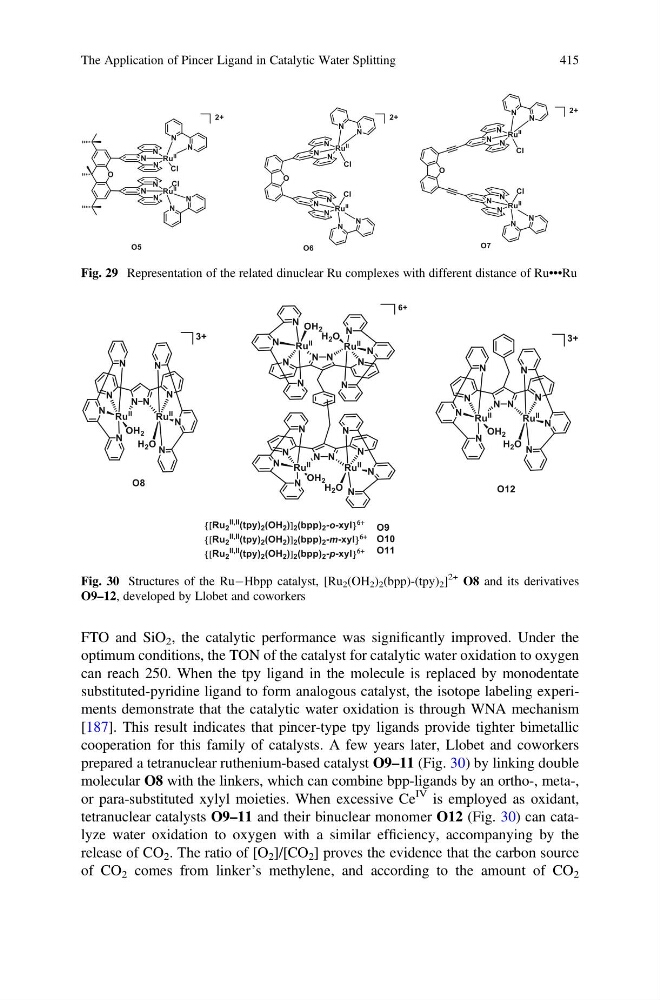
cooperation for this family of catalysts. A few years later, Llobet and coworkers
prepared a tetranuclear ruthenium-based catalyst O9–11 (Fig. 30) by linking double
molecular O8 with the linkers, which can combine bpp-ligands by an ortho-, meta-,
or para-substituted xylyl moieties. When excessive Ce
IV is employed as oxidant,
tetranuclear catalysts O9–11 and their binuclear monomer O12 (Fig. 30) can catalyze water oxidation to oxygen with a similar efficiency, accompanying by the
release of CO 2 . The ratio of [O 2 ]/[CO 2 ] proves the evidence that the carbon source
of CO 2 comes from linker’s methylene, and according to the amount of CO 2
Fig. 29 Representation of the related dinuclear Ru complexes with different distance of Ru•••Ru
Fig. 30 Structures of the RuÀHbpp catalyst, [Ru 2 (OH 2 ) 2 (bpp)-(tpy) 2 ]
2+ O8 and its derivatives
O9–12, developed by Llobet and coworkers
The Application of Pincer Ligand in Catalytic Water Splitting
415
optimum conditions, the TON of the catalyst for catalytic water oxidation to oxygen
can reach 250. When the tpy ligand in the molecule is replaced by monodentate
substituted-pyridine ligand to form analogous catalyst, the isotope labeling experiments demonstrate that the catalytic water oxidation is through WNA mechanism
[187]. This result indicates that pincer-type tpy ligands provide tighter bimetallic
cooperation for this family of catalysts. A few years later, Llobet and coworkers
prepared a tetranuclear ruthenium-based catalyst O9–11 (Fig. 30) by linking double
molecular O8 with the linkers, which can combine bpp-ligands by an ortho-, meta-,
or para-substituted xylyl moieties. When excessive Ce
IV is employed as oxidant,
tetranuclear catalysts O9–11 and their binuclear monomer O12 (Fig. 30) can catalyze water oxidation to oxygen with a similar efficiency, accompanying by the
release of CO 2 . The ratio of [O 2 ]/[CO 2 ] proves the evidence that the carbon source
of CO 2 comes from linker’s methylene, and according to the amount of CO 2
Fig. 29 Representation of the related dinuclear Ru complexes with different distance of Ru•••Ru
Fig. 30 Structures of the RuÀHbpp catalyst, [Ru 2 (OH 2 ) 2 (bpp)-(tpy) 2 ]
2+ O8 and its derivatives
O9–12, developed by Llobet and coworkers
The Application of Pincer Ligand in Catalytic Water Splitting
415