

surface of ITO electrode, and strong catalytic current can be observed at 1.7 V by
electrochemical measurement. TON of catalytic water oxidation to oxygen was as
high as 33,500 [173]. It was because of such excellent catalytic ability that
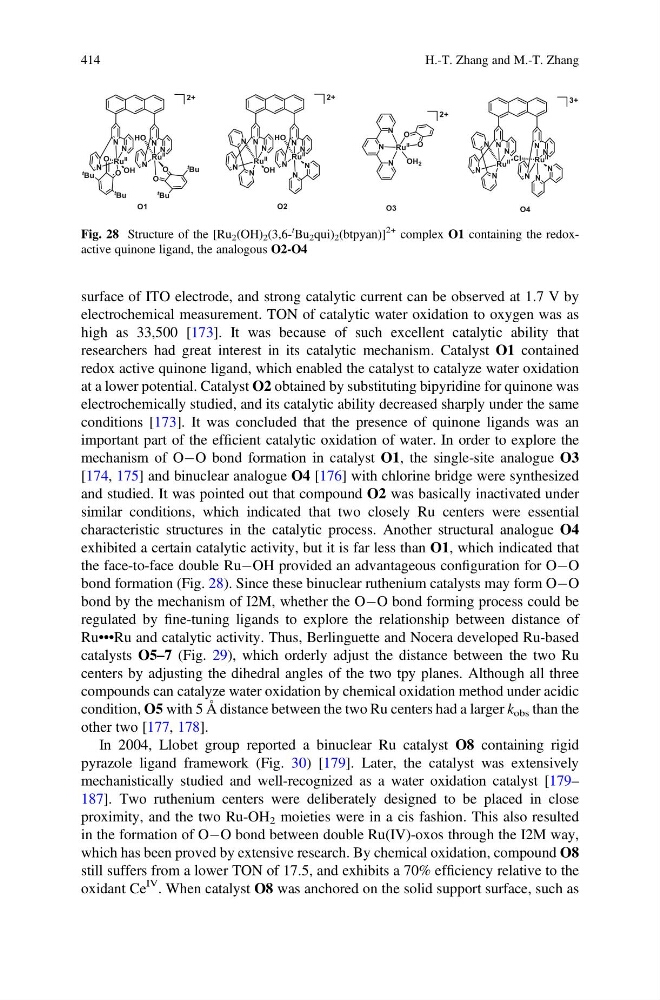
researchers had great interest in its catalytic mechanism. Catalyst O1 contained
redox active quinone ligand, which enabled the catalyst to catalyze water oxidation
at a lower potential. Catalyst O2 obtained by substituting bipyridine for quinone was
electrochemically studied, and its catalytic ability decreased sharply under the same
conditions [173]. It was concluded that the presence of quinone ligands was an
important part of the efficient catalytic oxidation of water. In order to explore the
mechanism of OÀO bond formation in catalyst O1, the single-site analogue O3
[174, 175] and binuclear analogue O4 [176] with chlorine bridge were synthesized
and studied. It was pointed out that compound O2 was basically inactivated under
similar conditions, which indicated that two closely Ru centers were essential
characteristic structures in the catalytic process. Another structural analogue O4
exhibited a certain catalytic activity, but it is far less than O1, which indicated that
the face-to-face double RuÀOH provided an advantageous configuration for OÀO
bond formation (Fig. 28). Since these binuclear ruthenium catalysts may form OÀO
bond by the mechanism of I2M, whether the OÀO bond forming process could be
regulated by fine-tuning ligands to explore the relationship between distance of
Ru•••Ru and catalytic activity. Thus, Berlinguette and Nocera developed Ru-based
catalysts O5–7 (Fig. 29), which orderly adjust the distance between the two Ru
centers by adjusting the dihedral angles of the two tpy planes. Although all three
compounds can catalyze water oxidation by chemical oxidation method under acidic
condition, O5 with 5 Å distance between the two Ru centers had a larger k obs than the
other two [177, 178].
In 2004, Llobet group reported a binuclear Ru catalyst O8 containing rigid
pyrazole ligand framework (Fig. 30) [179]. Later, the catalyst was extensively
mechanistically studied and well-recognized as a water oxidation catalyst [179–
187]. Two ruthenium centers were deliberately designed to be placed in close
proximity, and the two Ru-OH 2 moieties were in a cis fashion. This also resulted
in the formation of OÀO bond between double Ru(IV)-oxos through the I2M way,
which has been proved by extensive research. By chemical oxidation, compound O8
still suffers from a lower TON of 17.5, and exhibits a 70% efficiency relative to the
oxidant Ce
IV . When catalyst O8 was anchored on the solid support surface, such as
Fig. 28 Structure of the [Ru 2 (OH) 2 (3,6t Bu 2 qui) 2 (btpyan)]
2+ complex O1 containing the redoxactive quinone ligand, the analogous O2-O4
414
H.-T. Zhang and M.-T. Zhang
electrochemical measurement. TON of catalytic water oxidation to oxygen was as
high as 33,500 [173]. It was because of such excellent catalytic ability that
researchers had great interest in its catalytic mechanism. Catalyst O1 contained
redox active quinone ligand, which enabled the catalyst to catalyze water oxidation
at a lower potential. Catalyst O2 obtained by substituting bipyridine for quinone was
electrochemically studied, and its catalytic ability decreased sharply under the same
conditions [173]. It was concluded that the presence of quinone ligands was an
important part of the efficient catalytic oxidation of water. In order to explore the
mechanism of OÀO bond formation in catalyst O1, the single-site analogue O3
[174, 175] and binuclear analogue O4 [176] with chlorine bridge were synthesized
and studied. It was pointed out that compound O2 was basically inactivated under
similar conditions, which indicated that two closely Ru centers were essential
characteristic structures in the catalytic process. Another structural analogue O4
exhibited a certain catalytic activity, but it is far less than O1, which indicated that
the face-to-face double RuÀOH provided an advantageous configuration for OÀO
bond formation (Fig. 28). Since these binuclear ruthenium catalysts may form OÀO
bond by the mechanism of I2M, whether the OÀO bond forming process could be
regulated by fine-tuning ligands to explore the relationship between distance of
Ru•••Ru and catalytic activity. Thus, Berlinguette and Nocera developed Ru-based
catalysts O5–7 (Fig. 29), which orderly adjust the distance between the two Ru
centers by adjusting the dihedral angles of the two tpy planes. Although all three
compounds can catalyze water oxidation by chemical oxidation method under acidic
condition, O5 with 5 Å distance between the two Ru centers had a larger k obs than the
other two [177, 178].
In 2004, Llobet group reported a binuclear Ru catalyst O8 containing rigid
pyrazole ligand framework (Fig. 30) [179]. Later, the catalyst was extensively
mechanistically studied and well-recognized as a water oxidation catalyst [179–
187]. Two ruthenium centers were deliberately designed to be placed in close
proximity, and the two Ru-OH 2 moieties were in a cis fashion. This also resulted
in the formation of OÀO bond between double Ru(IV)-oxos through the I2M way,
which has been proved by extensive research. By chemical oxidation, compound O8
still suffers from a lower TON of 17.5, and exhibits a 70% efficiency relative to the
oxidant Ce
IV . When catalyst O8 was anchored on the solid support surface, such as
Fig. 28 Structure of the [Ru 2 (OH) 2 (3,6t Bu 2 qui) 2 (btpyan)]
2+ complex O1 containing the redoxactive quinone ligand, the analogous O2-O4
414
H.-T. Zhang and M.-T. Zhang