

Although many mononuclear ruthenium catalysts were initially developed, the
mechanism was proposed by Meyer and his coworkers until 2008 [192]. When
chloride in inactivated compounds O25–26 was replaced by water molecules,
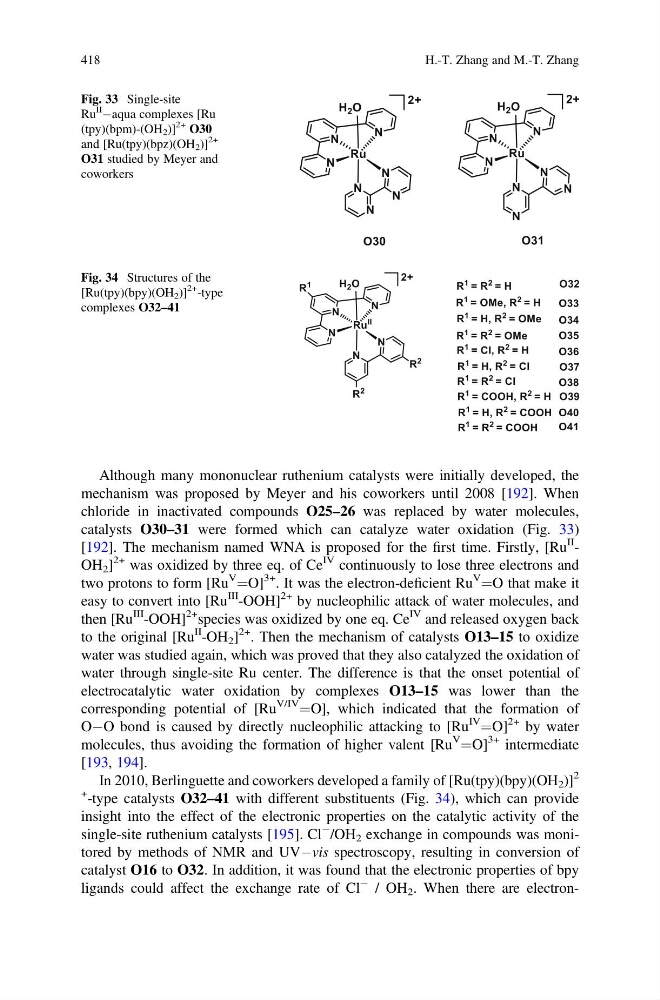
catalysts O30–31 were formed which can catalyze water oxidation (Fig. 33)
[192]. The mechanism named WNA is proposed for the first time. Firstly, [Ru
II -
OH 2 ]
2+ was oxidized by three eq. of Ce
IV continuously to lose three electrons and
two protons to form [Ru
V
¼O]
3+ . It was the electron-deficient Ru
V
¼O that make it
easy to convert into [Ru
III
-OOH]
2+ by nucleophilic attack of water molecules, and
then [Ru
III
-OOH]
2+ species was oxidized by one eq. Ce
IV and released oxygen back
to the original [Ru
II -OH 2 ]
2+ . Then the mechanism of catalysts O13–15 to oxidize
water was studied again, which was proved that they also catalyzed the oxidation of
water through single-site Ru center. The difference is that the onset potential of
electrocatalytic water oxidation by complexes O13–15 was lower than the
corresponding potential of [Ru
V/IV
¼O], which indicated that the formation of
OÀO bond is caused by directly nucleophilic attacking to [Ru
IV
¼O]
2+ by water
molecules, thus avoiding the formation of higher valent [Ru
V
¼O]
3+ intermediate
[193, 194].
In 2010, Berlinguette and coworkers developed a family of [Ru(tpy)(bpy)(OH 2 )]
2
+
-type catalysts O32–41 with different substituents (Fig. 34), which can provide
insight into the effect of the electronic properties on the catalytic activity of the
single-site ruthenium catalysts [195]. Cl
À /OH 2 exchange in compounds was monitored by methods of NMR and UVÀvis spectroscopy, resulting in conversion of
catalyst O16 to O32. In addition, it was found that the electronic properties of bpy
ligands could affect the exchange rate of Cl
À / OH 2 . When there are electronFig. 33 Single-site
Ru
II Àaqua complexes [Ru
(tpy)(bpm)-(OH 2 )]
2+ O30
and [Ru(tpy)(bpz)(OH 2 )]
2+
O31 studied by Meyer and
coworkers
Fig. 34 Structures of the
[Ru(tpy)(bpy)(OH 2 )]
2+ -type
complexes O32–41
418
H.-T. Zhang and M.-T. Zhang
mechanism was proposed by Meyer and his coworkers until 2008 [192]. When
chloride in inactivated compounds O25–26 was replaced by water molecules,
catalysts O30–31 were formed which can catalyze water oxidation (Fig. 33)
[192]. The mechanism named WNA is proposed for the first time. Firstly, [Ru
II -
OH 2 ]
2+ was oxidized by three eq. of Ce
IV continuously to lose three electrons and
two protons to form [Ru
V
¼O]
3+ . It was the electron-deficient Ru
V
¼O that make it
easy to convert into [Ru
III
-OOH]
2+ by nucleophilic attack of water molecules, and
then [Ru
III
-OOH]
2+ species was oxidized by one eq. Ce
IV and released oxygen back
to the original [Ru
II -OH 2 ]
2+ . Then the mechanism of catalysts O13–15 to oxidize
water was studied again, which was proved that they also catalyzed the oxidation of
water through single-site Ru center. The difference is that the onset potential of
electrocatalytic water oxidation by complexes O13–15 was lower than the
corresponding potential of [Ru
V/IV
¼O], which indicated that the formation of
OÀO bond is caused by directly nucleophilic attacking to [Ru
IV
¼O]
2+ by water
molecules, thus avoiding the formation of higher valent [Ru
V
¼O]
3+ intermediate
[193, 194].
In 2010, Berlinguette and coworkers developed a family of [Ru(tpy)(bpy)(OH 2 )]
2
+
-type catalysts O32–41 with different substituents (Fig. 34), which can provide
insight into the effect of the electronic properties on the catalytic activity of the
single-site ruthenium catalysts [195]. Cl
À /OH 2 exchange in compounds was monitored by methods of NMR and UVÀvis spectroscopy, resulting in conversion of
catalyst O16 to O32. In addition, it was found that the electronic properties of bpy
ligands could affect the exchange rate of Cl
À / OH 2 . When there are electronFig. 33 Single-site
Ru
II Àaqua complexes [Ru
(tpy)(bpm)-(OH 2 )]
2+ O30
and [Ru(tpy)(bpz)(OH 2 )]
2+
O31 studied by Meyer and
coworkers
Fig. 34 Structures of the
[Ru(tpy)(bpy)(OH 2 )]
2+ -type
complexes O32–41
418
H.-T. Zhang and M.-T. Zhang