

species, Ni
II
ÀH species was further reduced by one electron to form Ni
I
ÀH species;
Finally, one proton was obtained to form and release hydrogen back to [(PNN)Ni]
2+ .
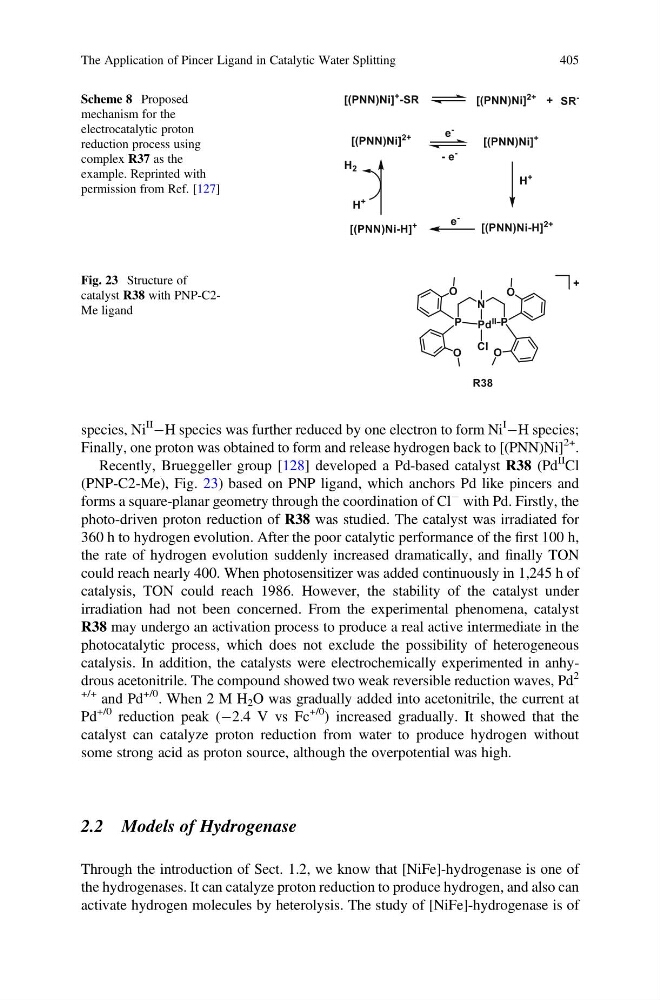
Recently, Brueggeller group [128] developed a Pd-based catalyst R38 (Pd
II Cl
(PNP-C2-Me), Fig. 23) based on PNP ligand, which anchors Pd like pincers and
forms a square-planar geometry through the coordination of Cl
À with Pd. Firstly, the
photo-driven proton reduction of R38 was studied. The catalyst was irradiated for
360 h to hydrogen evolution. After the poor catalytic performance of the first 100 h,
the rate of hydrogen evolution suddenly increased dramatically, and finally TON
could reach nearly 400. When photosensitizer was added continuously in 1,245 h of
catalysis, TON could reach 1986. However, the stability of the catalyst under
irradiation had not been concerned. From the experimental phenomena, catalyst
R38 may undergo an activation process to produce a real active intermediate in the
photocatalytic process, which does not exclude the possibility of heterogeneous
catalysis. In addition, the catalysts were electrochemically experimented in anhydrous acetonitrile. The compound showed two weak reversible reduction waves, Pd
2
+/+ and Pd
+/0 . When 2 M H 2 O was gradually added into acetonitrile, the current at
Pd
+/0 reduction peak (À2.4 V vs Fc
+/0 ) increased gradually. It showed that the
catalyst can catalyze proton reduction from water to produce hydrogen without
some strong acid as proton source, although the overpotential was high.
2.2 Models of Hydrogenase
Through the introduction of Sect. 1.2, we know that [NiFe]-hydrogenase is one of
the hydrogenases. It can catalyze proton reduction to produce hydrogen, and also can
activate hydrogen molecules by heterolysis. The study of [NiFe]-hydrogenase is of
Scheme 8 Proposed
mechanism for the
electrocatalytic proton
reduction process using
complex R37 as the
example. Reprinted with
permission from Ref. [127]
Fig. 23 Structure of
catalyst R38 with PNP-C2Me ligand
The Application of Pincer Ligand in Catalytic Water Splitting
405
II
ÀH species was further reduced by one electron to form Ni
I
ÀH species;
Finally, one proton was obtained to form and release hydrogen back to [(PNN)Ni]
2+ .
Recently, Brueggeller group [128] developed a Pd-based catalyst R38 (Pd
II Cl
(PNP-C2-Me), Fig. 23) based on PNP ligand, which anchors Pd like pincers and
forms a square-planar geometry through the coordination of Cl
À with Pd. Firstly, the
photo-driven proton reduction of R38 was studied. The catalyst was irradiated for
360 h to hydrogen evolution. After the poor catalytic performance of the first 100 h,
the rate of hydrogen evolution suddenly increased dramatically, and finally TON
could reach nearly 400. When photosensitizer was added continuously in 1,245 h of
catalysis, TON could reach 1986. However, the stability of the catalyst under
irradiation had not been concerned. From the experimental phenomena, catalyst
R38 may undergo an activation process to produce a real active intermediate in the
photocatalytic process, which does not exclude the possibility of heterogeneous
catalysis. In addition, the catalysts were electrochemically experimented in anhydrous acetonitrile. The compound showed two weak reversible reduction waves, Pd
2
+/+ and Pd
+/0 . When 2 M H 2 O was gradually added into acetonitrile, the current at
Pd
+/0 reduction peak (À2.4 V vs Fc
+/0 ) increased gradually. It showed that the
catalyst can catalyze proton reduction from water to produce hydrogen without
some strong acid as proton source, although the overpotential was high.
2.2 Models of Hydrogenase
Through the introduction of Sect. 1.2, we know that [NiFe]-hydrogenase is one of
the hydrogenases. It can catalyze proton reduction to produce hydrogen, and also can
activate hydrogen molecules by heterolysis. The study of [NiFe]-hydrogenase is of
Scheme 8 Proposed
mechanism for the
electrocatalytic proton
reduction process using
complex R37 as the
example. Reprinted with
permission from Ref. [127]
Fig. 23 Structure of
catalyst R38 with PNP-C2Me ligand
The Application of Pincer Ligand in Catalytic Water Splitting
405