

10 min. In addition, electron-rich sulfur ligands is unfavorable for the stability of
catalysts in the presence of oxygen, so these factors limited their potential application as hydrogen production catalysts.
The “Milstein catalysts” [104] mentioned above provide a valuable example for
the design and development of catalysts for water splitting, in which PNN pincer
ligand played an important role in the catalytic process. Based on this ligand, Fan
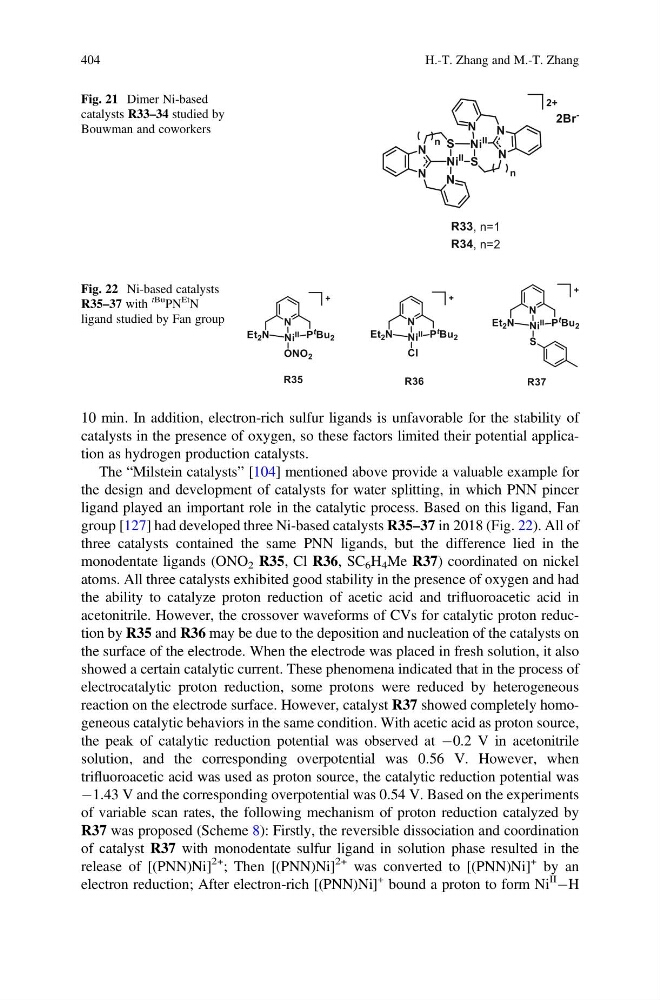
group [127] had developed three Ni-based catalysts R35–37 in 2018 (Fig. 22). All of
three catalysts contained the same PNN ligands, but the difference lied in the
monodentate ligands (ONO 2 R35, Cl R36, SC 6 H 4 Me R37) coordinated on nickel
atoms. All three catalysts exhibited good stability in the presence of oxygen and had
the ability to catalyze proton reduction of acetic acid and trifluoroacetic acid in
acetonitrile. However, the crossover waveforms of CVs for catalytic proton reduction by R35 and R36 may be due to the deposition and nucleation of the catalysts on
the surface of the electrode. When the electrode was placed in fresh solution, it also
showed a certain catalytic current. These phenomena indicated that in the process of
electrocatalytic proton reduction, some protons were reduced by heterogeneous
reaction on the electrode surface. However, catalyst R37 showed completely homogeneous catalytic behaviors in the same condition. With acetic acid as proton source,
the peak of catalytic reduction potential was observed at À0.2 V in acetonitrile
solution, and the corresponding overpotential was 0.56 V. However, when
trifluoroacetic acid was used as proton source, the catalytic reduction potential was
À1.43 V and the corresponding overpotential was 0.54 V. Based on the experiments
of variable scan rates, the following mechanism of proton reduction catalyzed by
R37 was proposed (Scheme 8): Firstly, the reversible dissociation and coordination
of catalyst R37 with monodentate sulfur ligand in solution phase resulted in the
release of [(PNN)Ni]
2+ ; Then [(PNN)Ni]
2+ was converted to [(PNN)Ni]
+ by an
electron reduction; After electron-rich [(PNN)Ni]
+ bound a proton to form Ni
II
ÀH
Fig. 21 Dimer Ni-based
catalysts R33–34 studied by
Bouwman and coworkers
Fig. 22 Ni-based catalysts
R35–37 with
tBu PN
Et N
ligand studied by Fan group
404
H.-T. Zhang and M.-T. Zhang
catalysts in the presence of oxygen, so these factors limited their potential application as hydrogen production catalysts.
The “Milstein catalysts” [104] mentioned above provide a valuable example for
the design and development of catalysts for water splitting, in which PNN pincer
ligand played an important role in the catalytic process. Based on this ligand, Fan
group [127] had developed three Ni-based catalysts R35–37 in 2018 (Fig. 22). All of
three catalysts contained the same PNN ligands, but the difference lied in the
monodentate ligands (ONO 2 R35, Cl R36, SC 6 H 4 Me R37) coordinated on nickel
atoms. All three catalysts exhibited good stability in the presence of oxygen and had
the ability to catalyze proton reduction of acetic acid and trifluoroacetic acid in
acetonitrile. However, the crossover waveforms of CVs for catalytic proton reduction by R35 and R36 may be due to the deposition and nucleation of the catalysts on
the surface of the electrode. When the electrode was placed in fresh solution, it also
showed a certain catalytic current. These phenomena indicated that in the process of
electrocatalytic proton reduction, some protons were reduced by heterogeneous
reaction on the electrode surface. However, catalyst R37 showed completely homogeneous catalytic behaviors in the same condition. With acetic acid as proton source,
the peak of catalytic reduction potential was observed at À0.2 V in acetonitrile
solution, and the corresponding overpotential was 0.56 V. However, when
trifluoroacetic acid was used as proton source, the catalytic reduction potential was
À1.43 V and the corresponding overpotential was 0.54 V. Based on the experiments
of variable scan rates, the following mechanism of proton reduction catalyzed by
R37 was proposed (Scheme 8): Firstly, the reversible dissociation and coordination
of catalyst R37 with monodentate sulfur ligand in solution phase resulted in the
release of [(PNN)Ni]
2+ ; Then [(PNN)Ni]
2+ was converted to [(PNN)Ni]
+ by an
electron reduction; After electron-rich [(PNN)Ni]
+ bound a proton to form Ni
II
ÀH
Fig. 21 Dimer Ni-based
catalysts R33–34 studied by
Bouwman and coworkers
Fig. 22 Ni-based catalysts
R35–37 with
tBu PN
Et N
ligand studied by Fan group
404
H.-T. Zhang and M.-T. Zhang