

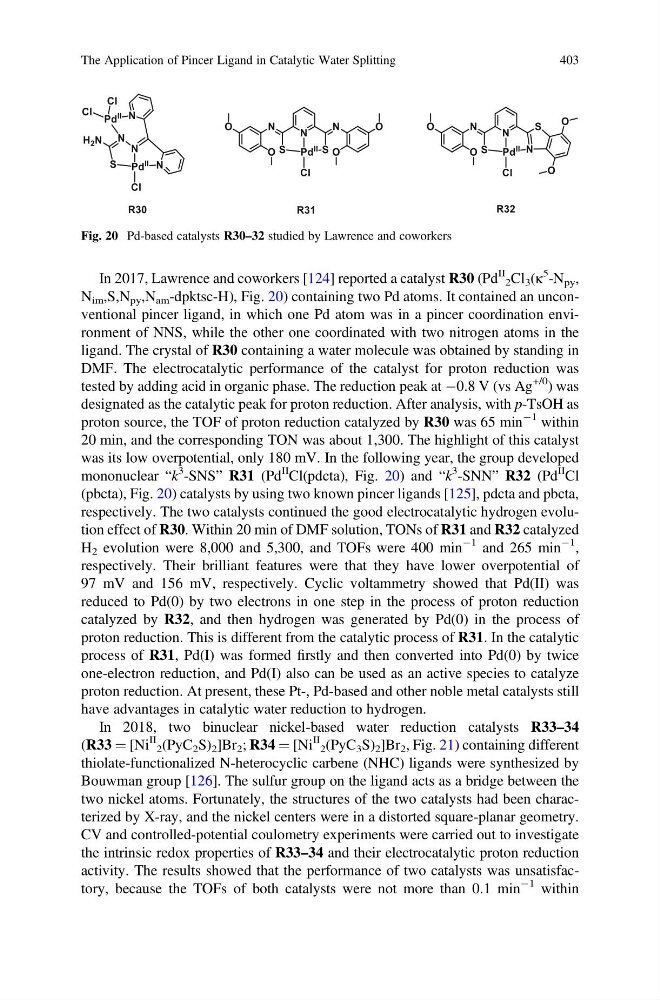
In 2017, Lawrence and coworkers [124] reported a catalyst R30 (Pd
II
2 Cl 3 (κ
5 -N py ,
N im ,S,N py ,N am -dpktsc-H), Fig. 20) containing two Pd atoms. It contained an unconventional pincer ligand, in which one Pd atom was in a pincer coordination environment of NNS, while the other one coordinated with two nitrogen atoms in the
ligand. The crystal of R30 containing a water molecule was obtained by standing in
DMF. The electrocatalytic performance of the catalyst for proton reduction was
tested by adding acid in organic phase. The reduction peak at À0.8 V (vs Ag
+/0 ) was
designated as the catalytic peak for proton reduction. After analysis, with p-TsOH as
proton source, the TOF of proton reduction catalyzed by R30 was 65 min
À1 within
20 min, and the corresponding TON was about 1,300. The highlight of this catalyst
was its low overpotential, only 180 mV. In the following year, the group developed
mononuclear “k
3 -SNS” R31 (Pd
II Cl(pdcta), Fig. 20) and “k
3 -SNN” R32 (Pd
II Cl
(pbcta), Fig. 20) catalysts by using two known pincer ligands [125], pdcta and pbcta,
respectively. The two catalysts continued the good electrocatalytic hydrogen evolution effect of R30. Within 20 min of DMF solution, TONs of R31 and R32 catalyzed
H 2 evolution were 8,000 and 5,300, and TOFs were 400 min
À1 and 265 min
À1 ,
respectively. Their brilliant features were that they have lower overpotential of
97 mV and 156 mV, respectively. Cyclic voltammetry showed that Pd(II) was
reduced to Pd(0) by two electrons in one step in the process of proton reduction
catalyzed by R32, and then hydrogen was generated by Pd(0) in the process of
proton reduction. This is different from the catalytic process of R31. In the catalytic
process of R31, Pd(I) was formed firstly and then converted into Pd(0) by twice
one-electron reduction, and Pd(I) also can be used as an active species to catalyze
proton reduction. At present, these Pt-, Pd-based and other noble metal catalysts still
have advantages in catalytic water reduction to hydrogen.
In 2018, two binuclear nickel-based water reduction catalysts R33–34
(R33 ¼ [Ni
II
2 (PyC 2 S) 2 ]Br 2 ; R34 ¼ [Ni
II
2 (PyC 3 S) 2 ]Br 2 , Fig. 21) containing different
thiolate-functionalized N-heterocyclic carbene (NHC) ligands were synthesized by
Bouwman group [126]. The sulfur group on the ligand acts as a bridge between the
two nickel atoms. Fortunately, the structures of the two catalysts had been characterized by X-ray, and the nickel centers were in a distorted square-planar geometry.
CV and controlled-potential coulometry experiments were carried out to investigate
the intrinsic redox properties of R33–34 and their electrocatalytic proton reduction
activity. The results showed that the performance of two catalysts was unsatisfactory, because the TOFs of both catalysts were not more than 0.1 min
À1 within
Fig. 20 Pd-based catalysts R30–32 studied by Lawrence and coworkers
The Application of Pincer Ligand in Catalytic Water Splitting
403
II
2 Cl 3 (κ
5 -N py ,
N im ,S,N py ,N am -dpktsc-H), Fig. 20) containing two Pd atoms. It contained an unconventional pincer ligand, in which one Pd atom was in a pincer coordination environment of NNS, while the other one coordinated with two nitrogen atoms in the
ligand. The crystal of R30 containing a water molecule was obtained by standing in
DMF. The electrocatalytic performance of the catalyst for proton reduction was
tested by adding acid in organic phase. The reduction peak at À0.8 V (vs Ag
+/0 ) was
designated as the catalytic peak for proton reduction. After analysis, with p-TsOH as
proton source, the TOF of proton reduction catalyzed by R30 was 65 min
À1 within
20 min, and the corresponding TON was about 1,300. The highlight of this catalyst
was its low overpotential, only 180 mV. In the following year, the group developed
mononuclear “k
3 -SNS” R31 (Pd
II Cl(pdcta), Fig. 20) and “k
3 -SNN” R32 (Pd
II Cl
(pbcta), Fig. 20) catalysts by using two known pincer ligands [125], pdcta and pbcta,
respectively. The two catalysts continued the good electrocatalytic hydrogen evolution effect of R30. Within 20 min of DMF solution, TONs of R31 and R32 catalyzed
H 2 evolution were 8,000 and 5,300, and TOFs were 400 min
À1 and 265 min
À1 ,
respectively. Their brilliant features were that they have lower overpotential of
97 mV and 156 mV, respectively. Cyclic voltammetry showed that Pd(II) was
reduced to Pd(0) by two electrons in one step in the process of proton reduction
catalyzed by R32, and then hydrogen was generated by Pd(0) in the process of
proton reduction. This is different from the catalytic process of R31. In the catalytic
process of R31, Pd(I) was formed firstly and then converted into Pd(0) by twice
one-electron reduction, and Pd(I) also can be used as an active species to catalyze
proton reduction. At present, these Pt-, Pd-based and other noble metal catalysts still
have advantages in catalytic water reduction to hydrogen.
In 2018, two binuclear nickel-based water reduction catalysts R33–34
(R33 ¼ [Ni
II
2 (PyC 2 S) 2 ]Br 2 ; R34 ¼ [Ni
II
2 (PyC 3 S) 2 ]Br 2 , Fig. 21) containing different
thiolate-functionalized N-heterocyclic carbene (NHC) ligands were synthesized by
Bouwman group [126]. The sulfur group on the ligand acts as a bridge between the
two nickel atoms. Fortunately, the structures of the two catalysts had been characterized by X-ray, and the nickel centers were in a distorted square-planar geometry.
CV and controlled-potential coulometry experiments were carried out to investigate
the intrinsic redox properties of R33–34 and their electrocatalytic proton reduction
activity. The results showed that the performance of two catalysts was unsatisfactory, because the TOFs of both catalysts were not more than 0.1 min
À1 within
Fig. 20 Pd-based catalysts R30–32 studied by Lawrence and coworkers
The Application of Pincer Ligand in Catalytic Water Splitting
403