

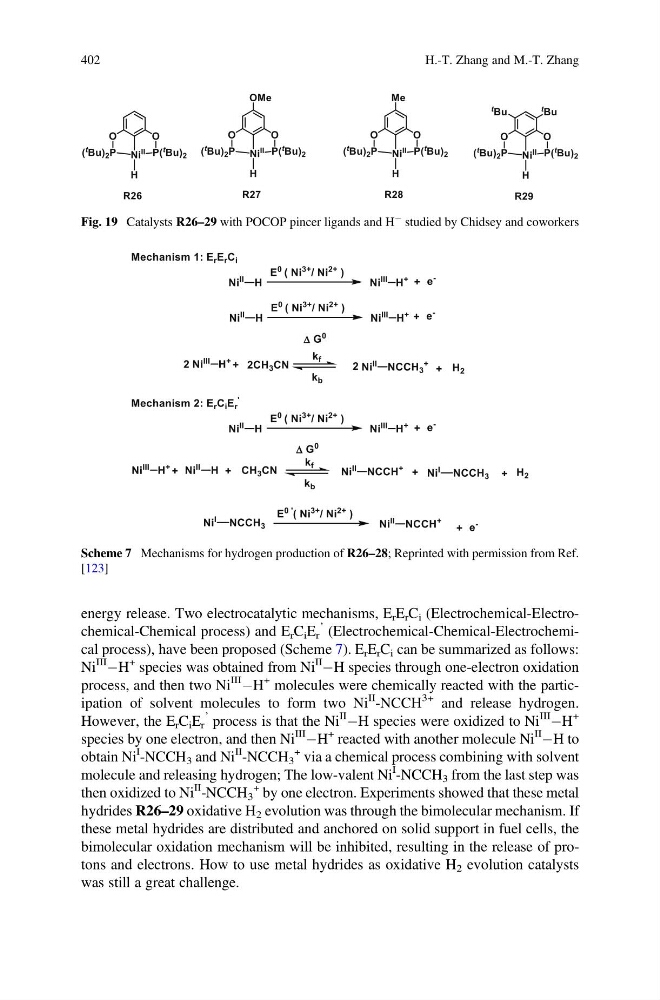
energy release. Two electrocatalytic mechanisms, E r E r C i (Electrochemical-Electrochemical-Chemical process) and E r C i E r
’ (Electrochemical-Chemical-Electrochemical process), have been proposed (Scheme 7). E r E r C i can be summarized as follows:
Ni
III
ÀH
+ species was obtained from Ni
II
ÀH species through one-electron oxidation
process, and then two Ni
III
ÀH
+ molecules were chemically reacted with the participation of solvent molecules to form two Ni
II -NCCH
3+ and release hydrogen.
However, the E r C i E r
’ process is that the Ni
II
ÀH species were oxidized to Ni
III
ÀH
+
species by one electron, and then Ni
III ÀH
+ reacted with another molecule Ni
II ÀH to
obtain Ni
I -NCCH 3 and Ni
II -NCCH 3
+ via a chemical process combining with solvent
molecule and releasing hydrogen; The low-valent Ni
I -NCCH 3 from the last step was
then oxidized to Ni
II -NCCH 3
+ by one electron. Experiments showed that these metal
hydrides R26–29 oxidative H 2 evolution was through the bimolecular mechanism. If
these metal hydrides are distributed and anchored on solid support in fuel cells, the
bimolecular oxidation mechanism will be inhibited, resulting in the release of protons and electrons. How to use metal hydrides as oxidative H 2 evolution catalysts
was still a great challenge.
Fig. 19 Catalysts R26–29 with POCOP pincer ligands and H
À studied by Chidsey and coworkers
Scheme 7 Mechanisms for hydrogen production of R26–28; Reprinted with permission from Ref.
[123]
402
H.-T. Zhang and M.-T. Zhang
’ (Electrochemical-Chemical-Electrochemical process), have been proposed (Scheme 7). E r E r C i can be summarized as follows:
Ni
III
ÀH
+ species was obtained from Ni
II
ÀH species through one-electron oxidation
process, and then two Ni
III
ÀH
+ molecules were chemically reacted with the participation of solvent molecules to form two Ni
II -NCCH
3+ and release hydrogen.
However, the E r C i E r
’ process is that the Ni
II
ÀH species were oxidized to Ni
III
ÀH
+
species by one electron, and then Ni
III ÀH
+ reacted with another molecule Ni
II ÀH to
obtain Ni
I -NCCH 3 and Ni
II -NCCH 3
+ via a chemical process combining with solvent
molecule and releasing hydrogen; The low-valent Ni
I -NCCH 3 from the last step was
then oxidized to Ni
II -NCCH 3
+ by one electron. Experiments showed that these metal
hydrides R26–29 oxidative H 2 evolution was through the bimolecular mechanism. If
these metal hydrides are distributed and anchored on solid support in fuel cells, the
bimolecular oxidation mechanism will be inhibited, resulting in the release of protons and electrons. How to use metal hydrides as oxidative H 2 evolution catalysts
was still a great challenge.
Fig. 19 Catalysts R26–29 with POCOP pincer ligands and H
À studied by Chidsey and coworkers
Scheme 7 Mechanisms for hydrogen production of R26–28; Reprinted with permission from Ref.
[123]
402
H.-T. Zhang and M.-T. Zhang