

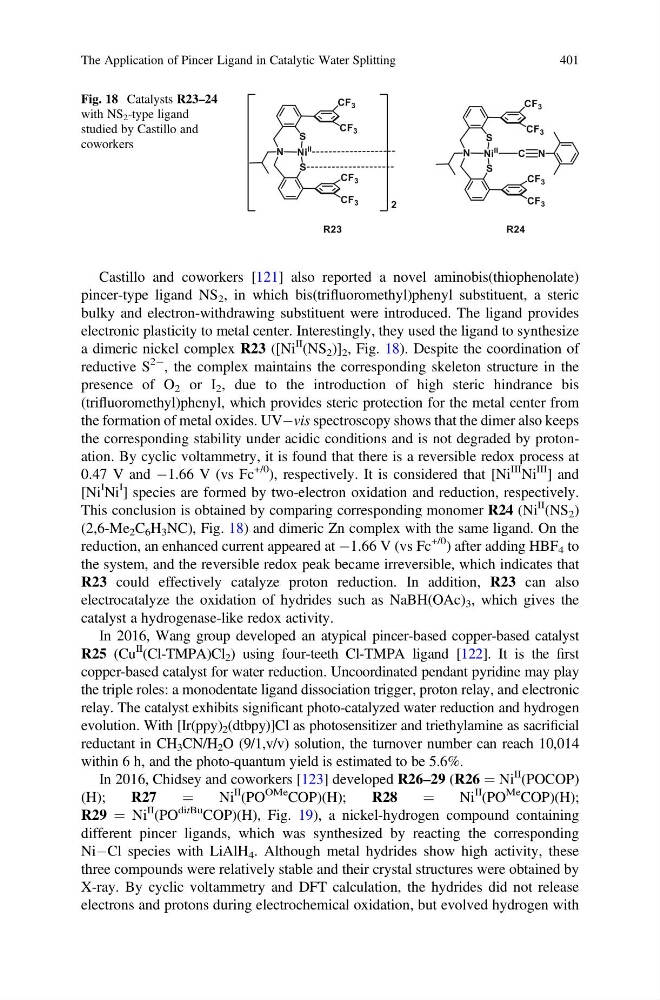
Castillo and coworkers [121] also reported a novel aminobis(thiophenolate)
pincer-type ligand NS 2 , in which bis(trifluoromethyl)phenyl substituent, a steric
bulky and electron-withdrawing substituent were introduced. The ligand provides
electronic plasticity to metal center. Interestingly, they used the ligand to synthesize
a dimeric nickel complex R23 ([Ni
II (NS 2 )] 2 , Fig. 18). Despite the coordination of
reductive S
2À , the complex maintains the corresponding skeleton structure in the
presence of O 2 or I 2 , due to the introduction of high steric hindrance bis
(trifluoromethyl)phenyl, which provides steric protection for the metal center from
the formation of metal oxides. UVÀvis spectroscopy shows that the dimer also keeps
the corresponding stability under acidic conditions and is not degraded by protonation. By cyclic voltammetry, it is found that there is a reversible redox process at
0.47 V and À1.66 V (vs Fc
+/0 ), respectively. It is considered that [Ni
III Ni
III ] and
[Ni
I Ni
I ] species are formed by two-electron oxidation and reduction, respectively.
This conclusion is obtained by comparing corresponding monomer R24 (Ni
II (NS 2 )
(2,6-Me 2 C 6 H 3 NC), Fig. 18) and dimeric Zn complex with the same ligand. On the
reduction, an enhanced current appeared at À1.66 V (vs Fc
+/0 ) after adding HBF 4 to
the system, and the reversible redox peak became irreversible, which indicates that
R23 could effectively catalyze proton reduction. In addition, R23 can also
electrocatalyze the oxidation of hydrides such as NaBH(OAc) 3 , which gives the
catalyst a hydrogenase-like redox activity.
In 2016, Wang group developed an atypical pincer-based copper-based catalyst
R25 (Cu
II
(Cl-TMPA)Cl 2 ) using four-teeth Cl-TMPA ligand [122]. It is the first
copper-based catalyst for water reduction. Uncoordinated pendant pyridine may play
the triple roles: a monodentate ligand dissociation trigger, proton relay, and electronic
relay. The catalyst exhibits significant photo-catalyzed water reduction and hydrogen
evolution. With [Ir(ppy) 2 (dtbpy)]Cl as photosensitizer and triethylamine as sacrificial
reductant in CH 3 CN/H 2 O (9/1,v/v) solution, the turnover number can reach 10,014
within 6 h, and the photo-quantum yield is estimated to be 5.6%.
In 2016, Chidsey and coworkers [123] developed R26–29 (R26 ¼ Ni
II (POCOP)
(H);
R27
¼
Ni
II (PO
OMe COP)(H);
R28
¼
Ni
II (PO
Me COP)(H);
R29 ¼ Ni
II (PO
ditBu COP)(H), Fig. 19), a nickel-hydrogen compound containing
different pincer ligands, which was synthesized by reacting the corresponding
NiÀCl species with LiAlH 4 . Although metal hydrides show high activity, these
three compounds were relatively stable and their crystal structures were obtained by
X-ray. By cyclic voltammetry and DFT calculation, the hydrides did not release
electrons and protons during electrochemical oxidation, but evolved hydrogen with
Fig. 18 Catalysts R23–24
with NS 2 -type ligand
studied by Castillo and
coworkers
The Application of Pincer Ligand in Catalytic Water Splitting
401
pincer-type ligand NS 2 , in which bis(trifluoromethyl)phenyl substituent, a steric
bulky and electron-withdrawing substituent were introduced. The ligand provides
electronic plasticity to metal center. Interestingly, they used the ligand to synthesize
a dimeric nickel complex R23 ([Ni
II (NS 2 )] 2 , Fig. 18). Despite the coordination of
reductive S
2À , the complex maintains the corresponding skeleton structure in the
presence of O 2 or I 2 , due to the introduction of high steric hindrance bis
(trifluoromethyl)phenyl, which provides steric protection for the metal center from
the formation of metal oxides. UVÀvis spectroscopy shows that the dimer also keeps
the corresponding stability under acidic conditions and is not degraded by protonation. By cyclic voltammetry, it is found that there is a reversible redox process at
0.47 V and À1.66 V (vs Fc
+/0 ), respectively. It is considered that [Ni
III Ni
III ] and
[Ni
I Ni
I ] species are formed by two-electron oxidation and reduction, respectively.
This conclusion is obtained by comparing corresponding monomer R24 (Ni
II (NS 2 )
(2,6-Me 2 C 6 H 3 NC), Fig. 18) and dimeric Zn complex with the same ligand. On the
reduction, an enhanced current appeared at À1.66 V (vs Fc
+/0 ) after adding HBF 4 to
the system, and the reversible redox peak became irreversible, which indicates that
R23 could effectively catalyze proton reduction. In addition, R23 can also
electrocatalyze the oxidation of hydrides such as NaBH(OAc) 3 , which gives the
catalyst a hydrogenase-like redox activity.
In 2016, Wang group developed an atypical pincer-based copper-based catalyst
R25 (Cu
II
(Cl-TMPA)Cl 2 ) using four-teeth Cl-TMPA ligand [122]. It is the first
copper-based catalyst for water reduction. Uncoordinated pendant pyridine may play
the triple roles: a monodentate ligand dissociation trigger, proton relay, and electronic
relay. The catalyst exhibits significant photo-catalyzed water reduction and hydrogen
evolution. With [Ir(ppy) 2 (dtbpy)]Cl as photosensitizer and triethylamine as sacrificial
reductant in CH 3 CN/H 2 O (9/1,v/v) solution, the turnover number can reach 10,014
within 6 h, and the photo-quantum yield is estimated to be 5.6%.
In 2016, Chidsey and coworkers [123] developed R26–29 (R26 ¼ Ni
II (POCOP)
(H);
R27
¼
Ni
II (PO
OMe COP)(H);
R28
¼
Ni
II (PO
Me COP)(H);
R29 ¼ Ni
II (PO
ditBu COP)(H), Fig. 19), a nickel-hydrogen compound containing
different pincer ligands, which was synthesized by reacting the corresponding
NiÀCl species with LiAlH 4 . Although metal hydrides show high activity, these
three compounds were relatively stable and their crystal structures were obtained by
X-ray. By cyclic voltammetry and DFT calculation, the hydrides did not release
electrons and protons during electrochemical oxidation, but evolved hydrogen with
Fig. 18 Catalysts R23–24
with NS 2 -type ligand
studied by Castillo and
coworkers
The Application of Pincer Ligand in Catalytic Water Splitting
401