

though the evidence is insufficient. The catalytic activity of the two catalysts for
water reduction was tested, and the dramatic difference between the two catalysts
was found under the same conditions. In KCl/HCl (pH ¼ 1), the turnover numbers of
controlled potential electrolysis R19–20 were 55 and 43 at À0.5 V (vs NHE),
respectively; In phosphate buffer (pH ¼ 4), the TON of R19 was three times than
R20 at À0.8 V (vs NHE); Interestingly, in neutral phosphate buffer, R20 exhibited
excellent catalytic performance 30 times higher than R19. No explanation was given
for this interesting experimental result. In terms of stability, only blank experiments
were carried out on electrolytic electrodes, while no detailed study was proceeded on
the real catalytic process.
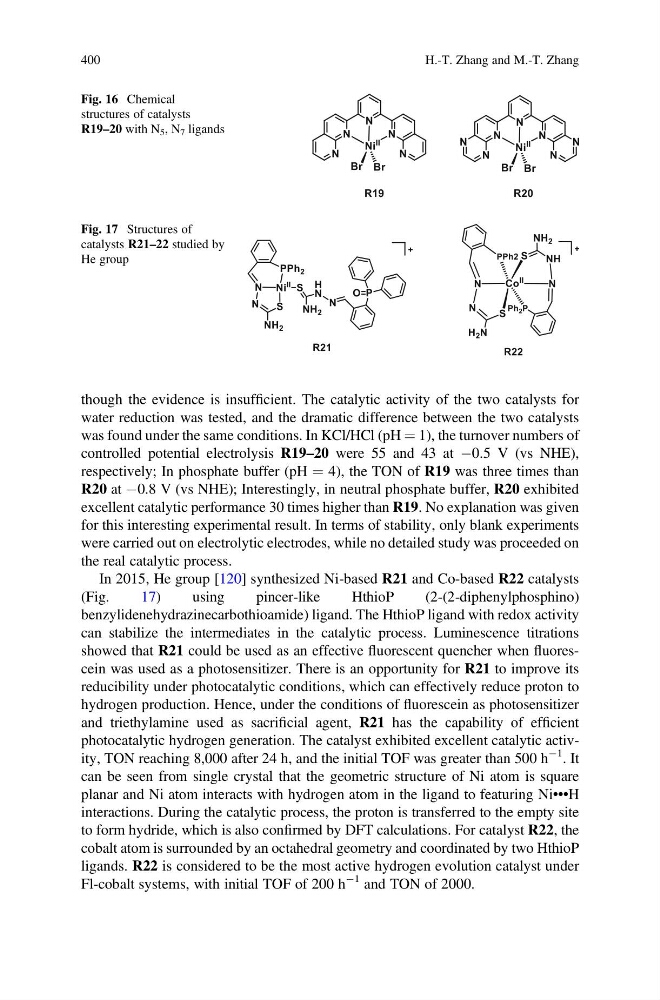
In 2015, He group [120] synthesized Ni-based R21 and Co-based R22 catalysts
(Fig.
17)
using
pincer-like
HthioP
(2-(2-diphenylphosphino)
benzylidenehydrazinecarbothioamide) ligand. The HthioP ligand with redox activity
can stabilize the intermediates in the catalytic process. Luminescence titrations
showed that R21 could be used as an effective fluorescent quencher when fluorescein was used as a photosensitizer. There is an opportunity for R21 to improve its
reducibility under photocatalytic conditions, which can effectively reduce proton to
hydrogen production. Hence, under the conditions of fluorescein as photosensitizer
and triethylamine used as sacrificial agent, R21 has the capability of efficient
photocatalytic hydrogen generation. The catalyst exhibited excellent catalytic activity, TON reaching 8,000 after 24 h, and the initial TOF was greater than 500 h
À1 . It
can be seen from single crystal that the geometric structure of Ni atom is square
planar and Ni atom interacts with hydrogen atom in the ligand to featuring Ni•••H
interactions. During the catalytic process, the proton is transferred to the empty site
to form hydride, which is also confirmed by DFT calculations. For catalyst R22, the
cobalt atom is surrounded by an octahedral geometry and coordinated by two HthioP
ligands. R22 is considered to be the most active hydrogen evolution catalyst under
Fl-cobalt systems, with initial TOF of 200 h
À1 and TON of 2000.
Fig. 16 Chemical
structures of catalysts
R19–20 with N 5 , N 7 ligands
Fig. 17 Structures of
catalysts R21–22 studied by
He group
400
H.-T. Zhang and M.-T. Zhang
water reduction was tested, and the dramatic difference between the two catalysts
was found under the same conditions. In KCl/HCl (pH ¼ 1), the turnover numbers of
controlled potential electrolysis R19–20 were 55 and 43 at À0.5 V (vs NHE),
respectively; In phosphate buffer (pH ¼ 4), the TON of R19 was three times than
R20 at À0.8 V (vs NHE); Interestingly, in neutral phosphate buffer, R20 exhibited
excellent catalytic performance 30 times higher than R19. No explanation was given
for this interesting experimental result. In terms of stability, only blank experiments
were carried out on electrolytic electrodes, while no detailed study was proceeded on
the real catalytic process.
In 2015, He group [120] synthesized Ni-based R21 and Co-based R22 catalysts
(Fig.
17)
using
pincer-like
HthioP
(2-(2-diphenylphosphino)
benzylidenehydrazinecarbothioamide) ligand. The HthioP ligand with redox activity
can stabilize the intermediates in the catalytic process. Luminescence titrations
showed that R21 could be used as an effective fluorescent quencher when fluorescein was used as a photosensitizer. There is an opportunity for R21 to improve its
reducibility under photocatalytic conditions, which can effectively reduce proton to
hydrogen production. Hence, under the conditions of fluorescein as photosensitizer
and triethylamine used as sacrificial agent, R21 has the capability of efficient
photocatalytic hydrogen generation. The catalyst exhibited excellent catalytic activity, TON reaching 8,000 after 24 h, and the initial TOF was greater than 500 h
À1 . It
can be seen from single crystal that the geometric structure of Ni atom is square
planar and Ni atom interacts with hydrogen atom in the ligand to featuring Ni•••H
interactions. During the catalytic process, the proton is transferred to the empty site
to form hydride, which is also confirmed by DFT calculations. For catalyst R22, the
cobalt atom is surrounded by an octahedral geometry and coordinated by two HthioP
ligands. R22 is considered to be the most active hydrogen evolution catalyst under
Fl-cobalt systems, with initial TOF of 200 h
À1 and TON of 2000.
Fig. 16 Chemical
structures of catalysts
R19–20 with N 5 , N 7 ligands
Fig. 17 Structures of
catalysts R21–22 studied by
He group
400
H.-T. Zhang and M.-T. Zhang