

pyridine, N 7 ¼ 2,6-di(1,5,8-triazanaphthalene-2-yl)pyridine) which were tpy derivatives. Based on these ligands, nickel-based catalysts R19–20 (R19 ¼ Ni
II (N 5 )Br 2 ,
R20 ¼ Ni
II (N 7 )Br 2 , Fig. 16) were synthesized for water reduction. By electrochemical comparison with Zn-based complexes containing same ligands, the potential of
Ni (II) to Ni (I) in R19–20 were À1.05 V and À0.51 V (vs NHE), respectively,
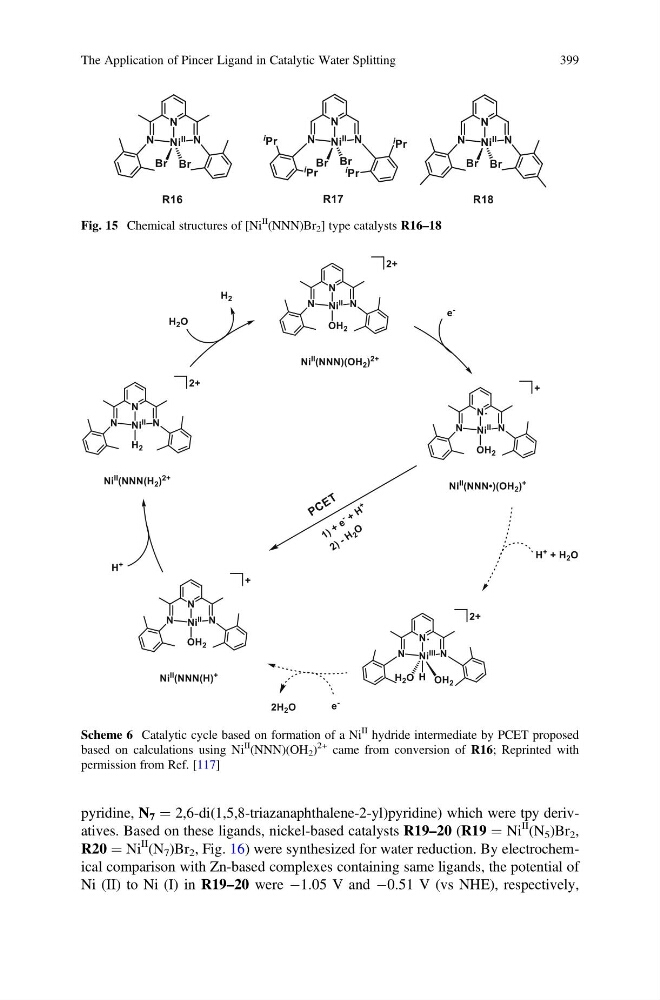
Fig. 15 Chemical structures of [Ni
II
(NNN)Br 2 ] type catalysts R16–18
Scheme 6 Catalytic cycle based on formation of a Ni
II hydride intermediate by PCET proposed
based on calculations using Ni
II
(NNN)(OH 2 )
2+ came from conversion of R16; Reprinted with
permission from Ref. [117]
The Application of Pincer Ligand in Catalytic Water Splitting
399
II (N 5 )Br 2 ,
R20 ¼ Ni
II (N 7 )Br 2 , Fig. 16) were synthesized for water reduction. By electrochemical comparison with Zn-based complexes containing same ligands, the potential of
Ni (II) to Ni (I) in R19–20 were À1.05 V and À0.51 V (vs NHE), respectively,
Fig. 15 Chemical structures of [Ni
II
(NNN)Br 2 ] type catalysts R16–18
Scheme 6 Catalytic cycle based on formation of a Ni
II hydride intermediate by PCET proposed
based on calculations using Ni
II
(NNN)(OH 2 )
2+ came from conversion of R16; Reprinted with
permission from Ref. [117]
The Application of Pincer Ligand in Catalytic Water Splitting
399