

back to Ni
II
(NNN)(OH 2 )
2+ (Scheme 6). The activation energy of the catalytic process
is greatly reduced by PCET, which makes an important contribution to the low
overpotential. A few years later, Groysman group [118] synthesized a series of
Ni-based catalysts similar to the R16 framework by ligand modification. R17–18
(R17 ¼ 2,6-(Ar
2
N¼CH) 2 C 5 H 3 N, Ar
2
¼ 2,6-diisopropyl phenyl; R18 ¼ 2,6(Ar
3
N¼CH) 2 C 5 H 3 N, Ar
3 ¼ 2,4,6-trimethyl phenyl, Fig. 15) were found as CO 2
catalysts in the catalytic process. The catalyst has high selectivity for reducing proton
hydrogen production. Through a continuous one-electron reduction reaction, they
were reduced to form an active intermediate which catalyzes the evolution of
hydrogen. For catalytic proton reduction, the catalysts have not been subjected to
subsequent studies.
Effective strategy for realizing multi-electron reactions of metal compounds by
incorporating redox active parts into ligand skeleton. In 2014, Crabtree group [119]
developed two novel redox-active ligands (N 5 ¼ 2,6-di(1,8-naphthyridin-2-yl)
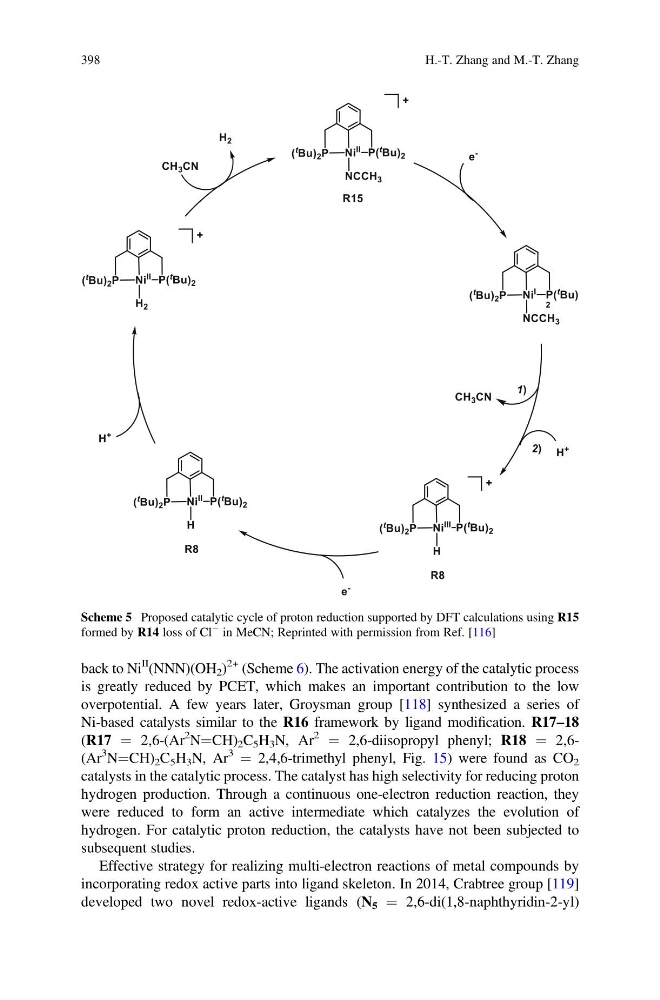
Scheme 5 Proposed catalytic cycle of proton reduction supported by DFT calculations using R15
formed by R14 loss of Cl
À in MeCN; Reprinted with permission from Ref. [116]
398
H.-T. Zhang and M.-T. Zhang
II
(NNN)(OH 2 )
2+ (Scheme 6). The activation energy of the catalytic process
is greatly reduced by PCET, which makes an important contribution to the low
overpotential. A few years later, Groysman group [118] synthesized a series of
Ni-based catalysts similar to the R16 framework by ligand modification. R17–18
(R17 ¼ 2,6-(Ar
2
N¼CH) 2 C 5 H 3 N, Ar
2
¼ 2,6-diisopropyl phenyl; R18 ¼ 2,6(Ar
3
N¼CH) 2 C 5 H 3 N, Ar
3 ¼ 2,4,6-trimethyl phenyl, Fig. 15) were found as CO 2
catalysts in the catalytic process. The catalyst has high selectivity for reducing proton
hydrogen production. Through a continuous one-electron reduction reaction, they
were reduced to form an active intermediate which catalyzes the evolution of
hydrogen. For catalytic proton reduction, the catalysts have not been subjected to
subsequent studies.
Effective strategy for realizing multi-electron reactions of metal compounds by
incorporating redox active parts into ligand skeleton. In 2014, Crabtree group [119]
developed two novel redox-active ligands (N 5 ¼ 2,6-di(1,8-naphthyridin-2-yl)
Scheme 5 Proposed catalytic cycle of proton reduction supported by DFT calculations using R15
formed by R14 loss of Cl
À in MeCN; Reprinted with permission from Ref. [116]
398
H.-T. Zhang and M.-T. Zhang