

Ru
II (NCCH 3 )]
0 is formed; The rate-limiting step is to capture a proton to form R12
by interaction with H 2 PO 4
À
; Further, a proton of another H 2 PO 4
À is captured and H 2
is released back to R11.
Non-noble metal nickel-based catalysts of hydrogen evolution have been widely
developed, such as the DuBois catalysts [54, 58, 115]. In 2012, Crabtree group [116]
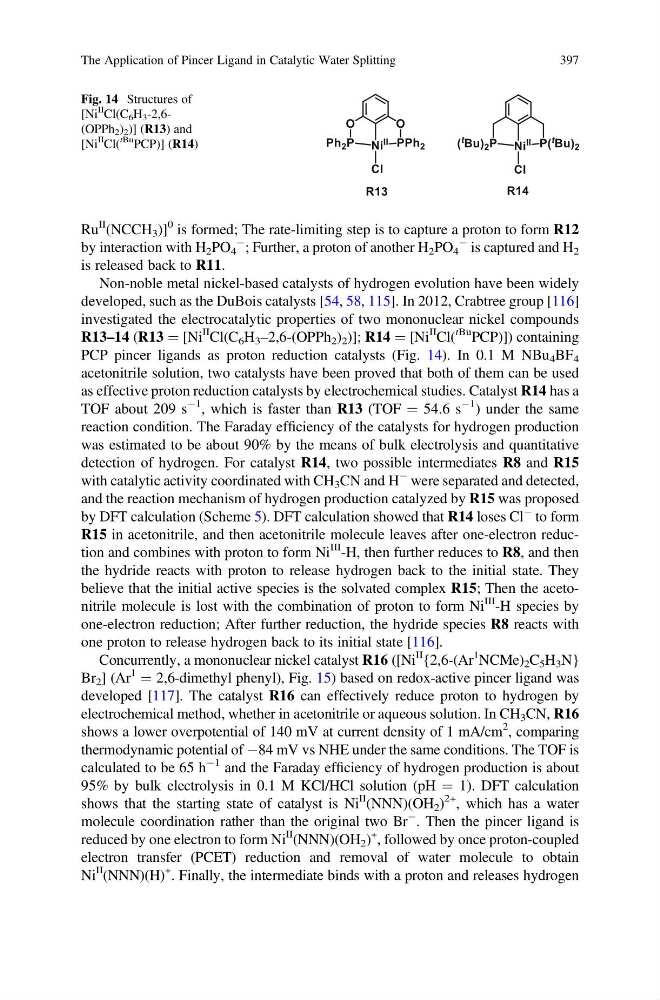
investigated the electrocatalytic properties of two mononuclear nickel compounds
R13–14 (R13 ¼ [Ni
II Cl(C 6 H 3 –2,6-(OPPh 2 ) 2 )]; R14 ¼ [Ni
II Cl(
tBu
PCP)]) containing
PCP pincer ligands as proton reduction catalysts (Fig. 14). In 0.1 M NBu 4 BF 4
acetonitrile solution, two catalysts have been proved that both of them can be used
as effective proton reduction catalysts by electrochemical studies. Catalyst R14 has a
TOF about 209 s
À1 , which is faster than R13 (TOF ¼ 54.6 s
À1
) under the same
reaction condition. The Faraday efficiency of the catalysts for hydrogen production
was estimated to be about 90% by the means of bulk electrolysis and quantitative
detection of hydrogen. For catalyst R14, two possible intermediates R8 and R15
with catalytic activity coordinated with CH 3 CN and H
À were separated and detected,
and the reaction mechanism of hydrogen production catalyzed by R15 was proposed
by DFT calculation (Scheme 5). DFT calculation showed that R14 loses Cl
À to form
R15 in acetonitrile, and then acetonitrile molecule leaves after one-electron reduction and combines with proton to form Ni
III -H, then further reduces to R8, and then
the hydride reacts with proton to release hydrogen back to the initial state. They
believe that the initial active species is the solvated complex R15; Then the acetonitrile molecule is lost with the combination of proton to form Ni
III -H species by
one-electron reduction; After further reduction, the hydride species R8 reacts with
one proton to release hydrogen back to its initial state [116].
Concurrently, a mononuclear nickel catalyst R16 ([Ni
II
{2,6-(Ar
1
NCMe) 2 C 5 H 3 N}
Br 2 ] (Ar
1
¼ 2,6-dimethyl phenyl), Fig. 15) based on redox-active pincer ligand was
developed [117]. The catalyst R16 can effectively reduce proton to hydrogen by
electrochemical method, whether in acetonitrile or aqueous solution. In CH 3 CN, R16
shows a lower overpotential of 140 mV at current density of 1 mA/cm
2
, comparing
thermodynamic potential of À84 mV vs NHE under the same conditions. The TOF is
calculated to be 65 h
À1 and the Faraday efficiency of hydrogen production is about
95% by bulk electrolysis in 0.1 M KCl/HCl solution (pH ¼ 1). DFT calculation
shows that the starting state of catalyst is Ni
II
(NNN)(OH 2 )
2+
, which has a water
molecule coordination rather than the original two Br
À . Then the pincer ligand is
reduced by one electron to form Ni
II
(NNN)(OH 2 )
+
, followed by once proton-coupled
electron transfer (PCET) reduction and removal of water molecule to obtain
Ni
II
(NNN)(H)
+
. Finally, the intermediate binds with a proton and releases hydrogen
Fig. 14 Structures of
[Ni
II
Cl(C 6 H 3 -2,6(OPPh 2 ) 2 )] (R13) and
[Ni
II
Cl(
tBu PCP)] (R14)
The Application of Pincer Ligand in Catalytic Water Splitting
397
II (NCCH 3 )]
0 is formed; The rate-limiting step is to capture a proton to form R12
by interaction with H 2 PO 4
À
; Further, a proton of another H 2 PO 4
À is captured and H 2
is released back to R11.
Non-noble metal nickel-based catalysts of hydrogen evolution have been widely
developed, such as the DuBois catalysts [54, 58, 115]. In 2012, Crabtree group [116]
investigated the electrocatalytic properties of two mononuclear nickel compounds
R13–14 (R13 ¼ [Ni
II Cl(C 6 H 3 –2,6-(OPPh 2 ) 2 )]; R14 ¼ [Ni
II Cl(
tBu
PCP)]) containing
PCP pincer ligands as proton reduction catalysts (Fig. 14). In 0.1 M NBu 4 BF 4
acetonitrile solution, two catalysts have been proved that both of them can be used
as effective proton reduction catalysts by electrochemical studies. Catalyst R14 has a
TOF about 209 s
À1 , which is faster than R13 (TOF ¼ 54.6 s
À1
) under the same
reaction condition. The Faraday efficiency of the catalysts for hydrogen production
was estimated to be about 90% by the means of bulk electrolysis and quantitative
detection of hydrogen. For catalyst R14, two possible intermediates R8 and R15
with catalytic activity coordinated with CH 3 CN and H
À were separated and detected,
and the reaction mechanism of hydrogen production catalyzed by R15 was proposed
by DFT calculation (Scheme 5). DFT calculation showed that R14 loses Cl
À to form
R15 in acetonitrile, and then acetonitrile molecule leaves after one-electron reduction and combines with proton to form Ni
III -H, then further reduces to R8, and then
the hydride reacts with proton to release hydrogen back to the initial state. They
believe that the initial active species is the solvated complex R15; Then the acetonitrile molecule is lost with the combination of proton to form Ni
III -H species by
one-electron reduction; After further reduction, the hydride species R8 reacts with
one proton to release hydrogen back to its initial state [116].
Concurrently, a mononuclear nickel catalyst R16 ([Ni
II
{2,6-(Ar
1
NCMe) 2 C 5 H 3 N}
Br 2 ] (Ar
1
¼ 2,6-dimethyl phenyl), Fig. 15) based on redox-active pincer ligand was
developed [117]. The catalyst R16 can effectively reduce proton to hydrogen by
electrochemical method, whether in acetonitrile or aqueous solution. In CH 3 CN, R16
shows a lower overpotential of 140 mV at current density of 1 mA/cm
2
, comparing
thermodynamic potential of À84 mV vs NHE under the same conditions. The TOF is
calculated to be 65 h
À1 and the Faraday efficiency of hydrogen production is about
95% by bulk electrolysis in 0.1 M KCl/HCl solution (pH ¼ 1). DFT calculation
shows that the starting state of catalyst is Ni
II
(NNN)(OH 2 )
2+
, which has a water
molecule coordination rather than the original two Br
À . Then the pincer ligand is
reduced by one electron to form Ni
II
(NNN)(OH 2 )
+
, followed by once proton-coupled
electron transfer (PCET) reduction and removal of water molecule to obtain
Ni
II
(NNN)(H)
+
. Finally, the intermediate binds with a proton and releases hydrogen
Fig. 14 Structures of
[Ni
II
Cl(C 6 H 3 -2,6(OPPh 2 ) 2 )] (R13) and
[Ni
II
Cl(
tBu PCP)] (R14)
The Application of Pincer Ligand in Catalytic Water Splitting
397