

great significance for hydrogen production and storage. It was not until 1996 that the
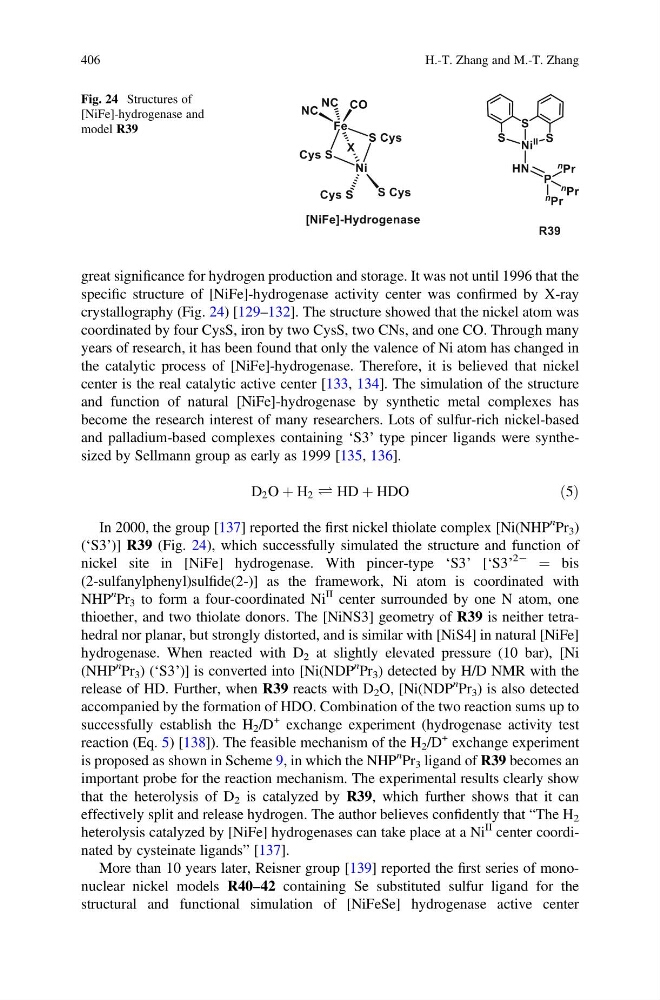
specific structure of [NiFe]-hydrogenase activity center was confirmed by X-ray
crystallography (Fig. 24) [129–132]. The structure showed that the nickel atom was
coordinated by four CysS, iron by two CysS, two CNs, and one CO. Through many
years of research, it has been found that only the valence of Ni atom has changed in
the catalytic process of [NiFe]-hydrogenase. Therefore, it is believed that nickel
center is the real catalytic active center [133, 134]. The simulation of the structure
and function of natural [NiFe]-hydrogenase by synthetic metal complexes has
become the research interest of many researchers. Lots of sulfur-rich nickel-based
and palladium-based complexes containing ‘S3’ type pincer ligands were synthesized by Sellmann group as early as 1999 [135, 136].
D 2 O þ H 2 Ð HD þ HDO
ð5Þ
In 2000, the group [137] reported the first nickel thiolate complex [Ni(NHP
n Pr 3 )
(‘S3’)] R39 (Fig. 24), which successfully simulated the structure and function of
nickel site in [NiFe] hydrogenase. With pincer-type ‘S3’ [‘S3’
2À
¼ bis
(2-sulfanylphenyl)sulfide(2-)] as the framework, Ni atom is coordinated with
NHP
n Pr 3 to form a four-coordinated Ni
II center surrounded by one N atom, one
thioether, and two thiolate donors. The [NiNS3] geometry of R39 is neither tetrahedral nor planar, but strongly distorted, and is similar with [NiS4] in natural [NiFe]
hydrogenase. When reacted with D 2 at slightly elevated pressure (10 bar), [Ni
(NHP
n Pr 3 ) (‘S3’)] is converted into [Ni(NDP
n Pr 3 ) detected by H/D NMR with the
release of HD. Further, when R39 reacts with D 2 O, [Ni(NDP
n Pr 3 ) is also detected
accompanied by the formation of HDO. Combination of the two reaction sums up to
successfully establish the H 2 /D
+ exchange experiment (hydrogenase activity test
reaction (Eq. 5) [138]). The feasible mechanism of the H 2 /D
+ exchange experiment
is proposed as shown in Scheme 9, in which the NHP
n Pr 3 ligand of R39 becomes an
important probe for the reaction mechanism. The experimental results clearly show
that the heterolysis of D 2 is catalyzed by R39, which further shows that it can
effectively split and release hydrogen. The author believes confidently that “The H 2
heterolysis catalyzed by [NiFe] hydrogenases can take place at a Ni
II center coordinated by cysteinate ligands” [137].
More than 10 years later, Reisner group [139] reported the first series of mononuclear nickel models R40–42 containing Se substituted sulfur ligand for the
structural and functional simulation of [NiFeSe] hydrogenase active center
Fig. 24 Structures of
[NiFe]-hydrogenase and
model R39
406
H.-T. Zhang and M.-T. Zhang
specific structure of [NiFe]-hydrogenase activity center was confirmed by X-ray
crystallography (Fig. 24) [129–132]. The structure showed that the nickel atom was
coordinated by four CysS, iron by two CysS, two CNs, and one CO. Through many
years of research, it has been found that only the valence of Ni atom has changed in
the catalytic process of [NiFe]-hydrogenase. Therefore, it is believed that nickel
center is the real catalytic active center [133, 134]. The simulation of the structure
and function of natural [NiFe]-hydrogenase by synthetic metal complexes has
become the research interest of many researchers. Lots of sulfur-rich nickel-based
and palladium-based complexes containing ‘S3’ type pincer ligands were synthesized by Sellmann group as early as 1999 [135, 136].
D 2 O þ H 2 Ð HD þ HDO
ð5Þ
In 2000, the group [137] reported the first nickel thiolate complex [Ni(NHP
n Pr 3 )
(‘S3’)] R39 (Fig. 24), which successfully simulated the structure and function of
nickel site in [NiFe] hydrogenase. With pincer-type ‘S3’ [‘S3’
2À
¼ bis
(2-sulfanylphenyl)sulfide(2-)] as the framework, Ni atom is coordinated with
NHP
n Pr 3 to form a four-coordinated Ni
II center surrounded by one N atom, one
thioether, and two thiolate donors. The [NiNS3] geometry of R39 is neither tetrahedral nor planar, but strongly distorted, and is similar with [NiS4] in natural [NiFe]
hydrogenase. When reacted with D 2 at slightly elevated pressure (10 bar), [Ni
(NHP
n Pr 3 ) (‘S3’)] is converted into [Ni(NDP
n Pr 3 ) detected by H/D NMR with the
release of HD. Further, when R39 reacts with D 2 O, [Ni(NDP
n Pr 3 ) is also detected
accompanied by the formation of HDO. Combination of the two reaction sums up to
successfully establish the H 2 /D
+ exchange experiment (hydrogenase activity test
reaction (Eq. 5) [138]). The feasible mechanism of the H 2 /D
+ exchange experiment
is proposed as shown in Scheme 9, in which the NHP
n Pr 3 ligand of R39 becomes an
important probe for the reaction mechanism. The experimental results clearly show
that the heterolysis of D 2 is catalyzed by R39, which further shows that it can
effectively split and release hydrogen. The author believes confidently that “The H 2
heterolysis catalyzed by [NiFe] hydrogenases can take place at a Ni
II center coordinated by cysteinate ligands” [137].
More than 10 years later, Reisner group [139] reported the first series of mononuclear nickel models R40–42 containing Se substituted sulfur ligand for the
structural and functional simulation of [NiFeSe] hydrogenase active center
Fig. 24 Structures of
[NiFe]-hydrogenase and
model R39
406
H.-T. Zhang and M.-T. Zhang