

process. However, they used the models containing PMe 2 and NMe 2 to replace
P
t Bu 2 and NEt 2 groups, respectively. It is pointed out that the release of hydrogen
from the interaction between protons and hydride ligand is the rate-limiting step in
the whole reaction, and protonation takes place preferentially with hydride rather
than OH. Hall group [106] calculated the position of pincer ligand de-aromatization
after H 2 formation using the same model as R5. Deprotonation on methylene with
P
t Bu 2 group is more favorable than on the side with NEt 2 . In 2011, Suresh group
[107] proposed a new catalytic process, which did not involve the aromatization–dearomatization of pincer ligands. In 2012, Fabris group [108] used “an explicit
description of the solvent and employ metadynamics coupled with the
Car-Parrinello method” to propose a catalytic mechanism with lower activation
energy. The aromatization and de-aromatization of ligand are also not involved,
and it shows that water molecules play an active role in the catalytic process. In
2015, 56 models with different substituents at 4-py or N-arm or P-arm were
calculated and compared by Suresh [109]. When only substituents on para-position
of the pyridyl were changed, there was only 1–1.4 kcal/mol energy effect between
them. When the P atom was substituted by Et or Me, the water molecule coordination would be promoted and the catalytic efficiency would be greatly improved.
Some transition-metal hydrides also have good reactivity as proton sources
[110]. Because hydrides of different metal hydrides show “acidity” or “alkalinity,”
they react with each other and form hydrogen such as [OsH 2 (PMePh 2 ) 4 ]/[CpM(H)
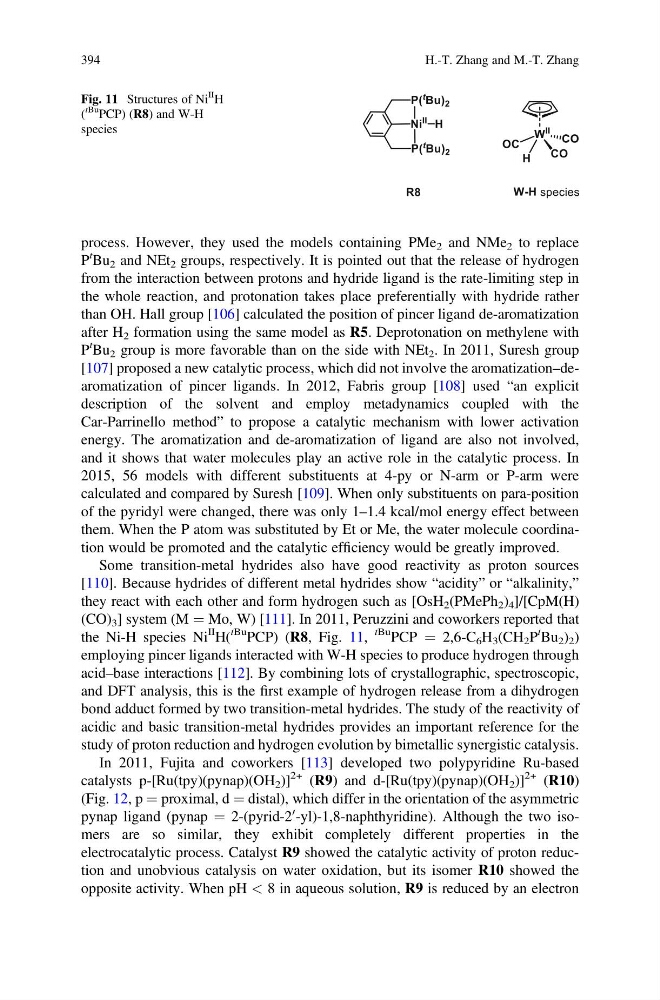
(CO) 3 ] system (M ¼ Mo, W) [111]. In 2011, Peruzzini and coworkers reported that
the Ni-H species Ni
II H(
tBu PCP) (R8, Fig. 11,
tBu PCP ¼ 2,6-C 6 H 3 (CH 2 P
t Bu 2 ) 2 )
employing pincer ligands interacted with W-H species to produce hydrogen through
acid–base interactions [112]. By combining lots of crystallographic, spectroscopic,
and DFT analysis, this is the first example of hydrogen release from a dihydrogen
bond adduct formed by two transition-metal hydrides. The study of the reactivity of
acidic and basic transition-metal hydrides provides an important reference for the
study of proton reduction and hydrogen evolution by bimetallic synergistic catalysis.
In 2011, Fujita and coworkers [113] developed two polypyridine Ru-based
catalysts p-[Ru(tpy)(pynap)(OH 2 )]
2+ (R9) and d-[Ru(tpy)(pynap)(OH 2 )]
2+ (R10)
(Fig. 12, p ¼ proximal, d ¼ distal), which differ in the orientation of the asymmetric
pynap ligand (pynap ¼ 2-(pyrid-2
0 -yl)-1,8-naphthyridine). Although the two isomers are so similar, they exhibit completely different properties in the
electrocatalytic process. Catalyst R9 showed the catalytic activity of proton reduction and unobvious catalysis on water oxidation, but its isomer R10 showed the
opposite activity. When pH < 8 in aqueous solution, R9 is reduced by an electron
Fig. 11 Structures of Ni
II H
(
tBu
PCP) (R8) and W-H
species
394
H.-T. Zhang and M.-T. Zhang
P
t Bu 2 and NEt 2 groups, respectively. It is pointed out that the release of hydrogen
from the interaction between protons and hydride ligand is the rate-limiting step in
the whole reaction, and protonation takes place preferentially with hydride rather
than OH. Hall group [106] calculated the position of pincer ligand de-aromatization
after H 2 formation using the same model as R5. Deprotonation on methylene with
P
t Bu 2 group is more favorable than on the side with NEt 2 . In 2011, Suresh group
[107] proposed a new catalytic process, which did not involve the aromatization–dearomatization of pincer ligands. In 2012, Fabris group [108] used “an explicit
description of the solvent and employ metadynamics coupled with the
Car-Parrinello method” to propose a catalytic mechanism with lower activation
energy. The aromatization and de-aromatization of ligand are also not involved,
and it shows that water molecules play an active role in the catalytic process. In
2015, 56 models with different substituents at 4-py or N-arm or P-arm were
calculated and compared by Suresh [109]. When only substituents on para-position
of the pyridyl were changed, there was only 1–1.4 kcal/mol energy effect between
them. When the P atom was substituted by Et or Me, the water molecule coordination would be promoted and the catalytic efficiency would be greatly improved.
Some transition-metal hydrides also have good reactivity as proton sources
[110]. Because hydrides of different metal hydrides show “acidity” or “alkalinity,”
they react with each other and form hydrogen such as [OsH 2 (PMePh 2 ) 4 ]/[CpM(H)
(CO) 3 ] system (M ¼ Mo, W) [111]. In 2011, Peruzzini and coworkers reported that
the Ni-H species Ni
II H(
tBu PCP) (R8, Fig. 11,
tBu PCP ¼ 2,6-C 6 H 3 (CH 2 P
t Bu 2 ) 2 )
employing pincer ligands interacted with W-H species to produce hydrogen through
acid–base interactions [112]. By combining lots of crystallographic, spectroscopic,
and DFT analysis, this is the first example of hydrogen release from a dihydrogen
bond adduct formed by two transition-metal hydrides. The study of the reactivity of
acidic and basic transition-metal hydrides provides an important reference for the
study of proton reduction and hydrogen evolution by bimetallic synergistic catalysis.
In 2011, Fujita and coworkers [113] developed two polypyridine Ru-based
catalysts p-[Ru(tpy)(pynap)(OH 2 )]
2+ (R9) and d-[Ru(tpy)(pynap)(OH 2 )]
2+ (R10)
(Fig. 12, p ¼ proximal, d ¼ distal), which differ in the orientation of the asymmetric
pynap ligand (pynap ¼ 2-(pyrid-2
0 -yl)-1,8-naphthyridine). Although the two isomers are so similar, they exhibit completely different properties in the
electrocatalytic process. Catalyst R9 showed the catalytic activity of proton reduction and unobvious catalysis on water oxidation, but its isomer R10 showed the
opposite activity. When pH < 8 in aqueous solution, R9 is reduced by an electron
Fig. 11 Structures of Ni
II H
(
tBu
PCP) (R8) and W-H
species
394
H.-T. Zhang and M.-T. Zhang