

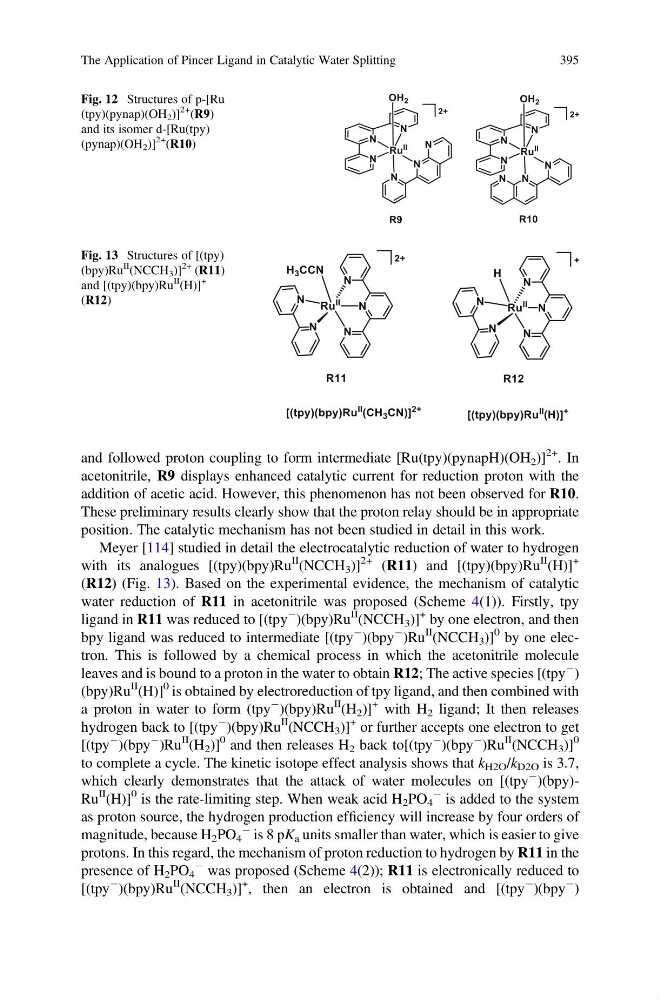
and followed proton coupling to form intermediate [Ru(tpy)(pynapH)(OH 2 )]
2+ . In
acetonitrile, R9 displays enhanced catalytic current for reduction proton with the
addition of acetic acid. However, this phenomenon has not been observed for R10.
These preliminary results clearly show that the proton relay should be in appropriate
position. The catalytic mechanism has not been studied in detail in this work.
Meyer [114] studied in detail the electrocatalytic reduction of water to hydrogen
with its analogues [(tpy)(bpy)Ru
II (NCCH 3 )]
2+ (R11) and [(tpy)(bpy)Ru
II (H)]
+
(R12) (Fig. 13). Based on the experimental evidence, the mechanism of catalytic
water reduction of R11 in acetonitrile was proposed (Scheme 4(1)). Firstly, tpy
ligand in R11 was reduced to [(tpy
À )(bpy)Ru
II (NCCH 3 )]
+ by one electron, and then
bpy ligand was reduced to intermediate [(tpy
À )(bpy
À
)Ru
II (NCCH 3 )]
0 by one electron. This is followed by a chemical process in which the acetonitrile molecule
leaves and is bound to a proton in the water to obtain R12; The active species [(tpy
À )
(bpy)Ru
II (H)]
0 is obtained by electroreduction of tpy ligand, and then combined with
a proton in water to form (tpy
À )(bpy)Ru
II (H 2 )]
+ with H 2 ligand; It then releases
hydrogen back to [(tpy
À )(bpy)Ru
II (NCCH 3 )]
+ or further accepts one electron to get
[(tpy
À )(bpy
À )Ru
II (H 2 )]
0 and then releases H 2 back to[(tpy
À )(bpy
À )Ru
II (NCCH 3 )]
0
to complete a cycle. The kinetic isotope effect analysis shows that k H2O /k D2O is 3.7,
which clearly demonstrates that the attack of water molecules on [(tpy
À )(bpy)Ru
II (H)]
0 is the rate-limiting step. When weak acid H 2 PO 4
À is added to the system
as proton source, the hydrogen production efficiency will increase by four orders of
magnitude, because H 2 PO 4
À is 8 pK a units smaller than water, which is easier to give
protons. In this regard, the mechanism of proton reduction to hydrogen by R11 in the
presence of H 2 PO 4
À was proposed (Scheme 4(2)); R11 is electronically reduced to
[(tpy
À )(bpy)Ru
II (NCCH 3 )]
+
, then an electron is obtained and [(tpy
À
)(bpy
À )
Fig. 12 Structures of p-[Ru
(tpy)(pynap)(OH 2 )]
2+ (R9)
and its isomer d-[Ru(tpy)
(pynap)(OH 2 )]
2+ (R10)
Fig. 13 Structures of [(tpy)
(bpy)Ru
II
(NCCH 3 )]
2+ (R11)
and [(tpy)(bpy)Ru
II
(H)]
+
(R12)
The Application of Pincer Ligand in Catalytic Water Splitting
395
2+ . In
acetonitrile, R9 displays enhanced catalytic current for reduction proton with the
addition of acetic acid. However, this phenomenon has not been observed for R10.
These preliminary results clearly show that the proton relay should be in appropriate
position. The catalytic mechanism has not been studied in detail in this work.
Meyer [114] studied in detail the electrocatalytic reduction of water to hydrogen
with its analogues [(tpy)(bpy)Ru
II (NCCH 3 )]
2+ (R11) and [(tpy)(bpy)Ru
II (H)]
+
(R12) (Fig. 13). Based on the experimental evidence, the mechanism of catalytic
water reduction of R11 in acetonitrile was proposed (Scheme 4(1)). Firstly, tpy
ligand in R11 was reduced to [(tpy
À )(bpy)Ru
II (NCCH 3 )]
+ by one electron, and then
bpy ligand was reduced to intermediate [(tpy
À )(bpy
À
)Ru
II (NCCH 3 )]
0 by one electron. This is followed by a chemical process in which the acetonitrile molecule
leaves and is bound to a proton in the water to obtain R12; The active species [(tpy
À )
(bpy)Ru
II (H)]
0 is obtained by electroreduction of tpy ligand, and then combined with
a proton in water to form (tpy
À )(bpy)Ru
II (H 2 )]
+ with H 2 ligand; It then releases
hydrogen back to [(tpy
À )(bpy)Ru
II (NCCH 3 )]
+ or further accepts one electron to get
[(tpy
À )(bpy
À )Ru
II (H 2 )]
0 and then releases H 2 back to[(tpy
À )(bpy
À )Ru
II (NCCH 3 )]
0
to complete a cycle. The kinetic isotope effect analysis shows that k H2O /k D2O is 3.7,
which clearly demonstrates that the attack of water molecules on [(tpy
À )(bpy)Ru
II (H)]
0 is the rate-limiting step. When weak acid H 2 PO 4
À is added to the system
as proton source, the hydrogen production efficiency will increase by four orders of
magnitude, because H 2 PO 4
À is 8 pK a units smaller than water, which is easier to give
protons. In this regard, the mechanism of proton reduction to hydrogen by R11 in the
presence of H 2 PO 4
À was proposed (Scheme 4(2)); R11 is electronically reduced to
[(tpy
À )(bpy)Ru
II (NCCH 3 )]
+
, then an electron is obtained and [(tpy
À
)(bpy
À )
Fig. 12 Structures of p-[Ru
(tpy)(pynap)(OH 2 )]
2+ (R9)
and its isomer d-[Ru(tpy)
(pynap)(OH 2 )]
2+ (R10)
Fig. 13 Structures of [(tpy)
(bpy)Ru
II
(NCCH 3 )]
2+ (R11)
and [(tpy)(bpy)Ru
II
(H)]
+
(R12)
The Application of Pincer Ligand in Catalytic Water Splitting
395