

of water to hydrogen under dark conditions. Complex [Pt(tpy)Cl]Cl (R4, Fig. 10)
containing tpy ligand was utilized as a molecular catalyst. In the atmosphere of inert
gas, the reaction process between MV
•+ produced by in-situ controlled potential
electrolysis and complex R4 was studied by stopped-flow technique. And by
monitoring the decay process of MV
•+ , it is confirmed that MV
•+ can reduce Pt
(II) by one electron [103]. Stopped-flow experiments show that there is no solid
particle sedimentation during the mixing process, so the formation of colloidal
platinum can be excluded. Under dark conditions, in AcOH/AcONa aqueous solution system, MV
•+ prepared by pre-electrolysis reacted with catalyst R4, and the gas
produced in the system was carried out by Ar gas stream. It was confirmed that
hydrogen was emitted, but the catalytic efficiency was relatively low.
The development of efficient photo-driven water splitting catalysts is the main
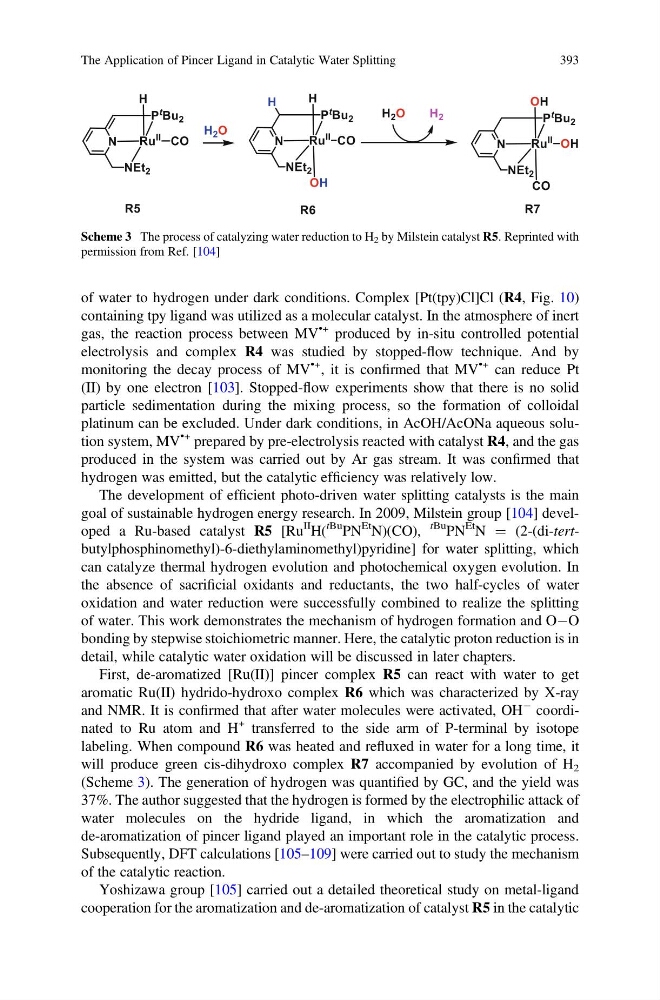
goal of sustainable hydrogen energy research. In 2009, Milstein group [104] developed a Ru-based catalyst R5 [Ru
II H(
tBu PN
Et
N)(CO),
tBu
PN
Et N ¼ (2-(di-tertbutylphosphinomethyl)-6-diethylaminomethyl)pyridine] for water splitting, which
can catalyze thermal hydrogen evolution and photochemical oxygen evolution. In
the absence of sacrificial oxidants and reductants, the two half-cycles of water
oxidation and water reduction were successfully combined to realize the splitting
of water. This work demonstrates the mechanism of hydrogen formation and OÀO
bonding by stepwise stoichiometric manner. Here, the catalytic proton reduction is in
detail, while catalytic water oxidation will be discussed in later chapters.
First, de-aromatized [Ru(II)] pincer complex R5 can react with water to get
aromatic Ru(II) hydrido-hydroxo complex R6 which was characterized by X-ray
and NMR. It is confirmed that after water molecules were activated, OH
À coordinated to Ru atom and H
+ transferred to the side arm of P-terminal by isotope
labeling. When compound R6 was heated and refluxed in water for a long time, it
will produce green cis-dihydroxo complex R7 accompanied by evolution of H 2
(Scheme 3). The generation of hydrogen was quantified by GC, and the yield was
37%. The author suggested that the hydrogen is formed by the electrophilic attack of
water molecules on the hydride ligand, in which the aromatization and
de-aromatization of pincer ligand played an important role in the catalytic process.
Subsequently, DFT calculations [105–109] were carried out to study the mechanism
of the catalytic reaction.
Yoshizawa group [105] carried out a detailed theoretical study on metal-ligand
cooperation for the aromatization and de-aromatization of catalyst R5 in the catalytic
Scheme 3 The process of catalyzing water reduction to H 2 by Milstein catalyst R5. Reprinted with
permission from Ref. [104]
The Application of Pincer Ligand in Catalytic Water Splitting
393
containing tpy ligand was utilized as a molecular catalyst. In the atmosphere of inert
gas, the reaction process between MV
•+ produced by in-situ controlled potential
electrolysis and complex R4 was studied by stopped-flow technique. And by
monitoring the decay process of MV
•+ , it is confirmed that MV
•+ can reduce Pt
(II) by one electron [103]. Stopped-flow experiments show that there is no solid
particle sedimentation during the mixing process, so the formation of colloidal
platinum can be excluded. Under dark conditions, in AcOH/AcONa aqueous solution system, MV
•+ prepared by pre-electrolysis reacted with catalyst R4, and the gas
produced in the system was carried out by Ar gas stream. It was confirmed that
hydrogen was emitted, but the catalytic efficiency was relatively low.
The development of efficient photo-driven water splitting catalysts is the main
goal of sustainable hydrogen energy research. In 2009, Milstein group [104] developed a Ru-based catalyst R5 [Ru
II H(
tBu PN
Et
N)(CO),
tBu
PN
Et N ¼ (2-(di-tertbutylphosphinomethyl)-6-diethylaminomethyl)pyridine] for water splitting, which
can catalyze thermal hydrogen evolution and photochemical oxygen evolution. In
the absence of sacrificial oxidants and reductants, the two half-cycles of water
oxidation and water reduction were successfully combined to realize the splitting
of water. This work demonstrates the mechanism of hydrogen formation and OÀO
bonding by stepwise stoichiometric manner. Here, the catalytic proton reduction is in
detail, while catalytic water oxidation will be discussed in later chapters.
First, de-aromatized [Ru(II)] pincer complex R5 can react with water to get
aromatic Ru(II) hydrido-hydroxo complex R6 which was characterized by X-ray
and NMR. It is confirmed that after water molecules were activated, OH
À coordinated to Ru atom and H
+ transferred to the side arm of P-terminal by isotope
labeling. When compound R6 was heated and refluxed in water for a long time, it
will produce green cis-dihydroxo complex R7 accompanied by evolution of H 2
(Scheme 3). The generation of hydrogen was quantified by GC, and the yield was
37%. The author suggested that the hydrogen is formed by the electrophilic attack of
water molecules on the hydride ligand, in which the aromatization and
de-aromatization of pincer ligand played an important role in the catalytic process.
Subsequently, DFT calculations [105–109] were carried out to study the mechanism
of the catalytic reaction.
Yoshizawa group [105] carried out a detailed theoretical study on metal-ligand
cooperation for the aromatization and de-aromatization of catalyst R5 in the catalytic
Scheme 3 The process of catalyzing water reduction to H 2 by Milstein catalyst R5. Reprinted with
permission from Ref. [104]
The Application of Pincer Ligand in Catalytic Water Splitting
393