

molecular Pt-based catalysts for proton reduction are designed for significantly
improving the catalytic efficiency. In early 2000, many platinum group metal
complexes as molecular catalysts [96, 97] were reported to enhance catalytic efficiency and cost-effectiveness instead of the traditional heterogeneous colloidal Pt.
Eisenberg group [98] had different opinions on whether these Pt(II) complexes
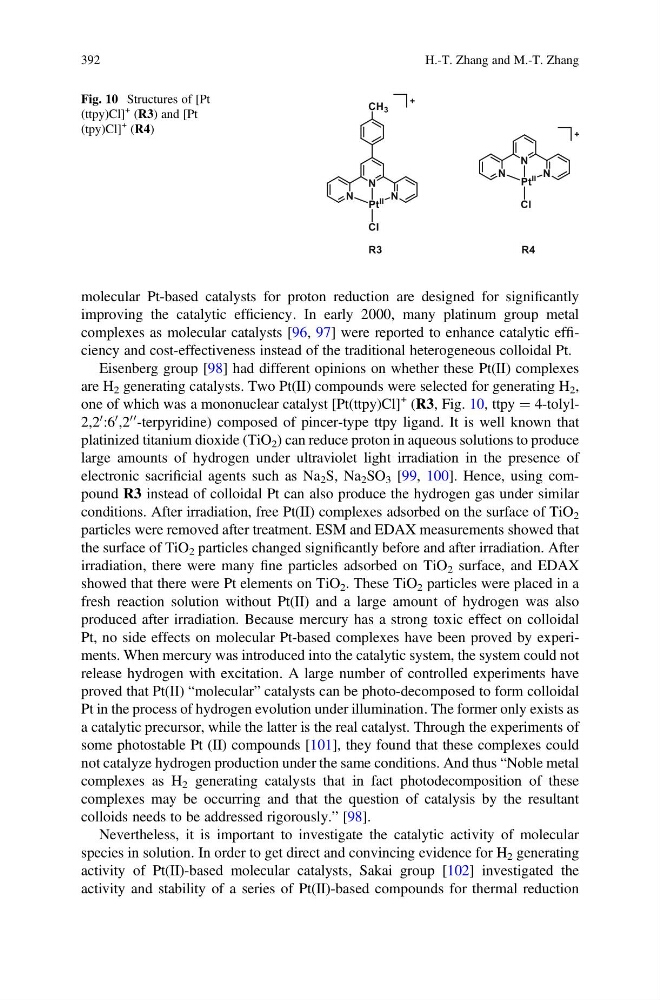
are H 2 generating catalysts. Two Pt(II) compounds were selected for generating H 2 ,
one of which was a mononuclear catalyst [Pt(ttpy)Cl]
+ (R3, Fig. 10, ttpy ¼ 4-tolyl2,2
0 :6
0 ,2
00 -terpyridine) composed of pincer-type ttpy ligand. It is well known that
platinized titanium dioxide (TiO 2 ) can reduce proton in aqueous solutions to produce
large amounts of hydrogen under ultraviolet light irradiation in the presence of
electronic sacrificial agents such as Na 2 S, Na 2 SO 3 [99, 100]. Hence, using compound R3 instead of colloidal Pt can also produce the hydrogen gas under similar
conditions. After irradiation, free Pt(II) complexes adsorbed on the surface of TiO 2
particles were removed after treatment. ESM and EDAX measurements showed that
the surface of TiO 2 particles changed significantly before and after irradiation. After
irradiation, there were many fine particles adsorbed on TiO 2 surface, and EDAX
showed that there were Pt elements on TiO 2 . These TiO 2 particles were placed in a
fresh reaction solution without Pt(II) and a large amount of hydrogen was also
produced after irradiation. Because mercury has a strong toxic effect on colloidal
Pt, no side effects on molecular Pt-based complexes have been proved by experiments. When mercury was introduced into the catalytic system, the system could not
release hydrogen with excitation. A large number of controlled experiments have
proved that Pt(II) “molecular” catalysts can be photo-decomposed to form colloidal
Pt in the process of hydrogen evolution under illumination. The former only exists as
a catalytic precursor, while the latter is the real catalyst. Through the experiments of
some photostable Pt (II) compounds [101], they found that these complexes could
not catalyze hydrogen production under the same conditions. And thus “Noble metal
complexes as H 2 generating catalysts that in fact photodecomposition of these
complexes may be occurring and that the question of catalysis by the resultant
colloids needs to be addressed rigorously.” [98].
Nevertheless, it is important to investigate the catalytic activity of molecular
species in solution. In order to get direct and convincing evidence for H 2 generating
activity of Pt(II)-based molecular catalysts, Sakai group [102] investigated the
activity and stability of a series of Pt(II)-based compounds for thermal reduction
Fig. 10 Structures of [Pt
(ttpy)Cl]
+ (R3) and [Pt
(tpy)Cl]
+ (R4)
392
H.-T. Zhang and M.-T. Zhang
improving the catalytic efficiency. In early 2000, many platinum group metal
complexes as molecular catalysts [96, 97] were reported to enhance catalytic efficiency and cost-effectiveness instead of the traditional heterogeneous colloidal Pt.
Eisenberg group [98] had different opinions on whether these Pt(II) complexes
are H 2 generating catalysts. Two Pt(II) compounds were selected for generating H 2 ,
one of which was a mononuclear catalyst [Pt(ttpy)Cl]
+ (R3, Fig. 10, ttpy ¼ 4-tolyl2,2
0 :6
0 ,2
00 -terpyridine) composed of pincer-type ttpy ligand. It is well known that
platinized titanium dioxide (TiO 2 ) can reduce proton in aqueous solutions to produce
large amounts of hydrogen under ultraviolet light irradiation in the presence of
electronic sacrificial agents such as Na 2 S, Na 2 SO 3 [99, 100]. Hence, using compound R3 instead of colloidal Pt can also produce the hydrogen gas under similar
conditions. After irradiation, free Pt(II) complexes adsorbed on the surface of TiO 2
particles were removed after treatment. ESM and EDAX measurements showed that
the surface of TiO 2 particles changed significantly before and after irradiation. After
irradiation, there were many fine particles adsorbed on TiO 2 surface, and EDAX
showed that there were Pt elements on TiO 2 . These TiO 2 particles were placed in a
fresh reaction solution without Pt(II) and a large amount of hydrogen was also
produced after irradiation. Because mercury has a strong toxic effect on colloidal
Pt, no side effects on molecular Pt-based complexes have been proved by experiments. When mercury was introduced into the catalytic system, the system could not
release hydrogen with excitation. A large number of controlled experiments have
proved that Pt(II) “molecular” catalysts can be photo-decomposed to form colloidal
Pt in the process of hydrogen evolution under illumination. The former only exists as
a catalytic precursor, while the latter is the real catalyst. Through the experiments of
some photostable Pt (II) compounds [101], they found that these complexes could
not catalyze hydrogen production under the same conditions. And thus “Noble metal
complexes as H 2 generating catalysts that in fact photodecomposition of these
complexes may be occurring and that the question of catalysis by the resultant
colloids needs to be addressed rigorously.” [98].
Nevertheless, it is important to investigate the catalytic activity of molecular
species in solution. In order to get direct and convincing evidence for H 2 generating
activity of Pt(II)-based molecular catalysts, Sakai group [102] investigated the
activity and stability of a series of Pt(II)-based compounds for thermal reduction
Fig. 10 Structures of [Pt
(ttpy)Cl]
+ (R3) and [Pt
(tpy)Cl]
+ (R4)
392
H.-T. Zhang and M.-T. Zhang