

to react with proton. This might be the reason that catalytic efficiency of catalyst R1
is much lower than that of [Co(pdt) 3 ]
2+ . According to both electrochemical- and
light-driven hydrogen evolution, the author proposed the following mechanisms:
Firstly, [Co(tpp) 2 ]
2+ was reduced to [Co(tpp) 2 ]
+ by
3 *Ru; Then a water molecule
coordinates with [Co(tpp) 2 ]
+ and dissociates one of the ligands to form a [CoH
(tpp)]
+ species; Finally, hydrogen is released from the interaction between the two
[CoH(tpp)]
+ species, and then combined with the free tpp to return to the initial state
of the catalyst.
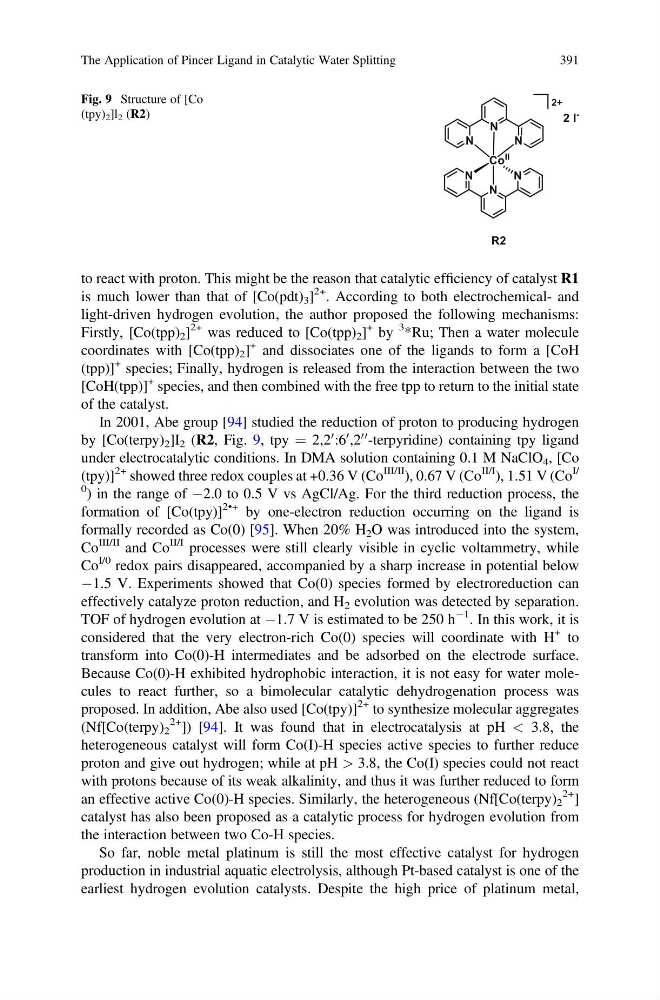
In 2001, Abe group [94] studied the reduction of proton to producing hydrogen
by [Co(terpy) 2 ]I 2 (R2, Fig. 9, tpy ¼ 2,2
0 :6
0 ,2
00 -terpyridine) containing tpy ligand
under electrocatalytic conditions. In DMA solution containing 0.1 M NaClO 4 , [Co
(tpy)]
2+ showed three redox couples at +0.36 V (Co
III/II ), 0.67 V (Co
II/I ), 1.51 V (Co
I/
0 ) in the range of À2.0 to 0.5 V vs AgCl/Ag. For the third reduction process, the
formation of [Co(tpy)]
2•+ by one-electron reduction occurring on the ligand is
formally recorded as Co(0) [95]. When 20% H 2 O was introduced into the system,
Co
III/II and Co
II/I processes were still clearly visible in cyclic voltammetry, while
Co
I/0 redox pairs disappeared, accompanied by a sharp increase in potential below
À1.5 V. Experiments showed that Co(0) species formed by electroreduction can
effectively catalyze proton reduction, and H 2 evolution was detected by separation.
TOF of hydrogen evolution at À1.7 V is estimated to be 250 h
À1 . In this work, it is
considered that the very electron-rich Co(0) species will coordinate with H
+ to
transform into Co(0)-H intermediates and be adsorbed on the electrode surface.
Because Co(0)-H exhibited hydrophobic interaction, it is not easy for water molecules to react further, so a bimolecular catalytic dehydrogenation process was
proposed. In addition, Abe also used [Co(tpy)]
2+ to synthesize molecular aggregates
(Nf[Co(terpy) 2
2+ ]) [94]. It was found that in electrocatalysis at pH < 3.8, the
heterogeneous catalyst will form Co(I)-H species active species to further reduce
proton and give out hydrogen; while at pH > 3.8, the Co(I) species could not react
with protons because of its weak alkalinity, and thus it was further reduced to form
an effective active Co(0)-H species. Similarly, the heterogeneous (Nf[Co(terpy) 2
2+ ]
catalyst has also been proposed as a catalytic process for hydrogen evolution from
the interaction between two Co-H species.
So far, noble metal platinum is still the most effective catalyst for hydrogen
production in industrial aquatic electrolysis, although Pt-based catalyst is one of the
earliest hydrogen evolution catalysts. Despite the high price of platinum metal,
Fig. 9 Structure of [Co
(tpy) 2 ]l 2 (R2)
The Application of Pincer Ligand in Catalytic Water Splitting
391
is much lower than that of [Co(pdt) 3 ]
2+ . According to both electrochemical- and
light-driven hydrogen evolution, the author proposed the following mechanisms:
Firstly, [Co(tpp) 2 ]
2+ was reduced to [Co(tpp) 2 ]
+ by
3 *Ru; Then a water molecule
coordinates with [Co(tpp) 2 ]
+ and dissociates one of the ligands to form a [CoH
(tpp)]
+ species; Finally, hydrogen is released from the interaction between the two
[CoH(tpp)]
+ species, and then combined with the free tpp to return to the initial state
of the catalyst.
In 2001, Abe group [94] studied the reduction of proton to producing hydrogen
by [Co(terpy) 2 ]I 2 (R2, Fig. 9, tpy ¼ 2,2
0 :6
0 ,2
00 -terpyridine) containing tpy ligand
under electrocatalytic conditions. In DMA solution containing 0.1 M NaClO 4 , [Co
(tpy)]
2+ showed three redox couples at +0.36 V (Co
III/II ), 0.67 V (Co
II/I ), 1.51 V (Co
I/
0 ) in the range of À2.0 to 0.5 V vs AgCl/Ag. For the third reduction process, the
formation of [Co(tpy)]
2•+ by one-electron reduction occurring on the ligand is
formally recorded as Co(0) [95]. When 20% H 2 O was introduced into the system,
Co
III/II and Co
II/I processes were still clearly visible in cyclic voltammetry, while
Co
I/0 redox pairs disappeared, accompanied by a sharp increase in potential below
À1.5 V. Experiments showed that Co(0) species formed by electroreduction can
effectively catalyze proton reduction, and H 2 evolution was detected by separation.
TOF of hydrogen evolution at À1.7 V is estimated to be 250 h
À1 . In this work, it is
considered that the very electron-rich Co(0) species will coordinate with H
+ to
transform into Co(0)-H intermediates and be adsorbed on the electrode surface.
Because Co(0)-H exhibited hydrophobic interaction, it is not easy for water molecules to react further, so a bimolecular catalytic dehydrogenation process was
proposed. In addition, Abe also used [Co(tpy)]
2+ to synthesize molecular aggregates
(Nf[Co(terpy) 2
2+ ]) [94]. It was found that in electrocatalysis at pH < 3.8, the
heterogeneous catalyst will form Co(I)-H species active species to further reduce
proton and give out hydrogen; while at pH > 3.8, the Co(I) species could not react
with protons because of its weak alkalinity, and thus it was further reduced to form
an effective active Co(0)-H species. Similarly, the heterogeneous (Nf[Co(terpy) 2
2+ ]
catalyst has also been proposed as a catalytic process for hydrogen evolution from
the interaction between two Co-H species.
So far, noble metal platinum is still the most effective catalyst for hydrogen
production in industrial aquatic electrolysis, although Pt-based catalyst is one of the
earliest hydrogen evolution catalysts. Despite the high price of platinum metal,
Fig. 9 Structure of [Co
(tpy) 2 ]l 2 (R2)
The Application of Pincer Ligand in Catalytic Water Splitting
391