

2 Molecular Catalysts with Pincer Ligand for HER
2.1 Non-Hydrogenase Type HECs
As early as 1930, it has been known that a large amount of energy is stored in
hydrogen molecule, which can provide the necessary energy for the life activities of
some microorganisms [91]. After the energy crisis broke out in 1970, the research of
using solar energy to produce clean and renewable hydrogen has become a popular
field [92]. However, hydrogen production from water reduction by homogeneous
catalysts based on pincer-type ligands has rarely been reported.
Until 1997, Bauer’s group [93] reported the first novel cobalt-based catalyst [Co
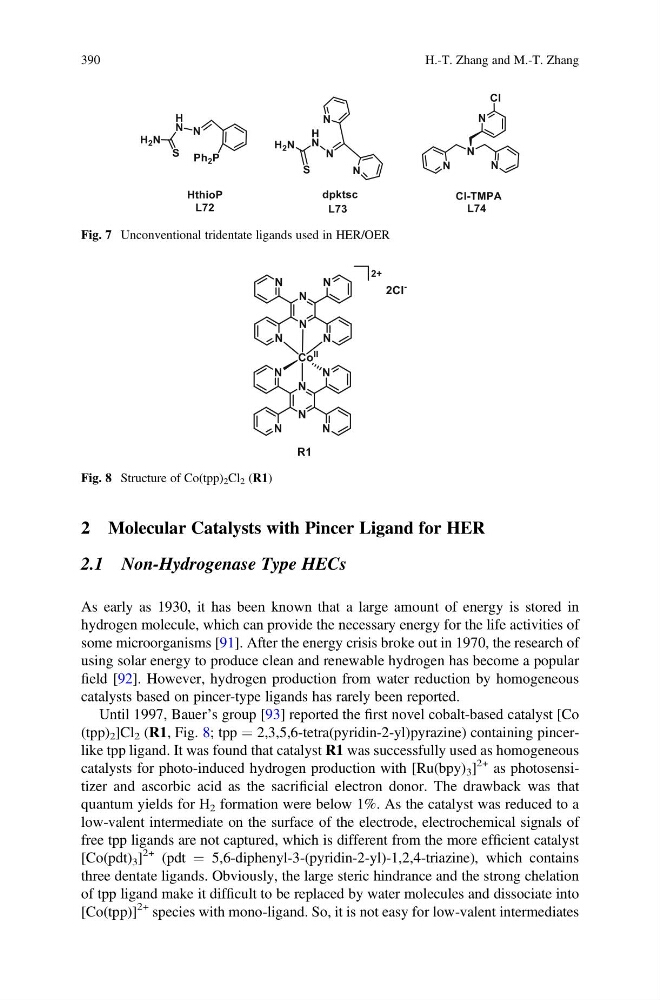
(tpp) 2 ]Cl 2 (R1, Fig. 8; tpp ¼ 2,3,5,6-tetra(pyridin-2-yl)pyrazine) containing pincerlike tpp ligand. It was found that catalyst R1 was successfully used as homogeneous
catalysts for photo-induced hydrogen production with [Ru(bpy) 3 ]
2+ as photosensitizer and ascorbic acid as the sacrificial electron donor. The drawback was that
quantum yields for H 2 formation were below 1%. As the catalyst was reduced to a
low-valent intermediate on the surface of the electrode, electrochemical signals of
free tpp ligands are not captured, which is different from the more efficient catalyst
[Co(pdt) 3 ]
2+ (pdt ¼ 5,6-diphenyl-3-(pyridin-2-yl)-1,2,4-triazine), which contains
three dentate ligands. Obviously, the large steric hindrance and the strong chelation
of tpp ligand make it difficult to be replaced by water molecules and dissociate into
[Co(tpp)]
2+ species with mono-ligand. So, it is not easy for low-valent intermediates
Fig. 7 Unconventional tridentate ligands used in HER/OER
Fig. 8 Structure of Co(tpp) 2 Cl 2 (R1)
390
H.-T. Zhang and M.-T. Zhang
2.1 Non-Hydrogenase Type HECs
As early as 1930, it has been known that a large amount of energy is stored in
hydrogen molecule, which can provide the necessary energy for the life activities of
some microorganisms [91]. After the energy crisis broke out in 1970, the research of
using solar energy to produce clean and renewable hydrogen has become a popular
field [92]. However, hydrogen production from water reduction by homogeneous
catalysts based on pincer-type ligands has rarely been reported.
Until 1997, Bauer’s group [93] reported the first novel cobalt-based catalyst [Co
(tpp) 2 ]Cl 2 (R1, Fig. 8; tpp ¼ 2,3,5,6-tetra(pyridin-2-yl)pyrazine) containing pincerlike tpp ligand. It was found that catalyst R1 was successfully used as homogeneous
catalysts for photo-induced hydrogen production with [Ru(bpy) 3 ]
2+ as photosensitizer and ascorbic acid as the sacrificial electron donor. The drawback was that
quantum yields for H 2 formation were below 1%. As the catalyst was reduced to a
low-valent intermediate on the surface of the electrode, electrochemical signals of
free tpp ligands are not captured, which is different from the more efficient catalyst
[Co(pdt) 3 ]
2+ (pdt ¼ 5,6-diphenyl-3-(pyridin-2-yl)-1,2,4-triazine), which contains
three dentate ligands. Obviously, the large steric hindrance and the strong chelation
of tpp ligand make it difficult to be replaced by water molecules and dissociate into
[Co(tpp)]
2+ species with mono-ligand. So, it is not easy for low-valent intermediates
Fig. 7 Unconventional tridentate ligands used in HER/OER
Fig. 8 Structure of Co(tpp) 2 Cl 2 (R1)
390
H.-T. Zhang and M.-T. Zhang