

A second, more versatile approach to the formation of a weak TM!A interaction
(A ¼ acceptor) relies on the synthesis of ambiphilic ligands combining Lewis basic
site(s) and Lewis-acidic site(s): a field pioneered by Bourissou and co-workers
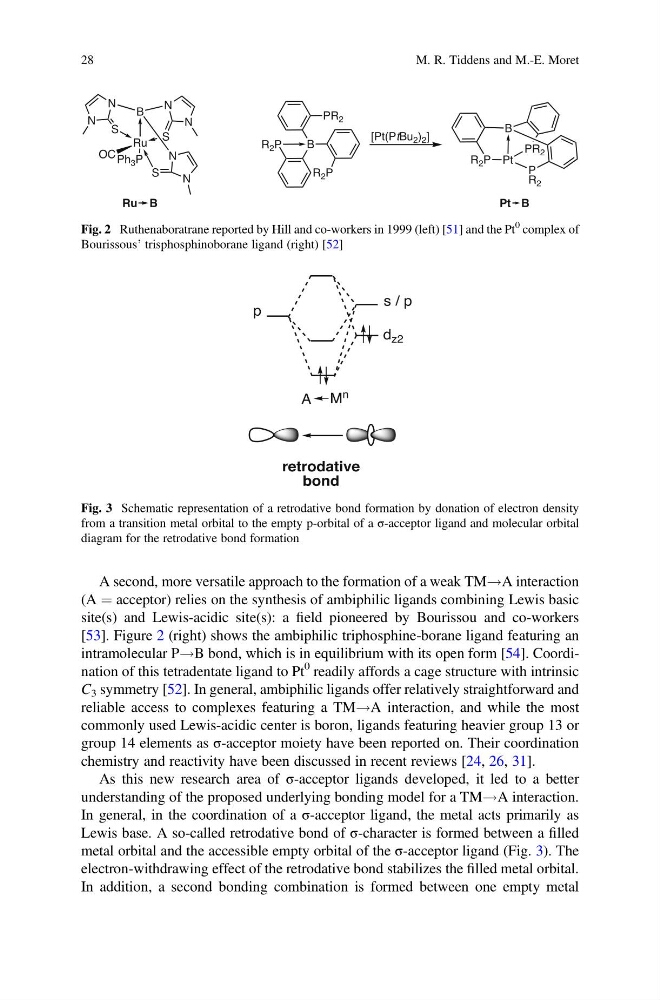
[53]. Figure 2 (right) shows the ambiphilic triphosphine-borane ligand featuring an
intramolecular P!B bond, which is in equilibrium with its open form [54]. Coordination of this tetradentate ligand to Pt
0 readily affords a cage structure with intrinsic
C 3 symmetry [52]. In general, ambiphilic ligands offer relatively straightforward and
reliable access to complexes featuring a TM!A interaction, and while the most
commonly used Lewis-acidic center is boron, ligands featuring heavier group 13 or
group 14 elements as σ-acceptor moiety have been reported on. Their coordination
chemistry and reactivity have been discussed in recent reviews [24, 26, 31].
As this new research area of σ-acceptor ligands developed, it led to a better
understanding of the proposed underlying bonding model for a TM!A interaction.
In general, in the coordination of a σ-acceptor ligand, the metal acts primarily as
Lewis base. A so-called retrodative bond of σ-character is formed between a filled
metal orbital and the accessible empty orbital of the σ-acceptor ligand (Fig. 3). The
electron-withdrawing effect of the retrodative bond stabilizes the filled metal orbital.
In addition, a second bonding combination is formed between one empty metal
Fig. 2 Ruthenaboratrane reported by Hill and co-workers in 1999 (left) [51] and the Pt
0 complex of
Bourissous’ trisphosphinoborane ligand (right) [52]
Fig. 3 Schematic representation of a retrodative bond formation by donation of electron density
from a transition metal orbital to the empty p-orbital of a σ-acceptor ligand and molecular orbital
diagram for the retrodative bond formation
28
M. R. Tiddens and M.-E. Moret
(A ¼ acceptor) relies on the synthesis of ambiphilic ligands combining Lewis basic
site(s) and Lewis-acidic site(s): a field pioneered by Bourissou and co-workers
[53]. Figure 2 (right) shows the ambiphilic triphosphine-borane ligand featuring an
intramolecular P!B bond, which is in equilibrium with its open form [54]. Coordination of this tetradentate ligand to Pt
0 readily affords a cage structure with intrinsic
C 3 symmetry [52]. In general, ambiphilic ligands offer relatively straightforward and
reliable access to complexes featuring a TM!A interaction, and while the most
commonly used Lewis-acidic center is boron, ligands featuring heavier group 13 or
group 14 elements as σ-acceptor moiety have been reported on. Their coordination
chemistry and reactivity have been discussed in recent reviews [24, 26, 31].
As this new research area of σ-acceptor ligands developed, it led to a better
understanding of the proposed underlying bonding model for a TM!A interaction.
In general, in the coordination of a σ-acceptor ligand, the metal acts primarily as
Lewis base. A so-called retrodative bond of σ-character is formed between a filled
metal orbital and the accessible empty orbital of the σ-acceptor ligand (Fig. 3). The
electron-withdrawing effect of the retrodative bond stabilizes the filled metal orbital.
In addition, a second bonding combination is formed between one empty metal
Fig. 2 Ruthenaboratrane reported by Hill and co-workers in 1999 (left) [51] and the Pt
0 complex of
Bourissous’ trisphosphinoborane ligand (right) [52]
Fig. 3 Schematic representation of a retrodative bond formation by donation of electron density
from a transition metal orbital to the empty p-orbital of a σ-acceptor ligand and molecular orbital
diagram for the retrodative bond formation
28
M. R. Tiddens and M.-E. Moret