

orbital of s or p parentage and the σ-acceptor. This low-lying vacant orbital is
responsible for an increased Lewis acidity of TM!A complexes [55].
Depending on the number of donor buttresses introduced in the ambiphilic ligand,
flexible or more rigid structures are obtained from mono-, bi-, or tripodal ligand
frameworks. In particular, the pincer-like bipodal framework offers a good compromise between stability and reactivity: this design strongly anchors the boron atom in
the vicinity of the metal center without excessively shielding it from reagent
molecules. Hence, the formed weak TM!B interaction bears potential for metalligand cooperative reactivity.
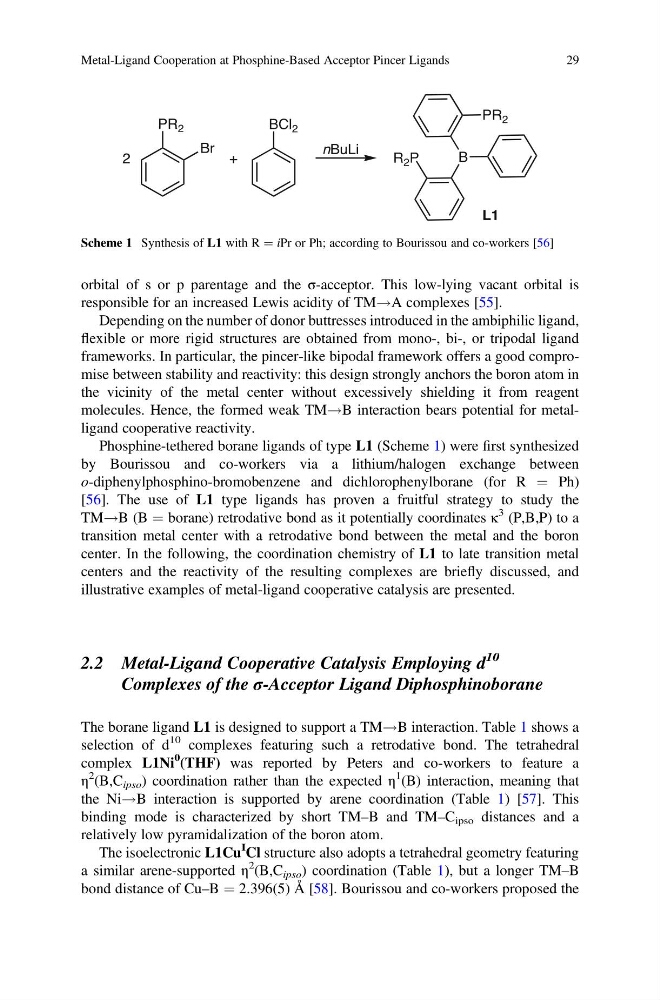
Phosphine-tethered borane ligands of type L1 (Scheme 1) were first synthesized
by Bourissou and co-workers via a lithium/halogen exchange between
o-diphenylphosphino-bromobenzene and dichlorophenylborane (for R ¼ Ph)
[56]. The use of L1 type ligands has proven a fruitful strategy to study the
TM!B (B ¼ borane) retrodative bond as it potentially coordinates κ
3 (P,B,P) to a
transition metal center with a retrodative bond between the metal and the boron
center. In the following, the coordination chemistry of L1 to late transition metal
centers and the reactivity of the resulting complexes are briefly discussed, and
illustrative examples of metal-ligand cooperative catalysis are presented.
2.2 Metal-Ligand Cooperative Catalysis Employing d
10
Complexes of the σ-Acceptor Ligand Diphosphinoborane
The borane ligand L1 is designed to support a TM!B interaction. Table 1 shows a
selection of d
10 complexes featuring such a retrodative bond. The tetrahedral
complex L1Ni
0 (THF) was reported by Peters and co-workers to feature a
η
2 (B,C ipso ) coordination rather than the expected η
1 (B) interaction, meaning that
the Ni!B interaction is supported by arene coordination (Table 1) [57]. This
binding mode is characterized by short TM–B and TM–C ipso distances and a
relatively low pyramidalization of the boron atom.
The isoelectronic L1Cu
I Cl structure also adopts a tetrahedral geometry featuring
a similar arene-supported η
2 (B,C ipso ) coordination (Table 1), but a longer TM–B
bond distance of Cu–B ¼ 2.396(5) Å [58]. Bourissou and co-workers proposed the
Scheme 1 Synthesis of L1 with R ¼ iPr or Ph; according to Bourissou and co-workers [56]
Metal-Ligand Cooperation at Phosphine-Based Acceptor Pincer Ligands
29
responsible for an increased Lewis acidity of TM!A complexes [55].
Depending on the number of donor buttresses introduced in the ambiphilic ligand,
flexible or more rigid structures are obtained from mono-, bi-, or tripodal ligand
frameworks. In particular, the pincer-like bipodal framework offers a good compromise between stability and reactivity: this design strongly anchors the boron atom in
the vicinity of the metal center without excessively shielding it from reagent
molecules. Hence, the formed weak TM!B interaction bears potential for metalligand cooperative reactivity.
Phosphine-tethered borane ligands of type L1 (Scheme 1) were first synthesized
by Bourissou and co-workers via a lithium/halogen exchange between
o-diphenylphosphino-bromobenzene and dichlorophenylborane (for R ¼ Ph)
[56]. The use of L1 type ligands has proven a fruitful strategy to study the
TM!B (B ¼ borane) retrodative bond as it potentially coordinates κ
3 (P,B,P) to a
transition metal center with a retrodative bond between the metal and the boron
center. In the following, the coordination chemistry of L1 to late transition metal
centers and the reactivity of the resulting complexes are briefly discussed, and
illustrative examples of metal-ligand cooperative catalysis are presented.
2.2 Metal-Ligand Cooperative Catalysis Employing d
10
Complexes of the σ-Acceptor Ligand Diphosphinoborane
The borane ligand L1 is designed to support a TM!B interaction. Table 1 shows a
selection of d
10 complexes featuring such a retrodative bond. The tetrahedral
complex L1Ni
0 (THF) was reported by Peters and co-workers to feature a
η
2 (B,C ipso ) coordination rather than the expected η
1 (B) interaction, meaning that
the Ni!B interaction is supported by arene coordination (Table 1) [57]. This
binding mode is characterized by short TM–B and TM–C ipso distances and a
relatively low pyramidalization of the boron atom.
The isoelectronic L1Cu
I Cl structure also adopts a tetrahedral geometry featuring
a similar arene-supported η
2 (B,C ipso ) coordination (Table 1), but a longer TM–B
bond distance of Cu–B ¼ 2.396(5) Å [58]. Bourissou and co-workers proposed the
Scheme 1 Synthesis of L1 with R ¼ iPr or Ph; according to Bourissou and co-workers [56]
Metal-Ligand Cooperation at Phosphine-Based Acceptor Pincer Ligands
29