

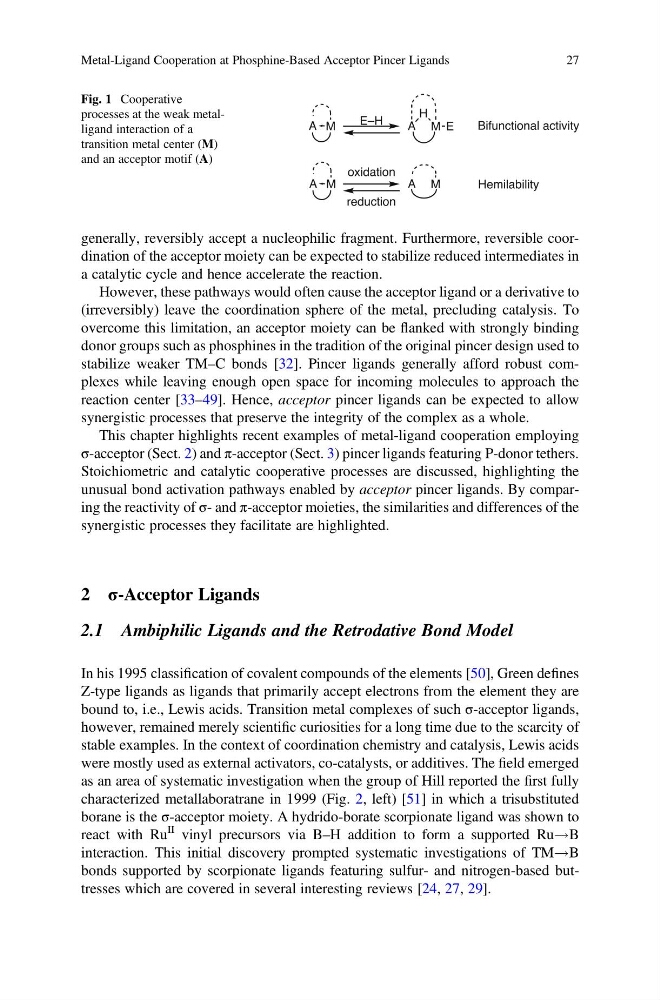
generally, reversibly accept a nucleophilic fragment. Furthermore, reversible coordination of the acceptor moiety can be expected to stabilize reduced intermediates in
a catalytic cycle and hence accelerate the reaction.
However, these pathways would often cause the acceptor ligand or a derivative to
(irreversibly) leave the coordination sphere of the metal, precluding catalysis. To
overcome this limitation, an acceptor moiety can be flanked with strongly binding
donor groups such as phosphines in the tradition of the original pincer design used to
stabilize weaker TM–C bonds [32]. Pincer ligands generally afford robust complexes while leaving enough open space for incoming molecules to approach the
reaction center [33–49]. Hence, acceptor pincer ligands can be expected to allow
synergistic processes that preserve the integrity of the complex as a whole.
This chapter highlights recent examples of metal-ligand cooperation employing
σ-acceptor (Sect. 2) and π-acceptor (Sect. 3) pincer ligands featuring P-donor tethers.
Stoichiometric and catalytic cooperative processes are discussed, highlighting the
unusual bond activation pathways enabled by acceptor pincer ligands. By comparing the reactivity of σ- and π-acceptor moieties, the similarities and differences of the
synergistic processes they facilitate are highlighted.
2 σ-Acceptor Ligands
2.1 Ambiphilic Ligands and the Retrodative Bond Model
In his 1995 classification of covalent compounds of the elements [50], Green defines
Z-type ligands as ligands that primarily accept electrons from the element they are
bound to, i.e., Lewis acids. Transition metal complexes of such σ-acceptor ligands,
however, remained merely scientific curiosities for a long time due to the scarcity of
stable examples. In the context of coordination chemistry and catalysis, Lewis acids
were mostly used as external activators, co-catalysts, or additives. The field emerged
as an area of systematic investigation when the group of Hill reported the first fully
characterized metallaboratrane in 1999 (Fig. 2, left) [51] in which a trisubstituted
borane is the σ-acceptor moiety. A hydrido-borate scorpionate ligand was shown to
react with Ru
II vinyl precursors via B–H addition to form a supported Ru!B
interaction. This initial discovery prompted systematic investigations of TM!B
bonds supported by scorpionate ligands featuring sulfur- and nitrogen-based buttresses which are covered in several interesting reviews [24, 27, 29].
Fig. 1 Cooperative
processes at the weak metalligand interaction of a
transition metal center (M)
and an acceptor motif (A)
Metal-Ligand Cooperation at Phosphine-Based Acceptor Pincer Ligands
27
a catalytic cycle and hence accelerate the reaction.
However, these pathways would often cause the acceptor ligand or a derivative to
(irreversibly) leave the coordination sphere of the metal, precluding catalysis. To
overcome this limitation, an acceptor moiety can be flanked with strongly binding
donor groups such as phosphines in the tradition of the original pincer design used to
stabilize weaker TM–C bonds [32]. Pincer ligands generally afford robust complexes while leaving enough open space for incoming molecules to approach the
reaction center [33–49]. Hence, acceptor pincer ligands can be expected to allow
synergistic processes that preserve the integrity of the complex as a whole.
This chapter highlights recent examples of metal-ligand cooperation employing
σ-acceptor (Sect. 2) and π-acceptor (Sect. 3) pincer ligands featuring P-donor tethers.
Stoichiometric and catalytic cooperative processes are discussed, highlighting the
unusual bond activation pathways enabled by acceptor pincer ligands. By comparing the reactivity of σ- and π-acceptor moieties, the similarities and differences of the
synergistic processes they facilitate are highlighted.
2 σ-Acceptor Ligands
2.1 Ambiphilic Ligands and the Retrodative Bond Model
In his 1995 classification of covalent compounds of the elements [50], Green defines
Z-type ligands as ligands that primarily accept electrons from the element they are
bound to, i.e., Lewis acids. Transition metal complexes of such σ-acceptor ligands,
however, remained merely scientific curiosities for a long time due to the scarcity of
stable examples. In the context of coordination chemistry and catalysis, Lewis acids
were mostly used as external activators, co-catalysts, or additives. The field emerged
as an area of systematic investigation when the group of Hill reported the first fully
characterized metallaboratrane in 1999 (Fig. 2, left) [51] in which a trisubstituted
borane is the σ-acceptor moiety. A hydrido-borate scorpionate ligand was shown to
react with Ru
II vinyl precursors via B–H addition to form a supported Ru!B
interaction. This initial discovery prompted systematic investigations of TM!B
bonds supported by scorpionate ligands featuring sulfur- and nitrogen-based buttresses which are covered in several interesting reviews [24, 27, 29].
Fig. 1 Cooperative
processes at the weak metalligand interaction of a
transition metal center (M)
and an acceptor motif (A)
Metal-Ligand Cooperation at Phosphine-Based Acceptor Pincer Ligands
27