

transformations are all Mannich-type reactions, the same catalyst has also been used
for an aza-Morita-Baylis-Hillman reaction between acrylonitrile and tosylated
imines (for the product, see Scheme 37, upper right). Here, the products were also
isolated in excellent yields and ee’s (up to 99% yield, 98% ee) [71].
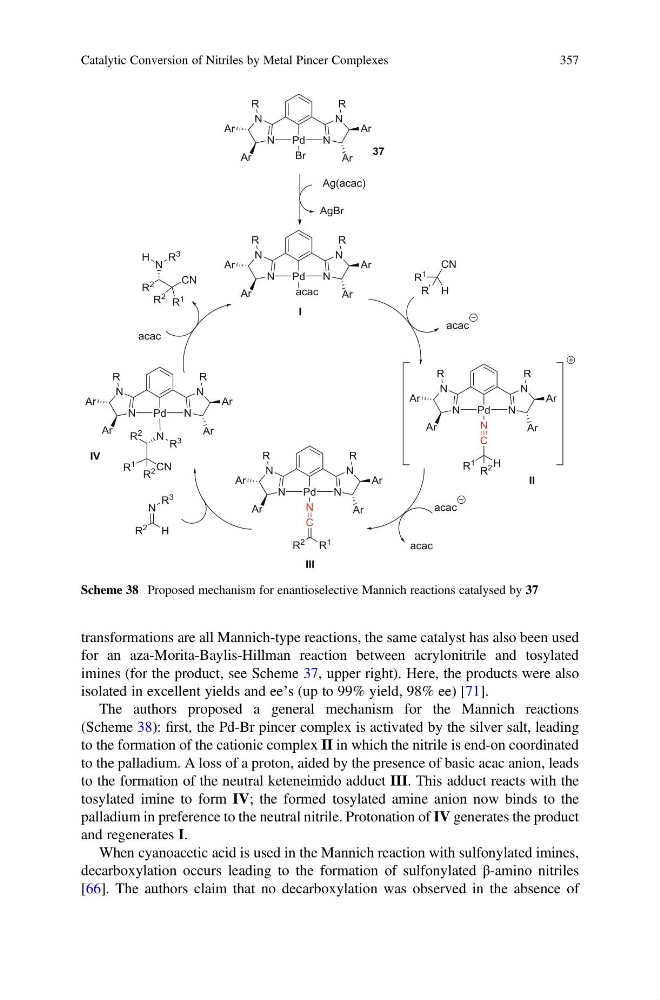
The authors proposed a general mechanism for the Mannich reactions
(Scheme 38): first, the Pd-Br pincer complex is activated by the silver salt, leading
to the formation of the cationic complex II in which the nitrile is end-on coordinated
to the palladium. A loss of a proton, aided by the presence of basic acac anion, leads
to the formation of the neutral keteneimido adduct III. This adduct reacts with the
tosylated imine to form IV; the formed tosylated amine anion now binds to the
palladium in preference to the neutral nitrile. Protonation of IV generates the product
and regenerates I.
When cyanoacetic acid is used in the Mannich reaction with sulfonylated imines,
decarboxylation occurs leading to the formation of sulfonylated β-amino nitriles
[66]. The authors claim that no decarboxylation was observed in the absence of
Scheme 38 Proposed mechanism for enantioselective Mannich reactions catalysed by 37
Catalytic Conversion of Nitriles by Metal Pincer Complexes
357
for an aza-Morita-Baylis-Hillman reaction between acrylonitrile and tosylated
imines (for the product, see Scheme 37, upper right). Here, the products were also
isolated in excellent yields and ee’s (up to 99% yield, 98% ee) [71].
The authors proposed a general mechanism for the Mannich reactions
(Scheme 38): first, the Pd-Br pincer complex is activated by the silver salt, leading
to the formation of the cationic complex II in which the nitrile is end-on coordinated
to the palladium. A loss of a proton, aided by the presence of basic acac anion, leads
to the formation of the neutral keteneimido adduct III. This adduct reacts with the
tosylated imine to form IV; the formed tosylated amine anion now binds to the
palladium in preference to the neutral nitrile. Protonation of IV generates the product
and regenerates I.
When cyanoacetic acid is used in the Mannich reaction with sulfonylated imines,
decarboxylation occurs leading to the formation of sulfonylated β-amino nitriles
[66]. The authors claim that no decarboxylation was observed in the absence of
Scheme 38 Proposed mechanism for enantioselective Mannich reactions catalysed by 37
Catalytic Conversion of Nitriles by Metal Pincer Complexes
357