

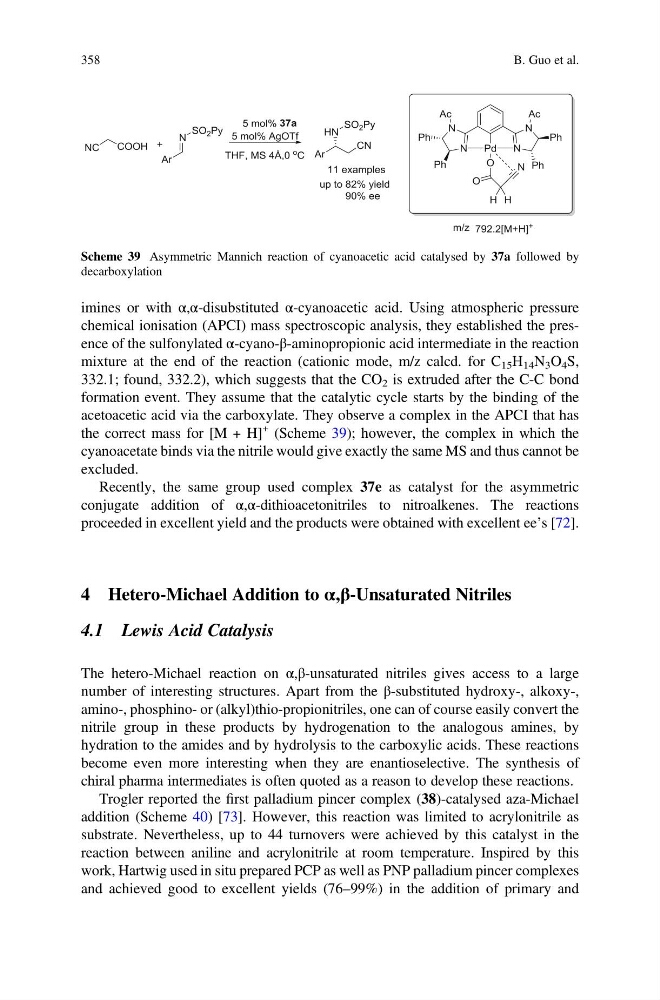
imines or with α,α-disubstituted α-cyanoacetic acid. Using atmospheric pressure
chemical ionisation (APCI) mass spectroscopic analysis, they established the presence of the sulfonylated α-cyano-β-aminopropionic acid intermediate in the reaction
mixture at the end of the reaction (cationic mode, m/z calcd. for C 15 H 14 N 3 O 4 S,
332.1; found, 332.2), which suggests that the CO 2 is extruded after the C-C bond
formation event. They assume that the catalytic cycle starts by the binding of the
acetoacetic acid via the carboxylate. They observe a complex in the APCI that has
the correct mass for [M + H]
+ (Scheme 39); however, the complex in which the
cyanoacetate binds via the nitrile would give exactly the same MS and thus cannot be
excluded.
Recently, the same group used complex 37e as catalyst for the asymmetric
conjugate addition of α,α-dithioacetonitriles to nitroalkenes. The reactions
proceeded in excellent yield and the products were obtained with excellent ee’s [72].
4 Hetero-Michael Addition to α,β-Unsaturated Nitriles
4.1 Lewis Acid Catalysis
The hetero-Michael reaction on α,β-unsaturated nitriles gives access to a large
number of interesting structures. Apart from the β-substituted hydroxy-, alkoxy-,
amino-, phosphino- or (alkyl)thio-propionitriles, one can of course easily convert the
nitrile group in these products by hydrogenation to the analogous amines, by
hydration to the amides and by hydrolysis to the carboxylic acids. These reactions
become even more interesting when they are enantioselective. The synthesis of
chiral pharma intermediates is often quoted as a reason to develop these reactions.
Trogler reported the first palladium pincer complex (38)-catalysed aza-Michael
addition (Scheme 40) [73]. However, this reaction was limited to acrylonitrile as
substrate. Nevertheless, up to 44 turnovers were achieved by this catalyst in the
reaction between aniline and acrylonitrile at room temperature. Inspired by this
work, Hartwig used in situ prepared PCP as well as PNP palladium pincer complexes
and achieved good to excellent yields (76–99%) in the addition of primary and
Scheme 39 Asymmetric Mannich reaction of cyanoacetic acid catalysed by 37a followed by
decarboxylation
358
B. Guo et al.
chemical ionisation (APCI) mass spectroscopic analysis, they established the presence of the sulfonylated α-cyano-β-aminopropionic acid intermediate in the reaction
mixture at the end of the reaction (cationic mode, m/z calcd. for C 15 H 14 N 3 O 4 S,
332.1; found, 332.2), which suggests that the CO 2 is extruded after the C-C bond
formation event. They assume that the catalytic cycle starts by the binding of the
acetoacetic acid via the carboxylate. They observe a complex in the APCI that has
the correct mass for [M + H]
+ (Scheme 39); however, the complex in which the
cyanoacetate binds via the nitrile would give exactly the same MS and thus cannot be
excluded.
Recently, the same group used complex 37e as catalyst for the asymmetric
conjugate addition of α,α-dithioacetonitriles to nitroalkenes. The reactions
proceeded in excellent yield and the products were obtained with excellent ee’s [72].
4 Hetero-Michael Addition to α,β-Unsaturated Nitriles
4.1 Lewis Acid Catalysis
The hetero-Michael reaction on α,β-unsaturated nitriles gives access to a large
number of interesting structures. Apart from the β-substituted hydroxy-, alkoxy-,
amino-, phosphino- or (alkyl)thio-propionitriles, one can of course easily convert the
nitrile group in these products by hydrogenation to the analogous amines, by
hydration to the amides and by hydrolysis to the carboxylic acids. These reactions
become even more interesting when they are enantioselective. The synthesis of
chiral pharma intermediates is often quoted as a reason to develop these reactions.
Trogler reported the first palladium pincer complex (38)-catalysed aza-Michael
addition (Scheme 40) [73]. However, this reaction was limited to acrylonitrile as
substrate. Nevertheless, up to 44 turnovers were achieved by this catalyst in the
reaction between aniline and acrylonitrile at room temperature. Inspired by this
work, Hartwig used in situ prepared PCP as well as PNP palladium pincer complexes
and achieved good to excellent yields (76–99%) in the addition of primary and
Scheme 39 Asymmetric Mannich reaction of cyanoacetic acid catalysed by 37a followed by
decarboxylation
358
B. Guo et al.