

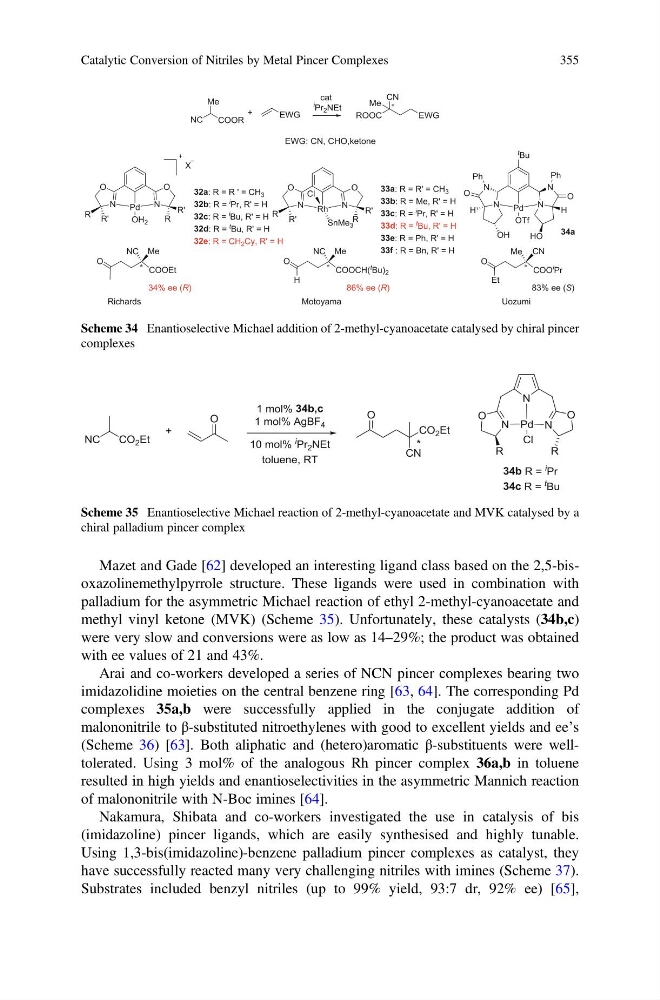
Mazet and Gade [62] developed an interesting ligand class based on the 2,5-bisoxazolinemethylpyrrole structure. These ligands were used in combination with
palladium for the asymmetric Michael reaction of ethyl 2-methyl-cyanoacetate and
methyl vinyl ketone (MVK) (Scheme 35). Unfortunately, these catalysts (34b,c)
were very slow and conversions were as low as 14–29%; the product was obtained
with ee values of 21 and 43%.
Arai and co-workers developed a series of NCN pincer complexes bearing two
imidazolidine moieties on the central benzene ring [63, 64]. The corresponding Pd
complexes 35a,b were successfully applied in the conjugate addition of
malononitrile to β-substituted nitroethylenes with good to excellent yields and ee’s
(Scheme 36) [63]. Both aliphatic and (hetero)aromatic β-substituents were welltolerated. Using 3 mol% of the analogous Rh pincer complex 36a,b in toluene
resulted in high yields and enantioselectivities in the asymmetric Mannich reaction
of malononitrile with N-Boc imines [64].
Nakamura, Shibata and co-workers investigated the use in catalysis of bis
(imidazoline) pincer ligands, which are easily synthesised and highly tunable.
Using 1,3-bis(imidazoline)-benzene palladium pincer complexes as catalyst, they
have successfully reacted many very challenging nitriles with imines (Scheme 37).
Substrates included benzyl nitriles (up to 99% yield, 93:7 dr, 92% ee) [65],
Scheme 34 Enantioselective Michael addition of 2-methyl-cyanoacetate catalysed by chiral pincer
complexes
Scheme 35 Enantioselective Michael reaction of 2-methyl-cyanoacetate and MVK catalysed by a
chiral palladium pincer complex
Catalytic Conversion of Nitriles by Metal Pincer Complexes
355
palladium for the asymmetric Michael reaction of ethyl 2-methyl-cyanoacetate and
methyl vinyl ketone (MVK) (Scheme 35). Unfortunately, these catalysts (34b,c)
were very slow and conversions were as low as 14–29%; the product was obtained
with ee values of 21 and 43%.
Arai and co-workers developed a series of NCN pincer complexes bearing two
imidazolidine moieties on the central benzene ring [63, 64]. The corresponding Pd
complexes 35a,b were successfully applied in the conjugate addition of
malononitrile to β-substituted nitroethylenes with good to excellent yields and ee’s
(Scheme 36) [63]. Both aliphatic and (hetero)aromatic β-substituents were welltolerated. Using 3 mol% of the analogous Rh pincer complex 36a,b in toluene
resulted in high yields and enantioselectivities in the asymmetric Mannich reaction
of malononitrile with N-Boc imines [64].
Nakamura, Shibata and co-workers investigated the use in catalysis of bis
(imidazoline) pincer ligands, which are easily synthesised and highly tunable.
Using 1,3-bis(imidazoline)-benzene palladium pincer complexes as catalyst, they
have successfully reacted many very challenging nitriles with imines (Scheme 37).
Substrates included benzyl nitriles (up to 99% yield, 93:7 dr, 92% ee) [65],
Scheme 34 Enantioselective Michael addition of 2-methyl-cyanoacetate catalysed by chiral pincer
complexes
Scheme 35 Enantioselective Michael reaction of 2-methyl-cyanoacetate and MVK catalysed by a
chiral palladium pincer complex
Catalytic Conversion of Nitriles by Metal Pincer Complexes
355