

3.7 Enantioselective α-Functionalisation of Nitriles
Quite some effort has gone into developing enantioselective versions of the reactions
described above. Richards and co-workers did pioneering work on the synthesis of
cationic NCN Pd pincer complexes 32a–e bearing two chiral oxazoline ligands on
the central benzene ring (Scheme 34) [58, 59]. They reported the asymmetric
Michael addition of 2-methyl-cyanoacetate to α,β-unsaturated ketones/nitriles
catalysed by these complexes. Unfortunately, the enantioselectivity of these reactions remained low and did not exceed 34%. Motoyoma and co-workers found that
simply replacing the Pd metal by Rh (carrying additional chloride and Me 3 Sn
ligands) but using similar ligands gave complexes 33a–f that led to a significant
improvement of the enantioselectivity of this type of reaction, reaching values above
80% [60]. Uozumi [61] and co-workers used their unique Pd pincer complex 34a
bearing two chiral hexahydro-1H-pyrrolo[1,2-c]imidazol-1-one moieties on the
central benzene ring. In the Michael reaction on ethyl acrylate catalysed by this
complex, an ee of 83% was obtained.
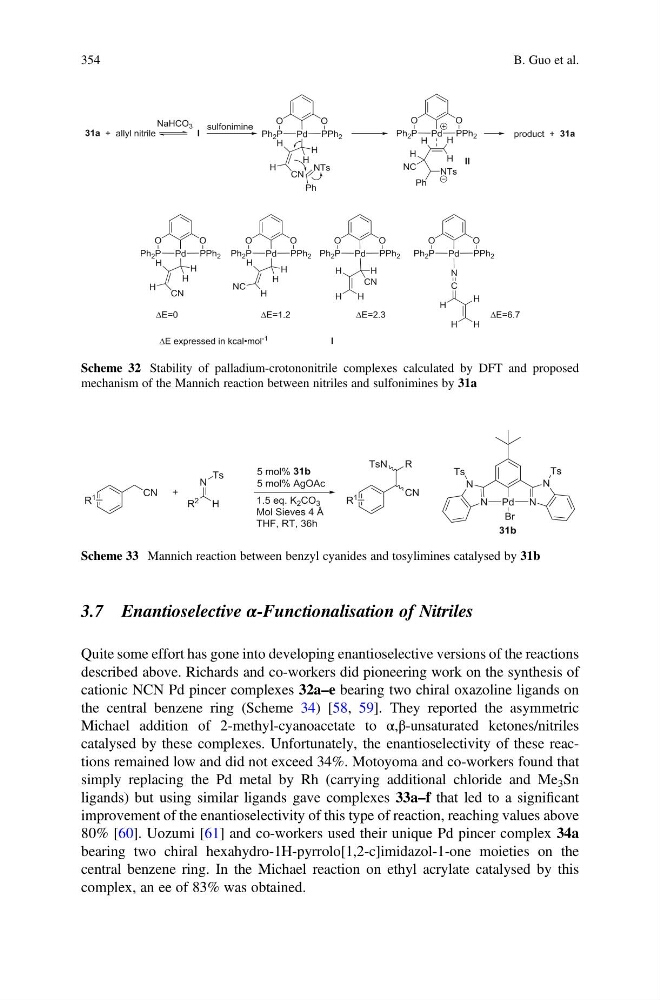
Scheme 32 Stability of palladium-crotononitrile complexes calculated by DFT and proposed
mechanism of the Mannich reaction between nitriles and sulfonimines by 31a
Scheme 33 Mannich reaction between benzyl cyanides and tosylimines catalysed by 31b
354
B. Guo et al.
Quite some effort has gone into developing enantioselective versions of the reactions
described above. Richards and co-workers did pioneering work on the synthesis of
cationic NCN Pd pincer complexes 32a–e bearing two chiral oxazoline ligands on
the central benzene ring (Scheme 34) [58, 59]. They reported the asymmetric
Michael addition of 2-methyl-cyanoacetate to α,β-unsaturated ketones/nitriles
catalysed by these complexes. Unfortunately, the enantioselectivity of these reactions remained low and did not exceed 34%. Motoyoma and co-workers found that
simply replacing the Pd metal by Rh (carrying additional chloride and Me 3 Sn
ligands) but using similar ligands gave complexes 33a–f that led to a significant
improvement of the enantioselectivity of this type of reaction, reaching values above
80% [60]. Uozumi [61] and co-workers used their unique Pd pincer complex 34a
bearing two chiral hexahydro-1H-pyrrolo[1,2-c]imidazol-1-one moieties on the
central benzene ring. In the Michael reaction on ethyl acrylate catalysed by this
complex, an ee of 83% was obtained.
Scheme 32 Stability of palladium-crotononitrile complexes calculated by DFT and proposed
mechanism of the Mannich reaction between nitriles and sulfonimines by 31a
Scheme 33 Mannich reaction between benzyl cyanides and tosylimines catalysed by 31b
354
B. Guo et al.