

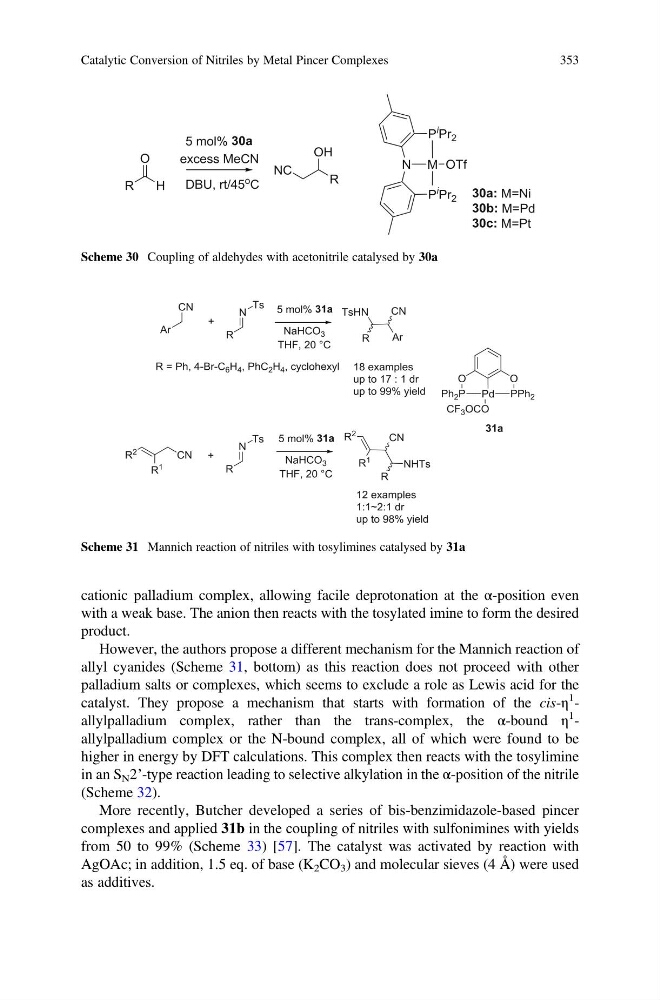
cationic palladium complex, allowing facile deprotonation at the α-position even
with a weak base. The anion then reacts with the tosylated imine to form the desired
product.
However, the authors propose a different mechanism for the Mannich reaction of
allyl cyanides (Scheme 31, bottom) as this reaction does not proceed with other
palladium salts or complexes, which seems to exclude a role as Lewis acid for the
catalyst. They propose a mechanism that starts with formation of the cis-η
1 -
allylpalladium complex, rather than the trans-complex, the α-bound η
1 -
allylpalladium complex or the N-bound complex, all of which were found to be
higher in energy by DFT calculations. This complex then reacts with the tosylimine
in an S N 2’-type reaction leading to selective alkylation in the α-position of the nitrile
(Scheme 32).
More recently, Butcher developed a series of bis-benzimidazole-based pincer
complexes and applied 31b in the coupling of nitriles with sulfonimines with yields
from 50 to 99% (Scheme 33) [57]. The catalyst was activated by reaction with
AgOAc; in addition, 1.5 eq. of base (K 2 CO 3 ) and molecular sieves (4 Å) were used
as additives.
Scheme 30 Coupling of aldehydes with acetonitrile catalysed by 30a
Scheme 31 Mannich reaction of nitriles with tosylimines catalysed by 31a
Catalytic Conversion of Nitriles by Metal Pincer Complexes
353
with a weak base. The anion then reacts with the tosylated imine to form the desired
product.
However, the authors propose a different mechanism for the Mannich reaction of
allyl cyanides (Scheme 31, bottom) as this reaction does not proceed with other
palladium salts or complexes, which seems to exclude a role as Lewis acid for the
catalyst. They propose a mechanism that starts with formation of the cis-η
1 -
allylpalladium complex, rather than the trans-complex, the α-bound η
1 -
allylpalladium complex or the N-bound complex, all of which were found to be
higher in energy by DFT calculations. This complex then reacts with the tosylimine
in an S N 2’-type reaction leading to selective alkylation in the α-position of the nitrile
(Scheme 32).
More recently, Butcher developed a series of bis-benzimidazole-based pincer
complexes and applied 31b in the coupling of nitriles with sulfonimines with yields
from 50 to 99% (Scheme 33) [57]. The catalyst was activated by reaction with
AgOAc; in addition, 1.5 eq. of base (K 2 CO 3 ) and molecular sieves (4 Å) were used
as additives.
Scheme 30 Coupling of aldehydes with acetonitrile catalysed by 30a
Scheme 31 Mannich reaction of nitriles with tosylimines catalysed by 31a
Catalytic Conversion of Nitriles by Metal Pincer Complexes
353