

aromatic rings were well-tolerated. Since acylation of saturated nitriles under the
reaction conditions failed, the authors proposed that the role of DBU is solely to
activate the anhydrides, but it does not promote the base-assisted acylation of the
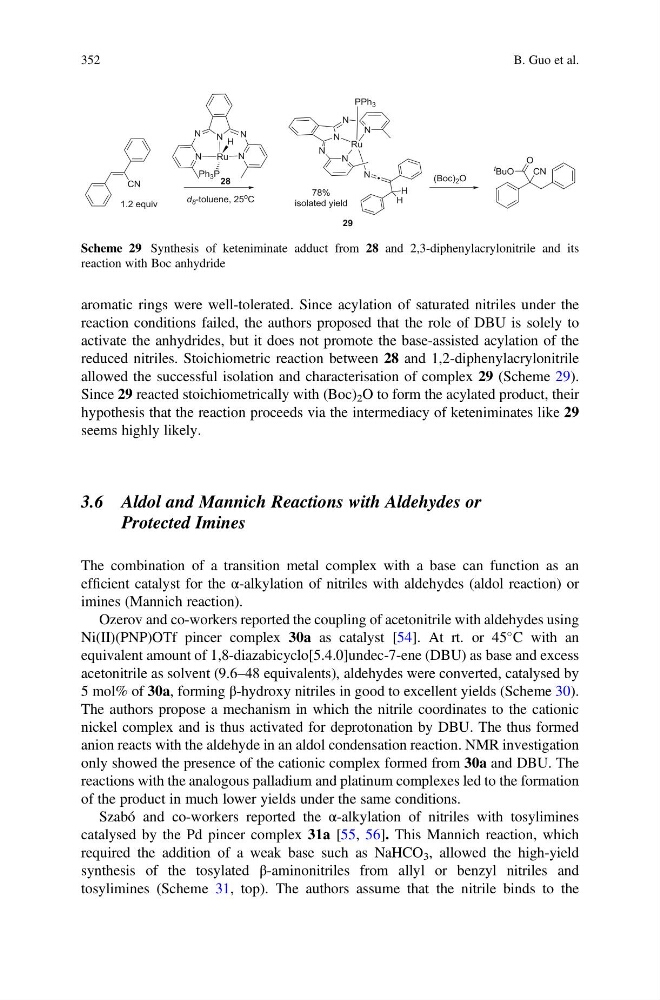
reduced nitriles. Stoichiometric reaction between 28 and 1,2-diphenylacrylonitrile
allowed the successful isolation and characterisation of complex 29 (Scheme 29).
Since 29 reacted stoichiometrically with (Boc) 2 O to form the acylated product, their
hypothesis that the reaction proceeds via the intermediacy of keteniminates like 29
seems highly likely.
3.6 Aldol and Mannich Reactions with Aldehydes or
Protected Imines
The combination of a transition metal complex with a base can function as an
efficient catalyst for the α-alkylation of nitriles with aldehydes (aldol reaction) or
imines (Mannich reaction).
Ozerov and co-workers reported the coupling of acetonitrile with aldehydes using
Ni(II)(PNP)OTf pincer complex 30a as catalyst [54]. At rt. or 45
C with an
equivalent amount of 1,8-diazabicyclo[5.4.0]undec-7-ene (DBU) as base and excess
acetonitrile as solvent (9.6–48 equivalents), aldehydes were converted, catalysed by
5 mol% of 30a, forming β-hydroxy nitriles in good to excellent yields (Scheme 30).
The authors propose a mechanism in which the nitrile coordinates to the cationic
nickel complex and is thus activated for deprotonation by DBU. The thus formed
anion reacts with the aldehyde in an aldol condensation reaction. NMR investigation
only showed the presence of the cationic complex formed from 30a and DBU. The
reactions with the analogous palladium and platinum complexes led to the formation
of the product in much lower yields under the same conditions.
Szabó and co-workers reported the α-alkylation of nitriles with tosylimines
catalysed by the Pd pincer complex 31a [55, 56]. This Mannich reaction, which
required the addition of a weak base such as NaHCO 3 , allowed the high-yield
synthesis of the tosylated β-aminonitriles from allyl or benzyl nitriles and
tosylimines (Scheme 31, top). The authors assume that the nitrile binds to the
Scheme 29 Synthesis of keteniminate adduct from 28 and 2,3-diphenylacrylonitrile and its
reaction with Boc anhydride
352
B. Guo et al.
reaction conditions failed, the authors proposed that the role of DBU is solely to
activate the anhydrides, but it does not promote the base-assisted acylation of the
reduced nitriles. Stoichiometric reaction between 28 and 1,2-diphenylacrylonitrile
allowed the successful isolation and characterisation of complex 29 (Scheme 29).
Since 29 reacted stoichiometrically with (Boc) 2 O to form the acylated product, their
hypothesis that the reaction proceeds via the intermediacy of keteniminates like 29
seems highly likely.
3.6 Aldol and Mannich Reactions with Aldehydes or
Protected Imines
The combination of a transition metal complex with a base can function as an
efficient catalyst for the α-alkylation of nitriles with aldehydes (aldol reaction) or
imines (Mannich reaction).
Ozerov and co-workers reported the coupling of acetonitrile with aldehydes using
Ni(II)(PNP)OTf pincer complex 30a as catalyst [54]. At rt. or 45
C with an
equivalent amount of 1,8-diazabicyclo[5.4.0]undec-7-ene (DBU) as base and excess
acetonitrile as solvent (9.6–48 equivalents), aldehydes were converted, catalysed by
5 mol% of 30a, forming β-hydroxy nitriles in good to excellent yields (Scheme 30).
The authors propose a mechanism in which the nitrile coordinates to the cationic
nickel complex and is thus activated for deprotonation by DBU. The thus formed
anion reacts with the aldehyde in an aldol condensation reaction. NMR investigation
only showed the presence of the cationic complex formed from 30a and DBU. The
reactions with the analogous palladium and platinum complexes led to the formation
of the product in much lower yields under the same conditions.
Szabó and co-workers reported the α-alkylation of nitriles with tosylimines
catalysed by the Pd pincer complex 31a [55, 56]. This Mannich reaction, which
required the addition of a weak base such as NaHCO 3 , allowed the high-yield
synthesis of the tosylated β-aminonitriles from allyl or benzyl nitriles and
tosylimines (Scheme 31, top). The authors assume that the nitrile binds to the
Scheme 29 Synthesis of keteniminate adduct from 28 and 2,3-diphenylacrylonitrile and its
reaction with Boc anhydride
352
B. Guo et al.