

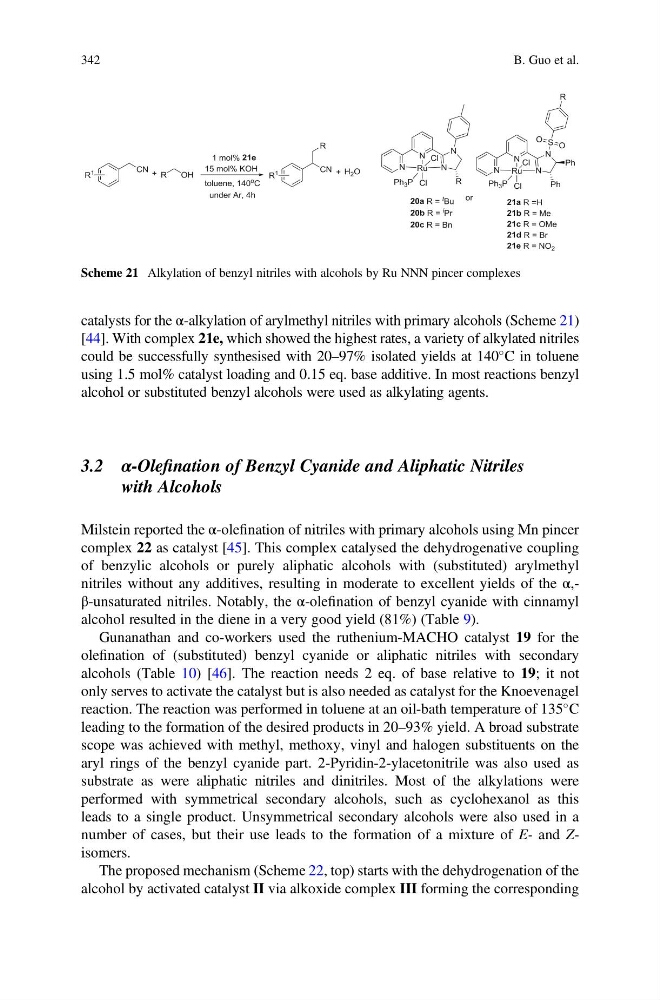
catalysts for the α-alkylation of arylmethyl nitriles with primary alcohols (Scheme 21)
[44]. With complex 21e, which showed the highest rates, a variety of alkylated nitriles
could be successfully synthesised with 20–97% isolated yields at 140
C in toluene
using 1.5 mol% catalyst loading and 0.15 eq. base additive. In most reactions benzyl
alcohol or substituted benzyl alcohols were used as alkylating agents.
3.2 α-Olefination of Benzyl Cyanide and Aliphatic Nitriles
with Alcohols
Milstein reported the α-olefination of nitriles with primary alcohols using Mn pincer
complex 22 as catalyst [45]. This complex catalysed the dehydrogenative coupling
of benzylic alcohols or purely aliphatic alcohols with (substituted) arylmethyl
nitriles without any additives, resulting in moderate to excellent yields of the α,β-unsaturated nitriles. Notably, the α-olefination of benzyl cyanide with cinnamyl
alcohol resulted in the diene in a very good yield (81%) (Table 9).
Gunanathan and co-workers used the ruthenium-MACHO catalyst 19 for the
olefination of (substituted) benzyl cyanide or aliphatic nitriles with secondary
alcohols (Table 10) [46]. The reaction needs 2 eq. of base relative to 19; it not
only serves to activate the catalyst but is also needed as catalyst for the Knoevenagel
reaction. The reaction was performed in toluene at an oil-bath temperature of 135
C
leading to the formation of the desired products in 20–93% yield. A broad substrate
scope was achieved with methyl, methoxy, vinyl and halogen substituents on the
aryl rings of the benzyl cyanide part. 2-Pyridin-2-ylacetonitrile was also used as
substrate as were aliphatic nitriles and dinitriles. Most of the alkylations were
performed with symmetrical secondary alcohols, such as cyclohexanol as this
leads to a single product. Unsymmetrical secondary alcohols were also used in a
number of cases, but their use leads to the formation of a mixture of E- and Zisomers.
The proposed mechanism (Scheme 22, top) starts with the dehydrogenation of the
alcohol by activated catalyst II via alkoxide complex III forming the corresponding
Scheme 21 Alkylation of benzyl nitriles with alcohols by Ru NNN pincer complexes
342
B. Guo et al.
[44]. With complex 21e, which showed the highest rates, a variety of alkylated nitriles
could be successfully synthesised with 20–97% isolated yields at 140
C in toluene
using 1.5 mol% catalyst loading and 0.15 eq. base additive. In most reactions benzyl
alcohol or substituted benzyl alcohols were used as alkylating agents.
3.2 α-Olefination of Benzyl Cyanide and Aliphatic Nitriles
with Alcohols
Milstein reported the α-olefination of nitriles with primary alcohols using Mn pincer
complex 22 as catalyst [45]. This complex catalysed the dehydrogenative coupling
of benzylic alcohols or purely aliphatic alcohols with (substituted) arylmethyl
nitriles without any additives, resulting in moderate to excellent yields of the α,β-unsaturated nitriles. Notably, the α-olefination of benzyl cyanide with cinnamyl
alcohol resulted in the diene in a very good yield (81%) (Table 9).
Gunanathan and co-workers used the ruthenium-MACHO catalyst 19 for the
olefination of (substituted) benzyl cyanide or aliphatic nitriles with secondary
alcohols (Table 10) [46]. The reaction needs 2 eq. of base relative to 19; it not
only serves to activate the catalyst but is also needed as catalyst for the Knoevenagel
reaction. The reaction was performed in toluene at an oil-bath temperature of 135
C
leading to the formation of the desired products in 20–93% yield. A broad substrate
scope was achieved with methyl, methoxy, vinyl and halogen substituents on the
aryl rings of the benzyl cyanide part. 2-Pyridin-2-ylacetonitrile was also used as
substrate as were aliphatic nitriles and dinitriles. Most of the alkylations were
performed with symmetrical secondary alcohols, such as cyclohexanol as this
leads to a single product. Unsymmetrical secondary alcohols were also used in a
number of cases, but their use leads to the formation of a mixture of E- and Zisomers.
The proposed mechanism (Scheme 22, top) starts with the dehydrogenation of the
alcohol by activated catalyst II via alkoxide complex III forming the corresponding
Scheme 21 Alkylation of benzyl nitriles with alcohols by Ru NNN pincer complexes
342
B. Guo et al.