

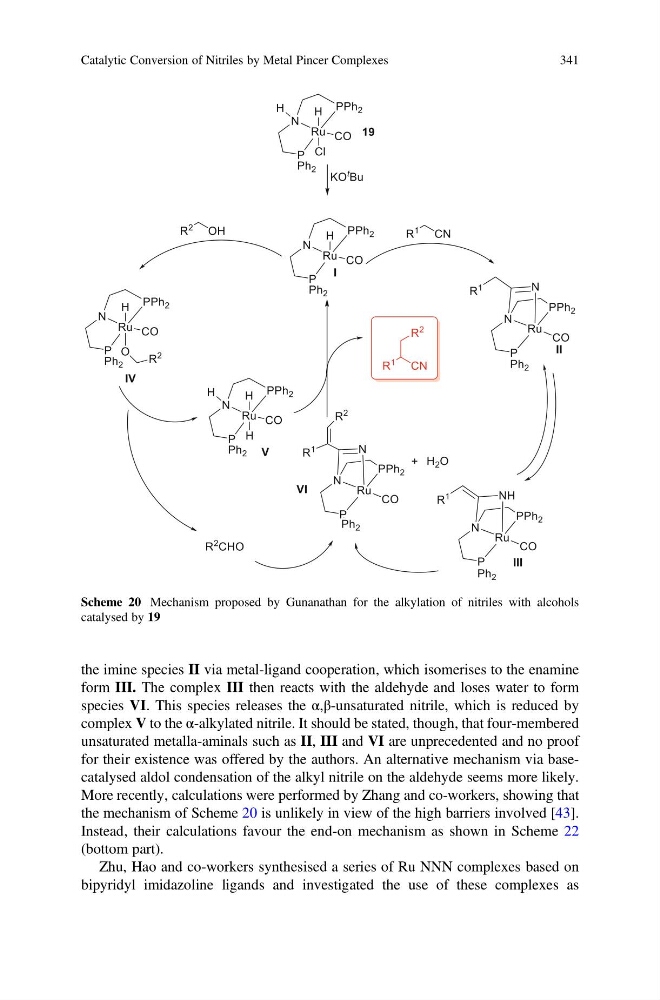
the imine species II via metal-ligand cooperation, which isomerises to the enamine
form III. The complex III then reacts with the aldehyde and loses water to form
species VI. This species releases the α,β-unsaturated nitrile, which is reduced by
complex V to the α-alkylated nitrile. It should be stated, though, that four-membered
unsaturated metalla-aminals such as II, III and VI are unprecedented and no proof
for their existence was offered by the authors. An alternative mechanism via basecatalysed aldol condensation of the alkyl nitrile on the aldehyde seems more likely.
More recently, calculations were performed by Zhang and co-workers, showing that
the mechanism of Scheme 20 is unlikely in view of the high barriers involved [43].
Instead, their calculations favour the end-on mechanism as shown in Scheme 22
(bottom part).
Zhu, Hao and co-workers synthesised a series of Ru NNN complexes based on
bipyridyl imidazoline ligands and investigated the use of these complexes as
Scheme 20 Mechanism proposed by Gunanathan for the alkylation of nitriles with alcohols
catalysed by 19
Catalytic Conversion of Nitriles by Metal Pincer Complexes
341
form III. The complex III then reacts with the aldehyde and loses water to form
species VI. This species releases the α,β-unsaturated nitrile, which is reduced by
complex V to the α-alkylated nitrile. It should be stated, though, that four-membered
unsaturated metalla-aminals such as II, III and VI are unprecedented and no proof
for their existence was offered by the authors. An alternative mechanism via basecatalysed aldol condensation of the alkyl nitrile on the aldehyde seems more likely.
More recently, calculations were performed by Zhang and co-workers, showing that
the mechanism of Scheme 20 is unlikely in view of the high barriers involved [43].
Instead, their calculations favour the end-on mechanism as shown in Scheme 22
(bottom part).
Zhu, Hao and co-workers synthesised a series of Ru NNN complexes based on
bipyridyl imidazoline ligands and investigated the use of these complexes as
Scheme 20 Mechanism proposed by Gunanathan for the alkylation of nitriles with alcohols
catalysed by 19
Catalytic Conversion of Nitriles by Metal Pincer Complexes
341