

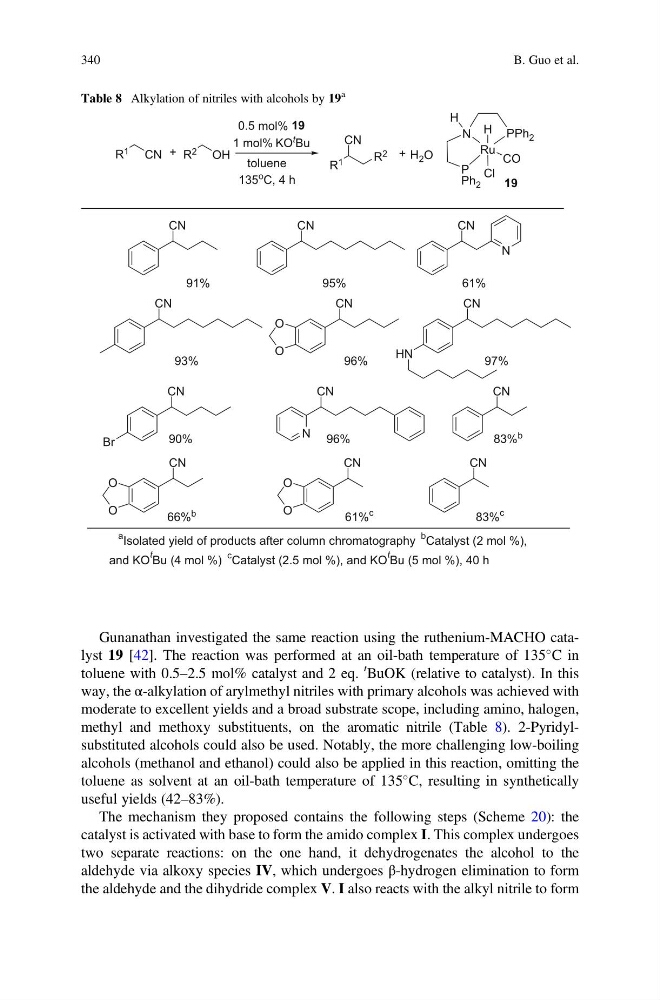
Gunanathan investigated the same reaction using the ruthenium-MACHO catalyst 19 [42]. The reaction was performed at an oil-bath temperature of 135
C in
toluene with 0.5–2.5 mol% catalyst and 2 eq.
t BuOK (relative to catalyst). In this
way, the α-alkylation of arylmethyl nitriles with primary alcohols was achieved with
moderate to excellent yields and a broad substrate scope, including amino, halogen,
methyl and methoxy substituents, on the aromatic nitrile (Table 8). 2-Pyridylsubstituted alcohols could also be used. Notably, the more challenging low-boiling
alcohols (methanol and ethanol) could also be applied in this reaction, omitting the
toluene as solvent at an oil-bath temperature of 135
C, resulting in synthetically
useful yields (42–83%).
The mechanism they proposed contains the following steps (Scheme 20): the
catalyst is activated with base to form the amido complex I. This complex undergoes
two separate reactions: on the one hand, it dehydrogenates the alcohol to the
aldehyde via alkoxy species IV, which undergoes β-hydrogen elimination to form
the aldehyde and the dihydride complex V. I also reacts with the alkyl nitrile to form
Table 8 Alkylation of nitriles with alcohols by 19
a
R 1 CN + R 2 OH
0.5 mol% 19
1 mol% KO
t Bu
toluene
135
o C, 4 h
R 1
CN
R 2
N
P
PPh 2
Ru CO
H
Cl
H
+ H 2 O
CN
91%
CN
95%
CN
61%
N
CN
93%
CN
96%
O
O
CN
97%
HN
CN
90%
Br
CN
N 96%
CN
83% b
CN
66% b
O
O
CN
61%
c
O
O
CN
83%
c
a Isolated yield of products after column chromatography
b Catalyst (2 mol %),
and KO
t Bu (4 mol %)
c Catalyst (2.5 mol %), and KO
t Bu (5 mol %), 40 h
19
Ph 2
340
B. Guo et al.
C in
toluene with 0.5–2.5 mol% catalyst and 2 eq.
t BuOK (relative to catalyst). In this
way, the α-alkylation of arylmethyl nitriles with primary alcohols was achieved with
moderate to excellent yields and a broad substrate scope, including amino, halogen,
methyl and methoxy substituents, on the aromatic nitrile (Table 8). 2-Pyridylsubstituted alcohols could also be used. Notably, the more challenging low-boiling
alcohols (methanol and ethanol) could also be applied in this reaction, omitting the
toluene as solvent at an oil-bath temperature of 135
C, resulting in synthetically
useful yields (42–83%).
The mechanism they proposed contains the following steps (Scheme 20): the
catalyst is activated with base to form the amido complex I. This complex undergoes
two separate reactions: on the one hand, it dehydrogenates the alcohol to the
aldehyde via alkoxy species IV, which undergoes β-hydrogen elimination to form
the aldehyde and the dihydride complex V. I also reacts with the alkyl nitrile to form
Table 8 Alkylation of nitriles with alcohols by 19
a
R 1 CN + R 2 OH
0.5 mol% 19
1 mol% KO
t Bu
toluene
135
o C, 4 h
R 1
CN
R 2
N
P
PPh 2
Ru CO
H
Cl
H
+ H 2 O
CN
91%
CN
95%
CN
61%
N
CN
93%
CN
96%
O
O
CN
97%
HN
CN
90%
Br
CN
N 96%
CN
83% b
CN
66% b
O
O
CN
61%
c
O
O
CN
83%
c
a Isolated yield of products after column chromatography
b Catalyst (2 mol %),
and KO
t Bu (4 mol %)
c Catalyst (2.5 mol %), and KO
t Bu (5 mol %), 40 h
19
Ph 2
340
B. Guo et al.