

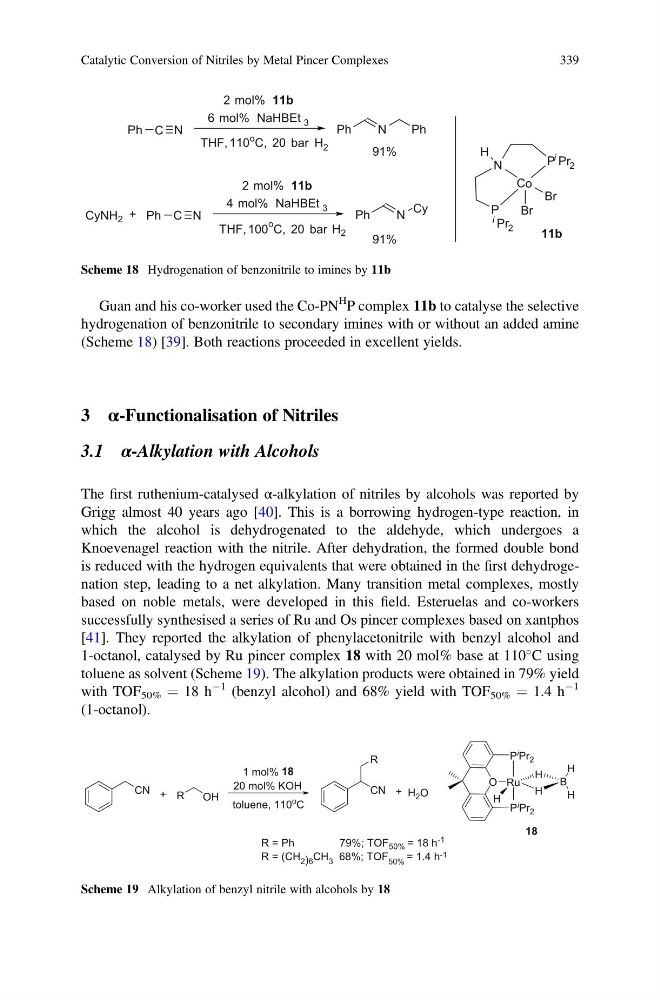
Guan and his co-worker used the Co-PN
H P complex 11b to catalyse the selective
hydrogenation of benzonitrile to secondary imines with or without an added amine
(Scheme 18) [39]. Both reactions proceeded in excellent yields.
3 α-Functionalisation of Nitriles
3.1 α-Alkylation with Alcohols
The first ruthenium-catalysed α-alkylation of nitriles by alcohols was reported by
Grigg almost 40 years ago [40]. This is a borrowing hydrogen-type reaction, in
which the alcohol is dehydrogenated to the aldehyde, which undergoes a
Knoevenagel reaction with the nitrile. After dehydration, the formed double bond
is reduced with the hydrogen equivalents that were obtained in the first dehydrogenation step, leading to a net alkylation. Many transition metal complexes, mostly
based on noble metals, were developed in this field. Esteruelas and co-workers
successfully synthesised a series of Ru and Os pincer complexes based on xantphos
[41]. They reported the alkylation of phenylacetonitrile with benzyl alcohol and
1-octanol, catalysed by Ru pincer complex 18 with 20 mol% base at 110
C using
toluene as solvent (Scheme 19). The alkylation products were obtained in 79% yield
with TOF 50% ¼ 18 h
À1 (benzyl alcohol) and 68% yield with TOF 50% ¼ 1.4 h
À1
(1-octanol).
Ph C N
Ph
N
Ph
2 mol% 11b
6 mol% NaHBEt 3
THF, 110
o C, 20 bar H 2
N
P
P
i Pr 2
Co
Br
Br
H
91%
Ph C N
Ph
N
Cy
2 mol% 11b
4 mol% NaHBEt 3
THF, 100
o C, 20 bar H 2
91%
CyNH 2 +
11b
i Pr 2
Scheme 18 Hydrogenation of benzonitrile to imines by 11b
CN
R
OH
+
1 mol% 18
20 mol% KOH
toluene, 110
o C
CN + H 2 O
R = Ph
79%; TOF 50% = 18 h
-1
R = (CH 2)6 CH 3 68%; TOF 50% = 1.4 h -1
O
P i Pr 2
P i Pr 2
Ru
H
H
H
B
18
R
H
H
Scheme 19 Alkylation of benzyl nitrile with alcohols by 18
Catalytic Conversion of Nitriles by Metal Pincer Complexes
339
H P complex 11b to catalyse the selective
hydrogenation of benzonitrile to secondary imines with or without an added amine
(Scheme 18) [39]. Both reactions proceeded in excellent yields.
3 α-Functionalisation of Nitriles
3.1 α-Alkylation with Alcohols
The first ruthenium-catalysed α-alkylation of nitriles by alcohols was reported by
Grigg almost 40 years ago [40]. This is a borrowing hydrogen-type reaction, in
which the alcohol is dehydrogenated to the aldehyde, which undergoes a
Knoevenagel reaction with the nitrile. After dehydration, the formed double bond
is reduced with the hydrogen equivalents that were obtained in the first dehydrogenation step, leading to a net alkylation. Many transition metal complexes, mostly
based on noble metals, were developed in this field. Esteruelas and co-workers
successfully synthesised a series of Ru and Os pincer complexes based on xantphos
[41]. They reported the alkylation of phenylacetonitrile with benzyl alcohol and
1-octanol, catalysed by Ru pincer complex 18 with 20 mol% base at 110
C using
toluene as solvent (Scheme 19). The alkylation products were obtained in 79% yield
with TOF 50% ¼ 18 h
À1 (benzyl alcohol) and 68% yield with TOF 50% ¼ 1.4 h
À1
(1-octanol).
Ph C N
Ph
N
Ph
2 mol% 11b
6 mol% NaHBEt 3
THF, 110
o C, 20 bar H 2
N
P
P
i Pr 2
Co
Br
Br
H
91%
Ph C N
Ph
N
Cy
2 mol% 11b
4 mol% NaHBEt 3
THF, 100
o C, 20 bar H 2
91%
CyNH 2 +
11b
i Pr 2
Scheme 18 Hydrogenation of benzonitrile to imines by 11b
CN
R
OH
+
1 mol% 18
20 mol% KOH
toluene, 110
o C
CN + H 2 O
R = Ph
79%; TOF 50% = 18 h
-1
R = (CH 2)6 CH 3 68%; TOF 50% = 1.4 h -1
O
P i Pr 2
P i Pr 2
Ru
H
H
H
B
18
R
H
H
Scheme 19 Alkylation of benzyl nitrile with alcohols by 18
Catalytic Conversion of Nitriles by Metal Pincer Complexes
339