

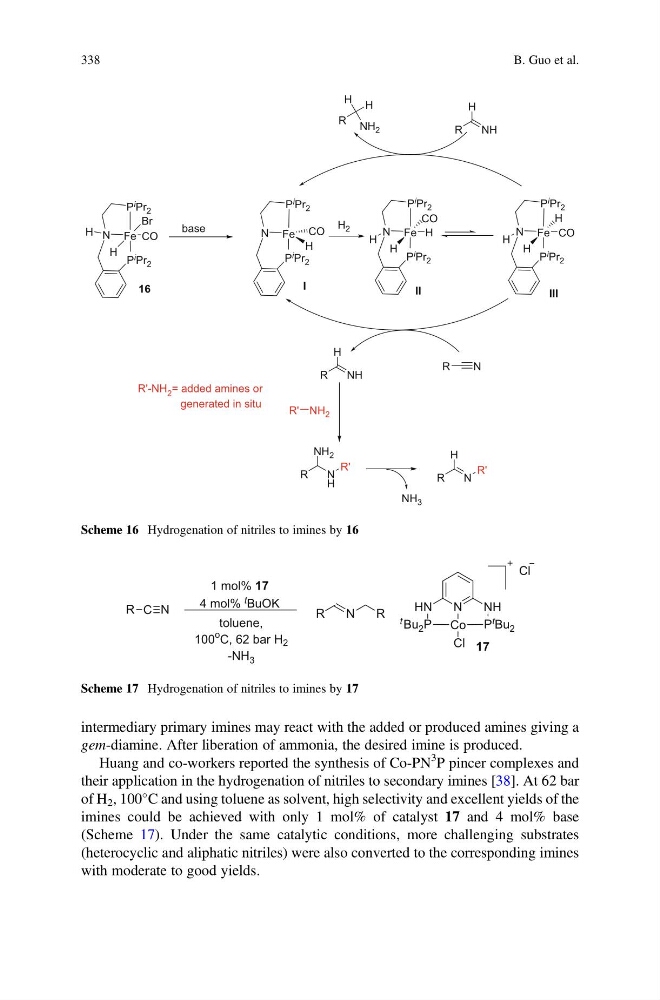
intermediary primary imines may react with the added or produced amines giving a
gem-diamine. After liberation of ammonia, the desired imine is produced.
Huang and co-workers reported the synthesis of Co-PN
3 P pincer complexes and
their application in the hydrogenation of nitriles to secondary imines [38]. At 62 bar
of H 2 , 100
C and using toluene as solvent, high selectivity and excellent yields of the
imines could be achieved with only 1 mol% of catalyst 17 and 4 mol% base
(Scheme 17). Under the same catalytic conditions, more challenging substrates
(heterocyclic and aliphatic nitriles) were also converted to the corresponding imines
with moderate to good yields.
N
P i Pr 2
P i Pr 2
Fe CO
H
Br
H
base
N
P i Pr 2
P i Pr 2
Fe CO
H
N
P i Pr 2
P i Pr 2
Fe
CO
H
H 2
H
H
N
P i Pr 2
P i Pr 2
Fe
H
H
CO
H
N
R
NH
R
H
NH
R
H
NH 2
R
H H
N
H
R
NH 2
R'
N
R
H
R'
NH 3
R' NH 2
R'-NH 2 = added amines or
generated in situ
16
I
II
III
Scheme 16 Hydrogenation of nitriles to imines by 16
R C N
R
N
1 mol% 17
4 mol% t BuOK
toluene,
100
o C, 62 bar H 2
-NH 3
N
HN
t Bu 2 P
NH
P t Bu 2
Co
Cl
Cl
R
17
Scheme 17 Hydrogenation of nitriles to imines by 17
338
B. Guo et al.
gem-diamine. After liberation of ammonia, the desired imine is produced.
Huang and co-workers reported the synthesis of Co-PN
3 P pincer complexes and
their application in the hydrogenation of nitriles to secondary imines [38]. At 62 bar
of H 2 , 100
C and using toluene as solvent, high selectivity and excellent yields of the
imines could be achieved with only 1 mol% of catalyst 17 and 4 mol% base
(Scheme 17). Under the same catalytic conditions, more challenging substrates
(heterocyclic and aliphatic nitriles) were also converted to the corresponding imines
with moderate to good yields.
N
P i Pr 2
P i Pr 2
Fe CO
H
Br
H
base
N
P i Pr 2
P i Pr 2
Fe CO
H
N
P i Pr 2
P i Pr 2
Fe
CO
H
H 2
H
H
N
P i Pr 2
P i Pr 2
Fe
H
H
CO
H
N
R
NH
R
H
NH
R
H
NH 2
R
H H
N
H
R
NH 2
R'
N
R
H
R'
NH 3
R' NH 2
R'-NH 2 = added amines or
generated in situ
16
I
II
III
Scheme 16 Hydrogenation of nitriles to imines by 16
R C N
R
N
1 mol% 17
4 mol% t BuOK
toluene,
100
o C, 62 bar H 2
-NH 3
N
HN
t Bu 2 P
NH
P t Bu 2
Co
Cl
Cl
R
17
Scheme 17 Hydrogenation of nitriles to imines by 17
338
B. Guo et al.