

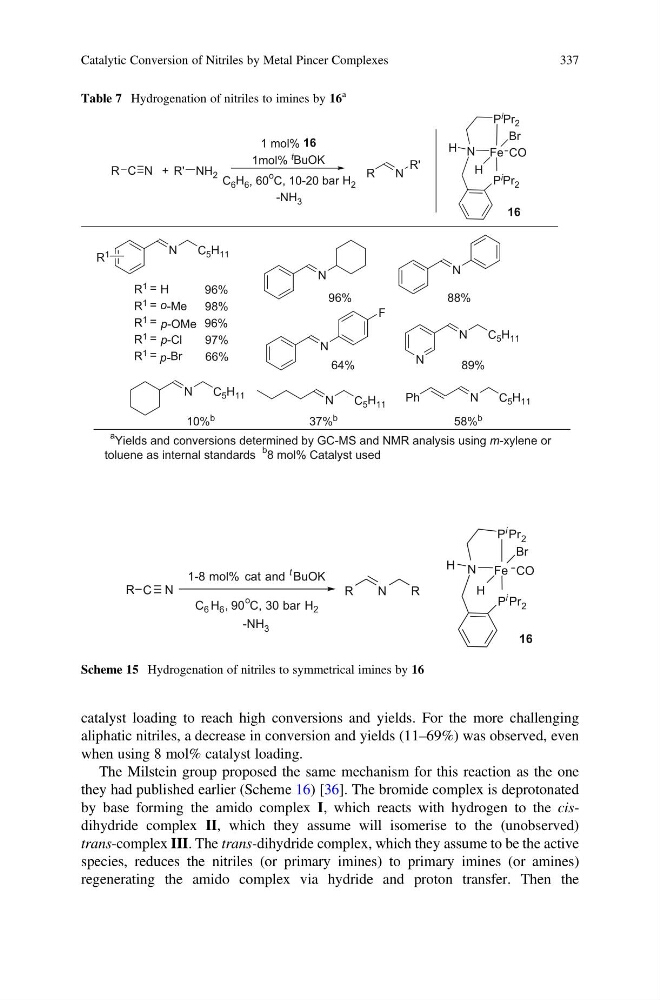
catalyst loading to reach high conversions and yields. For the more challenging
aliphatic nitriles, a decrease in conversion and yields (11–69%) was observed, even
when using 8 mol% catalyst loading.
The Milstein group proposed the same mechanism for this reaction as the one
they had published earlier (Scheme 16) [36]. The bromide complex is deprotonated
by base forming the amido complex I, which reacts with hydrogen to the cisdihydride complex II, which they assume will isomerise to the (unobserved)
trans-complex III. The trans-dihydride complex, which they assume to be the active
species, reduces the nitriles (or primary imines) to primary imines (or amines)
regenerating the amido complex via hydride and proton transfer. Then the
Table 7 Hydrogenation of nitriles to imines by 16
a
R C N
R
N
R'
1 mol% 16
1mol%
t BuOK
C 6 H 6 , 60
o C, 10-20 bar H 2
-NH 3
N
P i Pr 2
P i Pr 2
Fe CO
H
Br
H
R' NH 2
+
N
C 5 H 11
R 1 = H
96%
R 1 = o-Me 98%
R 1 = p-OMe 96%
R 1 = p-Cl
97%
R 1 = p-Br
66%
R 1
N
96%
N
88%
N
64%
F
N
N
C 5 H 11
89%
N
C 5 H 11
10% b
N
C 5 H 11
37% b
Ph
N
C 5 H 11
58% b
a Yields and conversions determined by GC-MS and NMR analysis using m-xylene or
toluene as internal standards
b 8 mol% Catalyst used
16
R C N
R
N
R
1-8 mol% cat and
t BuOK
C 6 H 6 , 90
o
C, 30 bar H 2
-NH 3
N
P
i Pr 2
P
i Pr 2
Fe CO
H
Br
H
16
Scheme 15 Hydrogenation of nitriles to symmetrical imines by 16
Catalytic Conversion of Nitriles by Metal Pincer Complexes
337
aliphatic nitriles, a decrease in conversion and yields (11–69%) was observed, even
when using 8 mol% catalyst loading.
The Milstein group proposed the same mechanism for this reaction as the one
they had published earlier (Scheme 16) [36]. The bromide complex is deprotonated
by base forming the amido complex I, which reacts with hydrogen to the cisdihydride complex II, which they assume will isomerise to the (unobserved)
trans-complex III. The trans-dihydride complex, which they assume to be the active
species, reduces the nitriles (or primary imines) to primary imines (or amines)
regenerating the amido complex via hydride and proton transfer. Then the
Table 7 Hydrogenation of nitriles to imines by 16
a
R C N
R
N
R'
1 mol% 16
1mol%
t BuOK
C 6 H 6 , 60
o C, 10-20 bar H 2
-NH 3
N
P i Pr 2
P i Pr 2
Fe CO
H
Br
H
R' NH 2
+
N
C 5 H 11
R 1 = H
96%
R 1 = o-Me 98%
R 1 = p-OMe 96%
R 1 = p-Cl
97%
R 1 = p-Br
66%
R 1
N
96%
N
88%
N
64%
F
N
N
C 5 H 11
89%
N
C 5 H 11
10% b
N
C 5 H 11
37% b
Ph
N
C 5 H 11
58% b
a Yields and conversions determined by GC-MS and NMR analysis using m-xylene or
toluene as internal standards
b 8 mol% Catalyst used
16
R C N
R
N
R
1-8 mol% cat and
t BuOK
C 6 H 6 , 90
o
C, 30 bar H 2
-NH 3
N
P
i Pr 2
P
i Pr 2
Fe CO
H
Br
H
16
Scheme 15 Hydrogenation of nitriles to symmetrical imines by 16
Catalytic Conversion of Nitriles by Metal Pincer Complexes
337