

In view of all the possible equilibria between the imines and amines during the
hydrogenation (see also Scheme 3), it can be rather challenging to obtain high
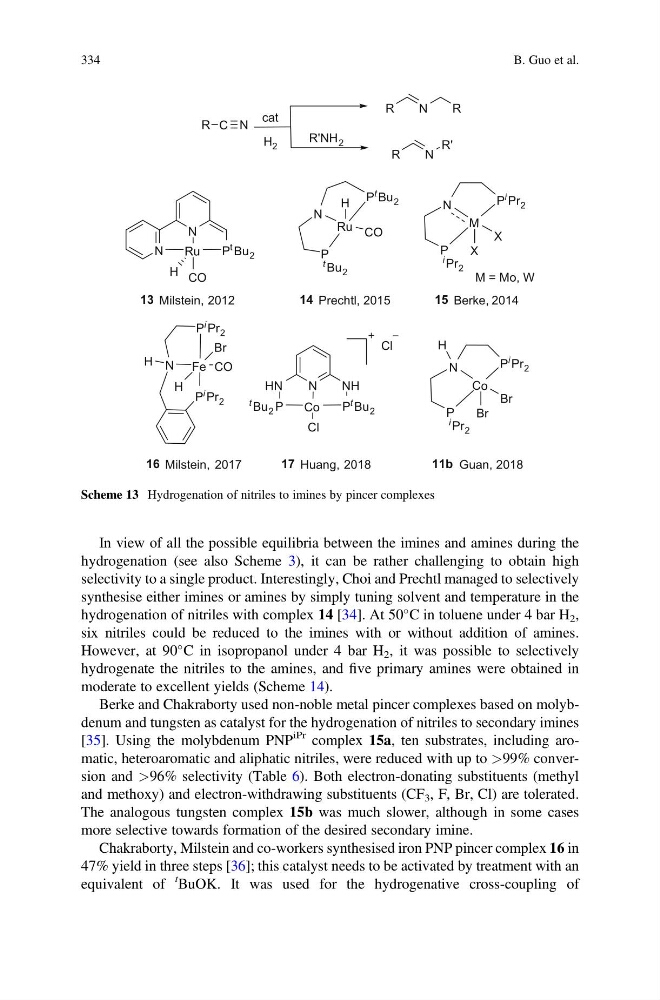
selectivity to a single product. Interestingly, Choi and Prechtl managed to selectively
synthesise either imines or amines by simply tuning solvent and temperature in the
hydrogenation of nitriles with complex 14 [34]. At 50
C in toluene under 4 bar H 2 ,
six nitriles could be reduced to the imines with or without addition of amines.
However, at 90
C in isopropanol under 4 bar H 2 , it was possible to selectively
hydrogenate the nitriles to the amines, and five primary amines were obtained in
moderate to excellent yields (Scheme 14).
Berke and Chakraborty used non-noble metal pincer complexes based on molybdenum and tungsten as catalyst for the hydrogenation of nitriles to secondary imines
[35]. Using the molybdenum PNP
iPr complex 15a, ten substrates, including aromatic, heteroaromatic and aliphatic nitriles, were reduced with up to >99% conversion and >96% selectivity (Table 6). Both electron-donating substituents (methyl
and methoxy) and electron-withdrawing substituents (CF 3 , F, Br, Cl) are tolerated.
The analogous tungsten complex 15b was much slower, although in some cases
more selective towards formation of the desired secondary imine.
Chakraborty, Milstein and co-workers synthesised iron PNP pincer complex 16 in
47% yield in three steps [36]; this catalyst needs to be activated by treatment with an
equivalent of
t
BuOK. It was used for the hydrogenative cross-coupling of
N
HN
t Bu 2 P
NH
P
t Bu 2
Co
Cl
Cl
17 Huang, 2018
N
P
i Pr 2
P
i Pr 2
Fe CO
H
Br
H
16 Milstein, 2017
11b Guan, 2018
N
P
P
i Pr 2
Co
Br
Br
H
N
P
P
t Bu 2
Ru CO
H
14 Prechtl, 2015
13 Milstein, 2012
N
N
P
t Bu 2
Ru
H CO
15 Berke, 2014
N
P
P
i Pr 2
M
X
X
M = Mo, W
R C N
cat
R
N
R
R'NH 2
R
N
R'
t Bu 2
i Pr 2
i Pr 2
H 2
Scheme 13 Hydrogenation of nitriles to imines by pincer complexes
334
B. Guo et al.
hydrogenation (see also Scheme 3), it can be rather challenging to obtain high
selectivity to a single product. Interestingly, Choi and Prechtl managed to selectively
synthesise either imines or amines by simply tuning solvent and temperature in the
hydrogenation of nitriles with complex 14 [34]. At 50
C in toluene under 4 bar H 2 ,
six nitriles could be reduced to the imines with or without addition of amines.
However, at 90
C in isopropanol under 4 bar H 2 , it was possible to selectively
hydrogenate the nitriles to the amines, and five primary amines were obtained in
moderate to excellent yields (Scheme 14).
Berke and Chakraborty used non-noble metal pincer complexes based on molybdenum and tungsten as catalyst for the hydrogenation of nitriles to secondary imines
[35]. Using the molybdenum PNP
iPr complex 15a, ten substrates, including aromatic, heteroaromatic and aliphatic nitriles, were reduced with up to >99% conversion and >96% selectivity (Table 6). Both electron-donating substituents (methyl
and methoxy) and electron-withdrawing substituents (CF 3 , F, Br, Cl) are tolerated.
The analogous tungsten complex 15b was much slower, although in some cases
more selective towards formation of the desired secondary imine.
Chakraborty, Milstein and co-workers synthesised iron PNP pincer complex 16 in
47% yield in three steps [36]; this catalyst needs to be activated by treatment with an
equivalent of
t
BuOK. It was used for the hydrogenative cross-coupling of
N
HN
t Bu 2 P
NH
P
t Bu 2
Co
Cl
Cl
17 Huang, 2018
N
P
i Pr 2
P
i Pr 2
Fe CO
H
Br
H
16 Milstein, 2017
11b Guan, 2018
N
P
P
i Pr 2
Co
Br
Br
H
N
P
P
t Bu 2
Ru CO
H
14 Prechtl, 2015
13 Milstein, 2012
N
N
P
t Bu 2
Ru
H CO
15 Berke, 2014
N
P
P
i Pr 2
M
X
X
M = Mo, W
R C N
cat
R
N
R
R'NH 2
R
N
R'
t Bu 2
i Pr 2
i Pr 2
H 2
Scheme 13 Hydrogenation of nitriles to imines by pincer complexes
334
B. Guo et al.