

(hetero)aromatic nitriles with amines and anilines at 60
C and 20 bar H 2 with
benzene as the solvent, which resulted in good to excellent yields of the imines
(Table 7). The more challenging aliphatic nitriles were still sluggishly reduced
(5–58% yields) even at higher temperatures and/or higher catalyst/base loading.
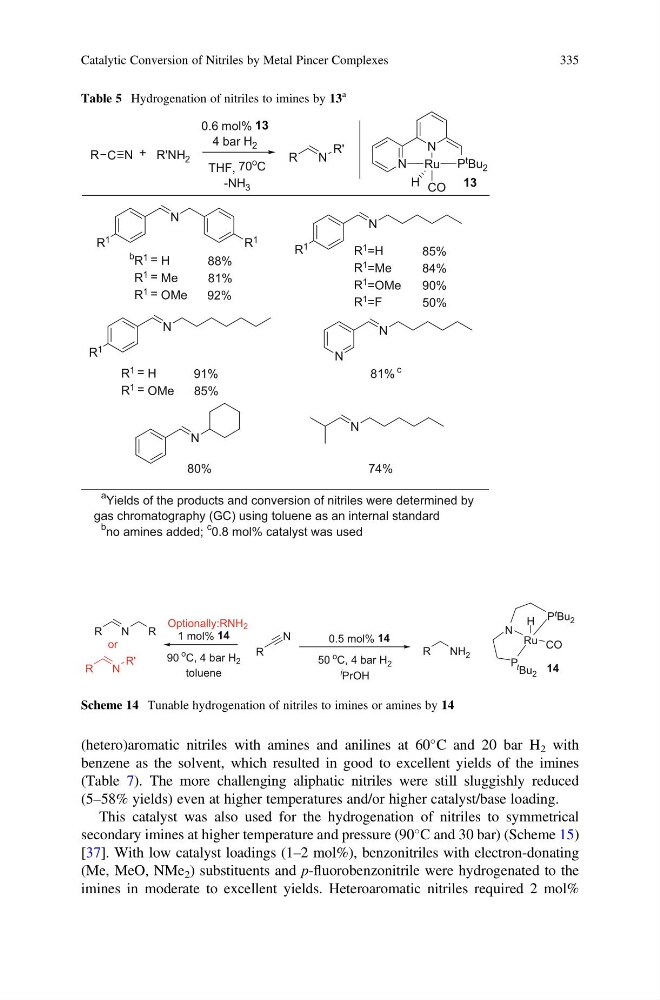
This catalyst was also used for the hydrogenation of nitriles to symmetrical
secondary imines at higher temperature and pressure (90
C and 30 bar) (Scheme 15)
[37]. With low catalyst loadings (1–2 mol%), benzonitriles with electron-donating
(Me, MeO, NMe 2 ) substituents and p-fluorobenzonitrile were hydrogenated to the
imines in moderate to excellent yields. Heteroaromatic nitriles required 2 mol%
Table 5 Hydrogenation of nitriles to imines by 13
a
R C N
0.6 mol% 13
4 bar H 2
R'NH 2
R
N
R'
THF, 70
o
C
-NH 3
+
N
N
P t Bu 2
Ru
H CO
N
R 1
R 1
R 1 = H
88%
R 1 = Me
81%
R 1 = OMe
92%
b
N
R 1
R 1 =H
85%
R 1 =Me
84%
R 1 =OMe
90%
R 1 =F
50%
N
R 1
R 1 = H
91%
R 1 = OMe
85%
N
N
81%
c
N
80%
N
74%
a Yields of the products and conversion of nitriles were determined by
gas chromatography (GC) using toluene as an internal standard
b no amines added;
c 0.8 mol% catalyst was used
13
R
N
R
NH 2
0.5 mol% 14
50
o
C, 4 bar H 2
i PrOH
1 mol% 14
90
o
C, 4 bar H 2
toluene
R
N
R
or
R
N
R'
N
P
P t Bu 2
Ru CO
H
14
t Bu 2
Optionally:RNH 2
Scheme 14 Tunable hydrogenation of nitriles to imines or amines by 14
Catalytic Conversion of Nitriles by Metal Pincer Complexes
335
C and 20 bar H 2 with
benzene as the solvent, which resulted in good to excellent yields of the imines
(Table 7). The more challenging aliphatic nitriles were still sluggishly reduced
(5–58% yields) even at higher temperatures and/or higher catalyst/base loading.
This catalyst was also used for the hydrogenation of nitriles to symmetrical
secondary imines at higher temperature and pressure (90
C and 30 bar) (Scheme 15)
[37]. With low catalyst loadings (1–2 mol%), benzonitriles with electron-donating
(Me, MeO, NMe 2 ) substituents and p-fluorobenzonitrile were hydrogenated to the
imines in moderate to excellent yields. Heteroaromatic nitriles required 2 mol%
Table 5 Hydrogenation of nitriles to imines by 13
a
R C N
0.6 mol% 13
4 bar H 2
R'NH 2
R
N
R'
THF, 70
o
C
-NH 3
+
N
N
P t Bu 2
Ru
H CO
N
R 1
R 1
R 1 = H
88%
R 1 = Me
81%
R 1 = OMe
92%
b
N
R 1
R 1 =H
85%
R 1 =Me
84%
R 1 =OMe
90%
R 1 =F
50%
N
R 1
R 1 = H
91%
R 1 = OMe
85%
N
N
81%
c
N
80%
N
74%
a Yields of the products and conversion of nitriles were determined by
gas chromatography (GC) using toluene as an internal standard
b no amines added;
c 0.8 mol% catalyst was used
13
R
N
R
NH 2
0.5 mol% 14
50
o
C, 4 bar H 2
i PrOH
1 mol% 14
90
o
C, 4 bar H 2
toluene
R
N
R
or
R
N
R'
N
P
P t Bu 2
Ru CO
H
14
t Bu 2
Optionally:RNH 2
Scheme 14 Tunable hydrogenation of nitriles to imines or amines by 14
Catalytic Conversion of Nitriles by Metal Pincer Complexes
335