

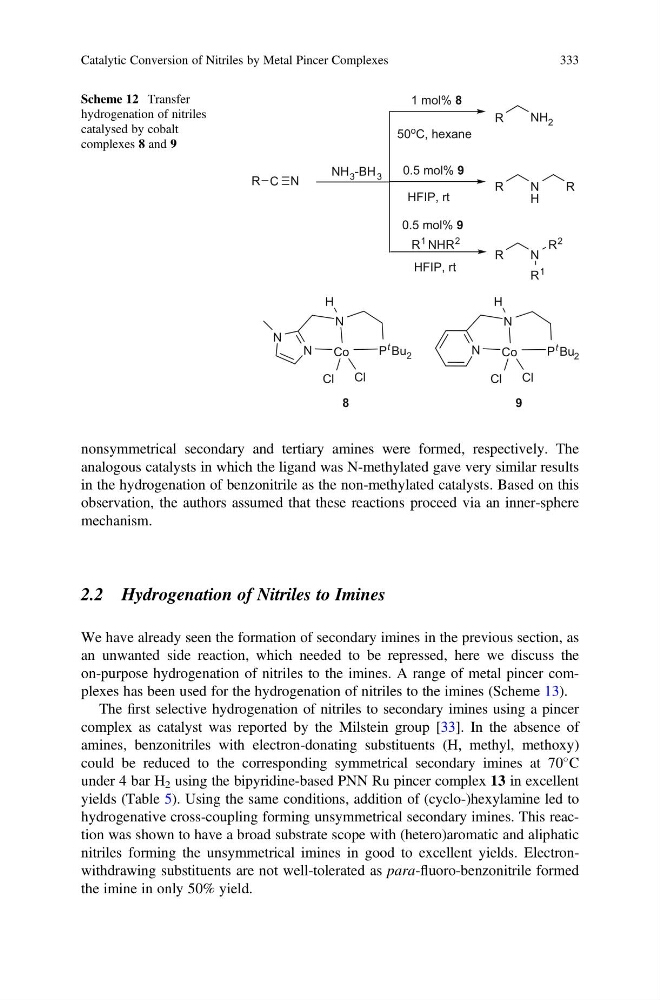
nonsymmetrical secondary and tertiary amines were formed, respectively. The
analogous catalysts in which the ligand was N-methylated gave very similar results
in the hydrogenation of benzonitrile as the non-methylated catalysts. Based on this
observation, the authors assumed that these reactions proceed via an inner-sphere
mechanism.
2.2 Hydrogenation of Nitriles to Imines
We have already seen the formation of secondary imines in the previous section, as
an unwanted side reaction, which needed to be repressed, here we discuss the
on-purpose hydrogenation of nitriles to the imines. A range of metal pincer complexes has been used for the hydrogenation of nitriles to the imines (Scheme 13).
The first selective hydrogenation of nitriles to secondary imines using a pincer
complex as catalyst was reported by the Milstein group [33]. In the absence of
amines, benzonitriles with electron-donating substituents (H, methyl, methoxy)
could be reduced to the corresponding symmetrical secondary imines at 70
C
under 4 bar H 2 using the bipyridine-based PNN Ru pincer complex 13 in excellent
yields (Table 5). Using the same conditions, addition of (cyclo-)hexylamine led to
hydrogenative cross-coupling forming unsymmetrical secondary imines. This reaction was shown to have a broad substrate scope with (hetero)aromatic and aliphatic
nitriles forming the unsymmetrical imines in good to excellent yields. Electronwithdrawing substituents are not well-tolerated as para-fluoro-benzonitrile formed
the imine in only 50% yield.
R C N
1 mol% 8
0.5 mol% 9
0.5 mol% 9
R
1 NHR
2
NH 3 -BH 3
50 o C, hexane
HFIP, rt
HFIP, rt
R
NH 2
R
N
H
R
R
N
R
1
R
2
N
P
t Bu 2
Co
Cl
Cl
H
N
N
N
P
t Bu 2
Co
Cl
Cl
H
N
8
9
Scheme 12 Transfer
hydrogenation of nitriles
catalysed by cobalt
complexes 8 and 9
Catalytic Conversion of Nitriles by Metal Pincer Complexes
333
analogous catalysts in which the ligand was N-methylated gave very similar results
in the hydrogenation of benzonitrile as the non-methylated catalysts. Based on this
observation, the authors assumed that these reactions proceed via an inner-sphere
mechanism.
2.2 Hydrogenation of Nitriles to Imines
We have already seen the formation of secondary imines in the previous section, as
an unwanted side reaction, which needed to be repressed, here we discuss the
on-purpose hydrogenation of nitriles to the imines. A range of metal pincer complexes has been used for the hydrogenation of nitriles to the imines (Scheme 13).
The first selective hydrogenation of nitriles to secondary imines using a pincer
complex as catalyst was reported by the Milstein group [33]. In the absence of
amines, benzonitriles with electron-donating substituents (H, methyl, methoxy)
could be reduced to the corresponding symmetrical secondary imines at 70
C
under 4 bar H 2 using the bipyridine-based PNN Ru pincer complex 13 in excellent
yields (Table 5). Using the same conditions, addition of (cyclo-)hexylamine led to
hydrogenative cross-coupling forming unsymmetrical secondary imines. This reaction was shown to have a broad substrate scope with (hetero)aromatic and aliphatic
nitriles forming the unsymmetrical imines in good to excellent yields. Electronwithdrawing substituents are not well-tolerated as para-fluoro-benzonitrile formed
the imine in only 50% yield.
R C N
1 mol% 8
0.5 mol% 9
0.5 mol% 9
R
1 NHR
2
NH 3 -BH 3
50 o C, hexane
HFIP, rt
HFIP, rt
R
NH 2
R
N
H
R
R
N
R
1
R
2
N
P
t Bu 2
Co
Cl
Cl
H
N
N
N
P
t Bu 2
Co
Cl
Cl
H
N
8
9
Scheme 12 Transfer
hydrogenation of nitriles
catalysed by cobalt
complexes 8 and 9
Catalytic Conversion of Nitriles by Metal Pincer Complexes
333