

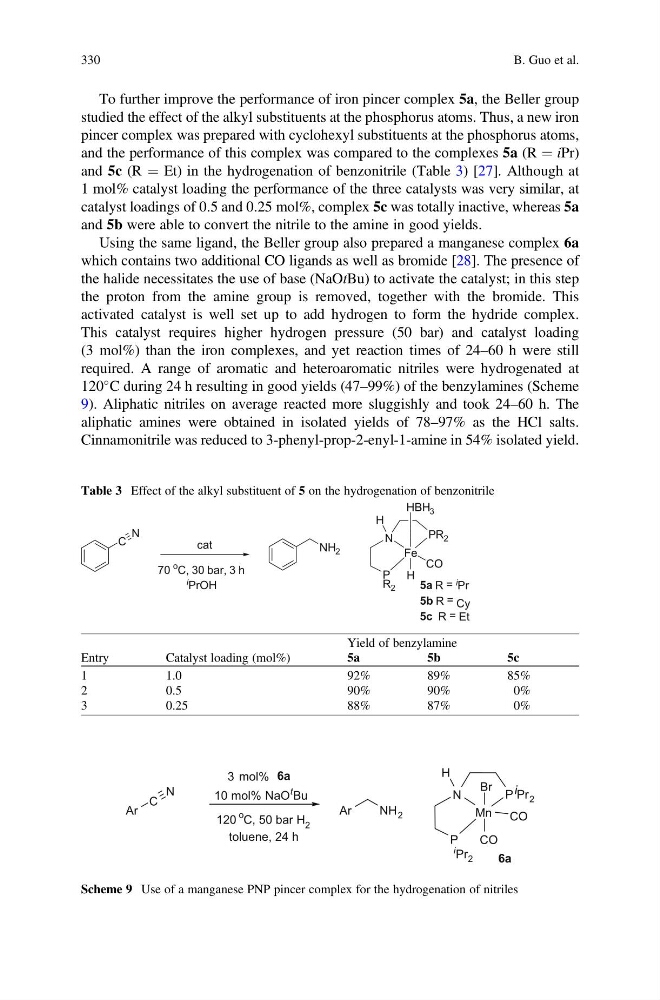
To further improve the performance of iron pincer complex 5a, the Beller group
studied the effect of the alkyl substituents at the phosphorus atoms. Thus, a new iron
pincer complex was prepared with cyclohexyl substituents at the phosphorus atoms,
and the performance of this complex was compared to the complexes 5a (R ¼ iPr)
and 5c (R ¼ Et) in the hydrogenation of benzonitrile (Table 3) [27]. Although at
1 mol% catalyst loading the performance of the three catalysts was very similar, at
catalyst loadings of 0.5 and 0.25 mol%, complex 5c was totally inactive, whereas 5a
and 5b were able to convert the nitrile to the amine in good yields.
Using the same ligand, the Beller group also prepared a manganese complex 6a
which contains two additional CO ligands as well as bromide [28]. The presence of
the halide necessitates the use of base (NaOtBu) to activate the catalyst; in this step
the proton from the amine group is removed, together with the bromide. This
activated catalyst is well set up to add hydrogen to form the hydride complex.
This catalyst requires higher hydrogen pressure (50 bar) and catalyst loading
(3 mol%) than the iron complexes, and yet reaction times of 24–60 h were still
required. A range of aromatic and heteroaromatic nitriles were hydrogenated at
120
C during 24 h resulting in good yields (47–99%) of the benzylamines (Scheme
9). Aliphatic nitriles on average reacted more sluggishly and took 24–60 h. The
aliphatic amines were obtained in isolated yields of 78–97% as the HCl salts.
Cinnamonitrile was reduced to 3-phenyl-prop-2-enyl-1-amine in 54% isolated yield.
Table 3 Effect of the alkyl substituent of 5 on the hydrogenation of benzonitrile
C
N
cat
NH 2
70
o
C, 30 bar, 3 h
i PrOH
N
P
R 2
PR 2
Fe
CO
H
HBH 3
H
5a R = i Pr
5b R = Cy
5c R = Et
Entry
Catalyst loading (mol%)
Yield of benzylamine
5a
5b
5c
1
1.0
92%
89%
85%
2
0.5
90%
90%
0%
3
0.25
88%
87%
0%
Ar
C
N
Ar
NH 2
120
o
C, 50 bar H 2
toluene, 24 h
N
P
P i Pr 2
Mn CO
CO
H
3 mol% 6a
10 mol% NaO
t Bu
Br
6a
i Pr 2
Scheme 9 Use of a manganese PNP pincer complex for the hydrogenation of nitriles
330
B. Guo et al.
studied the effect of the alkyl substituents at the phosphorus atoms. Thus, a new iron
pincer complex was prepared with cyclohexyl substituents at the phosphorus atoms,
and the performance of this complex was compared to the complexes 5a (R ¼ iPr)
and 5c (R ¼ Et) in the hydrogenation of benzonitrile (Table 3) [27]. Although at
1 mol% catalyst loading the performance of the three catalysts was very similar, at
catalyst loadings of 0.5 and 0.25 mol%, complex 5c was totally inactive, whereas 5a
and 5b were able to convert the nitrile to the amine in good yields.
Using the same ligand, the Beller group also prepared a manganese complex 6a
which contains two additional CO ligands as well as bromide [28]. The presence of
the halide necessitates the use of base (NaOtBu) to activate the catalyst; in this step
the proton from the amine group is removed, together with the bromide. This
activated catalyst is well set up to add hydrogen to form the hydride complex.
This catalyst requires higher hydrogen pressure (50 bar) and catalyst loading
(3 mol%) than the iron complexes, and yet reaction times of 24–60 h were still
required. A range of aromatic and heteroaromatic nitriles were hydrogenated at
120
C during 24 h resulting in good yields (47–99%) of the benzylamines (Scheme
9). Aliphatic nitriles on average reacted more sluggishly and took 24–60 h. The
aliphatic amines were obtained in isolated yields of 78–97% as the HCl salts.
Cinnamonitrile was reduced to 3-phenyl-prop-2-enyl-1-amine in 54% isolated yield.
Table 3 Effect of the alkyl substituent of 5 on the hydrogenation of benzonitrile
C
N
cat
NH 2
70
o
C, 30 bar, 3 h
i PrOH
N
P
R 2
PR 2
Fe
CO
H
HBH 3
H
5a R = i Pr
5b R = Cy
5c R = Et
Entry
Catalyst loading (mol%)
Yield of benzylamine
5a
5b
5c
1
1.0
92%
89%
85%
2
0.5
90%
90%
0%
3
0.25
88%
87%
0%
Ar
C
N
Ar
NH 2
120
o
C, 50 bar H 2
toluene, 24 h
N
P
P i Pr 2
Mn CO
CO
H
3 mol% 6a
10 mol% NaO
t Bu
Br
6a
i Pr 2
Scheme 9 Use of a manganese PNP pincer complex for the hydrogenation of nitriles
330
B. Guo et al.